The high stakes of merger rebranding for climate-focused companies
You've just closed a merger. The legal teams have signed off, the press release is drafted, and your investors are watching. Now comes the part most climate tech leadership teams underestimate: what the market sees next.
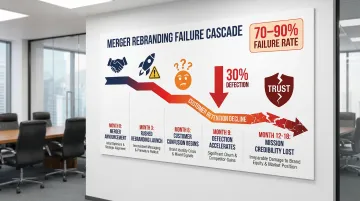
In the weeks following a merger announcement, customers, partners, and prospective enterprise buyers are all forming an updated opinion of your combined company. If the brand signal is confused, inconsistent, or out of step with the company's actual capabilities, that window closes fast. According to Clear Digital's analysis of post-merger brand integration, poor rebranding can trigger customer defection rates of 30% or higher.
The problem is rarely that companies don't care about branding during a merger. It's that rebranding gets treated as a logo swap and a website update, rather than a positioning decision with direct consequences for pipeline, hiring, and partnership credibility.
Research shows 70-90% of mergers fail to achieve their intended goals, with cultural mismatches and rushed brand integration consistently cited as key drivers. For climate tech companies specifically, the consequences compound: confused positioning makes it harder to close enterprise pilots, attract the next round, and maintain the kind of stakeholder trust that early-stage climate companies depend on.
This guide breaks down how to approach merger rebranding strategically — starting with what to audit, how to choose your brand architecture, and what to look for in an outside partner.
TLDR: key takeaways for merger rebranding
- Start with a structured brand audit that measures both market equity and messaging clarity before deciding on an integration approach
- The brand architecture choice — full integration, hybrid, or independent — is a strategic business decision, not a creative one. Drive it with data on relative brand strength and customer segment overlap
- Outside perspective matters: your internal team tends to default to the acquirer's brand regardless of which held more market equity
- Run stakeholder alignment sessions before any external launch, not after
- Track the right metrics post-rebrand: customer retention, brand recognition with target segments, and pipeline conversion rates in the 90 days following launch
Why merger rebranding requires strategic expertise
Mergers create compounding branding complexity: two organizational cultures, two customer bases with different expectations, and two sets of brand equity that need to be reconciled without destroying what either company built.
In climate tech, that complexity is amplified. Enterprise buyers, investors, and sector partners scrutinize not just your combined capabilities but whether your positioning is coherent. A confused brand signal in the months after a merger close is often read as organizational instability — which is the last message you want to send when you're asking customers to trust a new entity.
The risks of DIY or rushed rebranding
Managing merger rebranding internally tends to produce three specific problems:
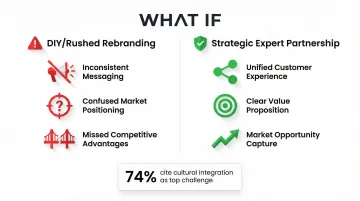
- Inconsistent messaging: your teams end up using different language to describe the combined company, and customers pick up on the inconsistency faster than you'd expect
- Unclear market positioning: your existing customers aren't sure what the merger means for them, and new prospects can't tell what the combined entity offers that either company didn't before
- Strategic blind spots: your internal stakeholders often prioritize cultural familiarity over market positioning — retiring a brand that held strong equity because internal politics favored the acquirer, not because the data supported it
According to Deloitte's post-merger integration research, 74% of executives identify cultural integration as the most challenging aspect of M&A and brand strategy is where that cultural tension becomes externally visible. In practice, that tension surfaces directly in your go-to-market: consider a battery storage company that acquires a grid analytics startup — if both teams spend three months going to market with conflicting narratives about the combined offer, an enterprise buyer in active evaluation is likely to pause the contract conversation and re-engage a competitor who appears more stable.
Essential vendor expertise for climate tech mergers
The right rebranding partner for a climate tech merger brings four specific capabilities. First, brand architecture expertise that protects existing equity while establishing clear positioning for the combined entity. Second, a genuine understanding of how technical credibility, sustainability credentials, and market positioning function as trust signals with enterprise buyers, investors, and partners in climate tech specifically — not general marketing knowledge dressed up in sector language. Third, the ability to coordinate visual identity, website messaging, and product positioning so the combined brand reads consistently across every point of contact. And fourth, the capacity to execute within a compressed timeline — because a 6-12 month agency process often means months of market confusion at exactly the wrong moment.
Why speed and strategy must coexist
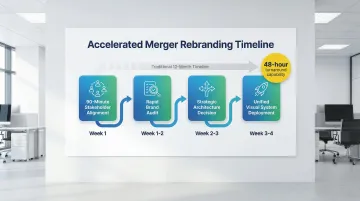
Climate tech companies face a particular timing problem during mergers: the window between announcement and customer uncertainty is short, and competitors will use that gap if you give them one. A realistic consequence: if your merger is announced and you spend the following three months working through internal alignment before presenting a coherent brand externally, a direct competitor can reposition against your combined entity in enterprise RFPs — turning a brief gap into a lost deal.
Traditional agency timelines assume the market will wait. It won't. The more practical approach is running rapid stakeholder alignment sessions, compressing the brand audit into the first few weeks post-close, and having a unified visual system deployed before customers start asking questions your website can't answer.
Conducting a comprehensive brand audit before integration
Before making any rebranding decisions, quantify what each brand actually owns in the market. The most common and costly mistake in post-merger integration is retiring a brand that held more equity than you realized — particularly when that brand has strong recognition in a specific customer segment or geography. Enterprise buyers in active conversations with your acquired company's brand won't necessarily transfer that trust to the new name — and credibility you've discarded can't be recovered.
What to audit in each brand
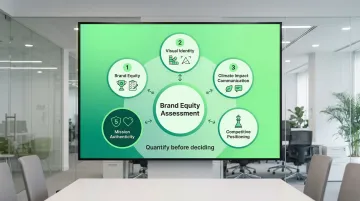
Evaluate four core dimensions:
- Brand equity: customer perception, market recognition, and trust levels measured through surveys and sentiment analysis
- Visual identity: logos, color systems, typography, and design elements that drive instant recognition in your specific market
- Messaging and narrative: tone of voice, value propositions, and how each brand describes what the technology does and who it's for — this is often where the sharpest divergence shows up between merged companies
- Competitive positioning: where each brand sits relative to incumbents and peers, including technical credibility signals and sector-specific recognition
The objective is a clear map of what to carry forward, what to phase out, and what the combined brand can credibly claim that neither company could on its own. That clarity is what lets you walk into procurement conversations with a coherent story — rather than leaving enterprise buyers to draw their own conclusions during vendor evaluation.
One established approach, described in Brand Finance's brand valuation methodology, is the Royalty Relief Method — estimating what the company would pay to license its brand if it didn't own it. This converts brand perception into a financial value that can be compared across both entities objectively.
How to measure brand equity
Quantitative approaches prevent subjective decisions from destroying value:
- Customer surveys: measure aided and unaided brand awareness, purchase intent, and perceived differentiation from competitors
- Stakeholder interviews: capture qualitative insights about emotional connection and mission alignment from employees, investors, and key partners who work with both brands
- Social media sentiment analysis: track volume and tone of brand mentions over the 12 months prior to merger to gauge baseline market perception
- Brand Strength Index (BSI): assess attributes like emotional connection, financial performance, and sector-specific credibility using balanced scorecards
For climate tech brands, add a fifth dimension: mission authenticity. How strongly do customers and partners associate each brand with genuine technical capability and market credibility, versus surface-level positioning? If you're operating in carbon markets, grid modernization, or industrial decarbonization, this intangible is often where the most value sits — because trust in these markets takes years to build and is difficult to transfer through a rebrand alone. A buyer who committed to a pilot based on your acquired brand's reputation will re-evaluate when the name changes.
Identifying strategic overlaps and gaps
Map where the two brands converge and diverge:
Overlaps worth building on: Shared technical positioning that can anchor unified messaging is worth preserving — if both companies have credibility with grid operators or industrial buyers, that's a foundation you can build on. Customer segments where both brands have presence are worth deepening rather than splitting across two names, and aligned market positioning relative to incumbents becomes a stronger competitive story when consolidated.
Gaps the merger addresses: The combined entity can now reach customer segments that neither brand accessed independently. Service or capability gaps that limited either brand's enterprise conversations are now resolved, and credibility markers one brand held that the other lacked — technical depth, regulatory familiarity, sector-specific case studies — are yours to claim as the combined entity.
Document findings in a comparative matrix: brand equity score by audience segment, visual identity recognition, messaging clarity rating, and mission authenticity score. This becomes the evidence base for the brand architecture decision — and it prevents the most common mistake, which is defaulting to the acquirer's brand by default rather than by merit.
Choosing your rebranding approach: full, hybrid, or independent
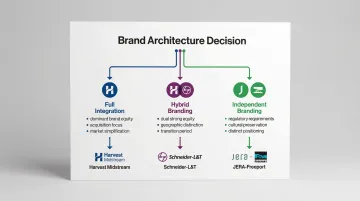
Brand architecture is a strategic business decision, not a creative preference. The architecture you choose shapes what enterprise buyers and procurement teams encounter when they evaluate your combined company — and it directly affects whether deals in your pipeline carry through or stall. Choose based on relative brand strength, market dynamics, and long-term positioning goals.
Full brand integration: when one brand absorbs the other
Full integration makes sense when one brand has significantly stronger market value, the merger is acquisition-focused, or market simplification is the strategic priority.
Advantages: Full integration gives customers one clear brand to trust, simplifies marketing operations with unified budgets and messaging, and concentrates market presence into a stronger competitive position — which is particularly valuable when you're competing for enterprise contracts where procurement teams evaluate vendor stability and longevity.
The tradeoffs require careful consideration. Your legacy customers loyal to the absorbed brand may disengage. Niche positioning that served specific segments can disappear. And your employees who identified with the retired brand often resist the transition — sometimes visibly, in ways that reach customers.
Example: Harvest Midstream fully absorbed Arrowhead ST Holdings, consolidating operations under a single energy infrastructure brand to reduce market confusion and concentrate its positioning with midstream customers.
Hybrid branding: combining elements from both brands
Hybrid strategies work best when both brands hold strong equity in meaningfully different customer segments, when geographic markets require distinct positioning, or when a transition period needs to preserve existing trust while the new unified identity takes hold.
According to Bolder Agency's climate tech M&A research, Schneider Electric co-branded with L&T Technology Services, maintaining L&T's engineering credibility with its existing customer base while connecting it to Schneider's global infrastructure positioning. The two brands served distinct enough audiences that a full integration would have created more confusion than it resolved.
The governance requirement for hybrid branding is real. Running two brand identities simultaneously means establishing clear rules about when each brand is used, who has authority over it, and how to handle contexts where both brands are relevant. It's the right trade-off when each brand serves a meaningfully different audience — but it adds overhead that full integration avoids, and in active enterprise conversations, inconsistency between the two identities can surface as a procurement concern.
Independent branding: maintaining separate identities
Separate identities make sense when regulatory licenses or certifications are tied to specific entities, when the cultures are different enough that integration would destroy value in both directions, or when the combined business genuinely needs distinct brand personalities to operate effectively in its different markets. In climate tech, this often applies when one entity has built credibility with a specific buyer category — utilities, large industrials, or government agencies — where a rebrand would put active relationships at risk.
Example: JERA Americas kept Freeport LNG independent after acquisition to maintain operational flexibility and preserve established customer relationships in distinct market segments.
Making the rebranding decision
The choice between full integration, hybrid, and independent branding is a strategic decision with revenue implications — and it should be made with data, not instinct or internal politics.
The founders who navigate merger rebranding well tend to share a few common traits: starting the brand audit before the deal closes, bringing in outside perspective early, and treating the rebranding timeline as part of the integration plan rather than an afterthought.
The ones who struggle typically wait until customer confusion forces the issue, or default to the acquirer's brand without evaluating what the acquired company actually held in the market. In climate tech specifically, where enterprise sales cycles are long and trust accumulates slowly, that kind of misstep takes time to recover from.
If your company is mid-merger or approaching one, the clearest path forward starts with understanding what each brand is actually worth to the people who matter: customers, enterprise buyers, and the partners who have to decide whether to keep working with you under the new name.
Choosing a rebranding partner for climate tech M&A
Most branding agencies approach merger rebranding the same way they approach any rebrand: a discovery phase, brand strategy, visual identity, rollout. That process works when you have six months. It creates real problems when your merger is announced and customers are already forming opinions.
What if Design works with climate and deep-tech companies at these inflection points, bringing the outside perspective and sector fluency to move fast enough to matter before enterprise buyers have formed their opinion of your combined entity.
Connect with us to talk through where the brand gaps are.
Frequently asked questions
How long should post-merger rebranding take?
It depends on the complexity of the brand architecture decision. For a full integration where one brand absorbs the other, a focused agency can deliver a unified visual identity and core web presence in 4-8 weeks. Hybrid and independent branding approaches typically take longer because they require more governance infrastructure and stakeholder alignment across two distinct identities.
When should the rebranding process start relative to deal close?
Ideally, the brand audit begins before the deal closes — or at minimum in the first 30 days after announcement. Waiting until full operational integration is complete often means several months of customer-facing confusion that's harder to undo than it is to prevent.
What's the biggest mistake companies make in post-merger rebranding?
Treating it as a design project rather than a positioning decision. The visual output matters, but the strategic choice — which brand to lead with, which to retire, which elements to carry forward — is what determines whether customers, partners, and enterprise buyers stay engaged through the transition.