Why brand positioning makes or breaks cleantech companies
You've raised your seed round. You've got a pilot running. Maybe you're deep into Series A conversations. But the moment a potential partner or enterprise buyer lands on your website, something breaks down. The technology is real, the team is credible, and the market timing is right — yet the website reads like a technical brief written for a grant committee, not a buyer who has six other vendors in their inbox.
This is one of the most common and costly gaps in early-stage cleantech: the brand hasn't caught up to the business. And unlike traditional B2B software where a clean UI can carry initial credibility, cleantech involves longer sales cycles, multi-stakeholder procurement committees, and buyers who are simultaneously curious about your innovation and skeptical about whether it will actually work at scale.
This article breaks down seven brand positioning strategies that climate tech companies at various stages actually use to build credibility, communicate differentiated value, and move past the "interesting technology, but let me think about it" stage of the buyer journey.
TLDR: 7 essential cleantech brand positioning strategies at a glance
- Build your brand story around a specific problem, not your company's mission statement
- Translate climate impact into quantifiable business outcomes — tons CO2e avoided, dollars saved, compliance milestones met
- Map the full buying committee, because cleantech decisions rarely involve just one person
- Lead with economic value before environmental benefit when selling to enterprise buyers
- Visual identity signals operational credibility before a single technical spec is read
- Proof points — certifications, case studies, industry awards — do more work than any headline claim
- What gets you to Series A won't get you to Series B: positioning needs to evolve with your company stage
Strategy 1: Define your mission-driven brand story
Why your origin story matters in cleantech
Most technical founders lead with what their technology does, not why it exists. That's understandable — the technology is the hard part, and in early conversations with engineers, investors, and research partners, the technical detail carries the room. But as you move into broader market conversations, the "what" alone doesn't build the kind of trust that closes pilots or attracts talent willing to take a risk on a pre-commercial company.
A founding story doesn't replace technical credibility — it gives investors and buyers a reason to stay engaged long enough to understand the technical case. Strong ESG and mission credentials directly correlate with higher employee engagement and lower turnover, which matters when you're competing with higher-paying incumbents for specialized talent. Growth-stage VCs increasingly evaluate "impact potential" alongside financial returns, giving companies with clear mission framing a real advantage in fundraising conversations.
The elements of a compelling cleantech brand story
Build your story around this framework: Problem → Insight → Solution → Vision for change.
- The environmental or social problem that inspired the founders
- The "aha moment" that revealed the solution pathway
- The personal stake founders have in solving this problem
- The vision for how the world changes when you succeed
How leading cleantech companies apply this framework:
Redwood Materials applies this framework clearly. Founded by JB Straubel, the company positions around a specific problem: most EV batteries don't have a viable end-of-life pathway in the US. Their mission centers on domestic battery material recovery, which positions them not as a recycler but as critical infrastructure for the EV supply chain. That framing unlocks very different conversations with automakers, cell manufacturers, and investors than "battery recycling company" would.
Enphase transformed from component supplier to holistic energy management brand by centering their purpose: "Advancing a sustainable future for all." This mission grounds their expansion from microinverters to complete home energy systems, creating a coherent narrative as their product line evolved.
Authenticity over polish
Cleantech audiences are sophisticated enough to identify when a brand story has been engineered for investors rather than built from actual company history. A genuine story that includes real obstacles and real decisions will carry more weight than a polished narrative that reads like it was written for a pitch deck.
Tell your story across different formats:
- Website About page: 200-300 words with founder photos and the core narrative
- Pitch decks: One slide dedicated to the founding story, positioned early to establish emotional grounding
- Social media: Specific moments from the journey, behind-the-scenes content, team spotlights
- Investor presentations: Weave mission throughout financial projections to show values-driven decision-making
Strategy 2: Identify and articulate your climate impact
Defining your specific climate challenge
The most common positioning mistake in early-stage climate tech is defaulting to the broadest possible problem framing. "We're fighting climate change" or "we're accelerating the energy transition" tells a sophisticated B2B buyer almost nothing about what your company actually does or why it's the right choice for their specific procurement problem. It also puts you in a category with hundreds of companies making the same claim.
You need to identify the specific environmental problem your solution addresses — whether that's reducing methane emissions from industrial processes, improving battery recycling rates for a specific chemistry, or capturing carbon in a particular industrial sector — and then connect it to the buyer's actual operations.
Quantify the scale of the problem you're solving: identify the total addressable environmental impact (e.g., "Industrial heat accounts for 20% of global emissions"), determine your solution's maximum potential impact within that space, calculate realistic market penetration scenarios, and express impact in concrete units — tons CO2e avoided, GWh of clean energy, percentage of waste diverted.
Setting measurable climate goals
Establish 10-year impact goals with specific, quantifiable metrics. "Help recycle 25% of lithium-ion batteries by 2035" carries far more credibility than "improve battery recycling."
Examples of well-articulated climate goals:
| Company | Specific commitment |
|---|---|
| Ørsted | 100% green energy generation after complete transition from fossil fuels |
| Climeworks | Measurable CO2 capture services starting from 1,000 tons with transparent removal verification |
| Redwood Materials | Scaling domestic battery material recovery to supply 25% of US lithium demand by 2030 |
Measurable goals enhance credibility by providing clear marketing narratives and accountability frameworks. Aligning your targets with recognized standards like the Science Based Targets initiative's Net-Zero framework demonstrates that goals are robust and credible to investors and customers.
Connecting climate impact to business value
Climate impact positioning must connect environmental benefits to business outcomes — because your buyer's procurement approval process runs on business logic, not environmental logic alone:
- Cost savings: "Reduce energy costs by 30% while cutting emissions"
- Regulatory compliance: "Meet Scope 3 reporting requirements with verified impact data"
- Competitive advantage: "Differentiate with certified carbon-neutral operations"
- Investor appeal: "Attract ESG-focused capital with transparent sustainability metrics"
B2B buyers need this data to satisfy their own reporting requirements. Suppliers who provide impact quantification upfront gain a real advantage in procurement processes.
Strategy 3: Map your target audience and decision-makers
Understanding B2B cleantech decision-making units
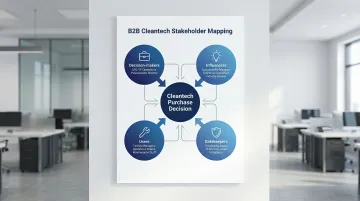
Cleantech deals rarely move through a single decision-maker. The average B2B purchase involves 13 stakeholders, ranging from sustainability officers to CFOs, procurement teams to technical validators — each with different risk tolerances and approval criteria.
This means your brand positioning has to hold up across very different conversations simultaneously.
Four key roles drive cleantech purchasing decisions:
- Decision-makers: Budget authority (CFO, VP Operations)
- Influencers: Technical validators (Engineering leads, Sustainability officers)
- Users: Day-to-day operators (Facility managers, Technicians)
- Gatekeepers: Procurement and Legal teams
| Stakeholder role | Primary concerns | Key positioning message |
|---|---|---|
| CFO / Finance | ROI, payback period, total cost of ownership | "Lowest levelized cost over 20 years with 3-year payback" |
| Sustainability officer | Emissions reduction, compliance reporting | "SBTi-validated impact to meet your Scope 3 targets" |
| Operations / Engineering | Reliability, integration, uptime | "99.9% uptime with seamless API integration" |
| Procurement | Supply chain security, cost predictability | "Diversified supply chain with fixed-price contracts" |
| Legal / Compliance | Regulatory risk, safety standards | "Fully compliant with IRA and EU Green Deal standards" |
Creating detailed buyer personas
Understanding these stakeholder roles is just the starting point. Build detailed personas that capture the nuances of each decision-maker's world.
Essential persona components:
- Role and title: Specific position within target organizations
- Pain points: Daily frustrations and strategic challenges
- Goals: What success looks like in their role
- Objections: Barriers to adoption (cost, risk, complexity)
- Information sources: Where they research solutions (industry forums, LinkedIn, trade publications)
- Priorities: How they balance cost vs. impact vs. innovation
The best personas come from direct research, not assumptions. Combine customer interviews with recent buyers, LinkedIn research on titles and career paths, industry forum participation, sales team insights from deal cycles, and win/loss analysis from closed opportunities.
Once you've built these personas, craft messaging that addresses each stakeholder's specific concerns while maintaining your core brand positioning at every point in the buyer journey.
Tailoring positioning to different cleantech segments
Positioning varies significantly based on sub-sector and maturity stage. Early-stage carbon capture companies need different positioning than established solar companies.
Match your positioning to your company's maturity:
- Pre-revenue startups: Highlight innovation, vision, and the problem's urgency
- Pilot/demonstration stage: Showcase technical validation and early customer success
- Growth-stage companies: Emphasize proven results, scale, and reliability
- Mature companies: Focus on market leadership, comprehensive solutions, and ecosystem partnerships
Strategy 4: Differentiate through unique value proposition
Conducting competitive positioning analysis
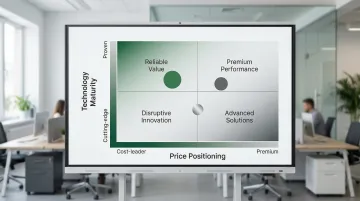
Map competitors on key dimensions to identify white space where your brand can own a unique position:
- Price positioning (premium vs. cost-leader)
- Technology maturity (proven vs. cutting-edge)
- Target market (enterprise vs. mid-market)
- Climate impact focus (specific problem addressed)
- Geographic focus (regional vs. global)
Framework for competitive analysis:
Analyze 3-5 direct competitors to identify differentiation opportunities. Create a positioning map plotting competitors on two axes most relevant to your buyers (e.g., cost vs. performance, or innovation vs. reliability).
Crafting your unique selling proposition (USP)
A strong cleantech USP contains three components: specific customer segment + unique benefit + proof point.
These cleantech companies demonstrate the formula in action:
- Bloom Energy: Positions around flexibility — "Improving fuel cell ramp up and ramp down capability to support grid stability" — which directly addresses the intermittency problem with renewables for grid operators who can't afford reliability gaps.
- First Solar: Competes on lowest levelized cost of energy (LCOE) for utility-scale deployments, making the economic argument before the environmental one.
- Fluence: Offers "hardware, software, and services" as a bundled approach to reduce risk in utility transitions, which matters to buyers who have been burned by integration complexity before.
The most common USP mistakes are being too broad ("We provide sustainable energy solutions"), focusing only on features rather than outcomes, lacking proof points or validation, and making superiority claims without specifics.
Positioning against "business as usual"
Cleantech faces a challenge that most B2B software companies don't: you're not just competing against other cleantech solutions, but against incumbent fossil fuel-based or unsustainable alternatives that buyers have used for decades and trust by default. The status quo has inertia on its side.
Position your solution as both environmentally superior and economically viable. Lead with business outcomes, then reinforce with environmental benefits. Address the "green premium" directly with total cost of ownership analysis. Highlight risk mitigation across regulatory, reputational, and supply chain dimensions, and emphasize resilience against carbon pricing and regulatory shifts.
Strategy 5: Craft consistent visual identity and messaging
The role of visual identity in brand positioning
Visual identity — logo, color palette, typography, imagery style — communicates brand values before a single word is read. In technical industries, execution quality signals operational capability. A visually inconsistent brand makes buyers wonder whether your operations are consistent too.
Consistent visual systems build familiarity, and familiarity is what converts skeptical buyers who are evaluating multiple vendors simultaneously.
What cleantech visual identity should convey:
- Innovation: Modern design language without being trendy
- Credibility: Professional execution that signals operational competence
- Environmental commitment through considered use of natural imagery, without defaulting to the visual clichés (wind turbines, green leaves) that now signal generic sustainability messaging rather than technical substance
- Technical authority via clean, precise visual systems that reflect engineering rigor
Enphase employs clear, consumer-friendly visuals even for B2B audiences to illustrate complex energy flows, making technical concepts accessible without dumbing them down. Their visual consistency across sales decks, website, and product interfaces signals that the company operates with precision at every level.
Developing core messaging architecture
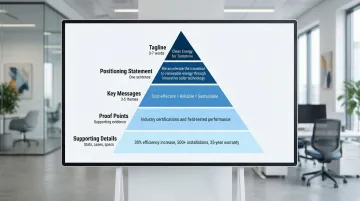
Create a messaging hierarchy that ensures consistency across all touchpoints:
- Tagline: 3-7 words capturing your essence
- Positioning statement: One sentence defining who you serve, what you offer, and why it matters
- Key messages: 3-5 core themes you want associated with your brand
- Proof points: Specific evidence supporting each key message
- Supporting details: Statistics, case studies, and technical specifications
Tone of voice guidance:
Balance technical authority with accessibility. Use precise language when discussing technology, but translate benefits into business outcomes. Avoid jargon when simpler terms work, but never oversimplify the science.
Working with specialized design partners
Many early-stage cleantech companies try to build brand in-house, which usually means one of two things: the technical founder ends up writing copy that reads like a whitepaper, or a general-purpose freelancer produces visuals that look polished but miss the sector-specific credibility signals that matter to utility buyers, deep-tech investors, or enterprise procurement teams.
The alternative isn't necessarily a large agency engagement. For a seed or Series A company, what typically works is a focused positioning sprint — two to four weeks of structured work that produces a clear narrative, a consistent visual system, and messaging that holds up across investor decks, website copy, and partner conversations. The key criteria for any design partner at this stage: do they understand your technical landscape well enough that you're not spending half the engagement on basic education?
Strategy 6: Build credibility with proof points
Overcoming the cleantech credibility gap
Cleantech startups often lack long track records, which creates a specific problem: enterprise buyers and institutional investors are being asked to trust a company that hasn't yet had the time to accumulate the evidence they'd normally want. This isn't a messaging problem — it's a structural challenge that requires a deliberate strategy.
The approach is to substitute breadth of track record with depth of specific validation:
- Pilot programs: Even small-scale deployments provide technical proof that doesn't exist on paper alone
- Partnerships: Collaborations with established organizations transfer credibility by association
- Certifications: Industry-recognized standards (ISO 14001, B Corp status) signal process maturity
- Awards: Recognition like the Global Cleantech 100 signals peer validation within the sector
- Media coverage: Third-party editorial coverage carries more weight than owned content at this stage
Using customer success stories and case studies
These credibility-building tactics lay the foundation, but nothing moves a skeptical buyer like documented results from a company they recognize. Case studies are among the top three trust-building content formats in B2B, with companies reporting conversion rate increases of up to 300%.
The difference between a case study that converts and one that doesn't is usually specificity.
Framework for compelling case studies:
- Customer challenge: Specific problem faced (with quantified impact)
- Your solution: What you implemented and why
- Measurable results: Both business outcomes (cost savings, efficiency gains) and environmental impact (emissions reduced, energy saved)
"Reduced energy costs by $127,000 annually while cutting carbon emissions by 340 tons CO2e" is a fundamentally different claim than "significant cost and emissions reductions" — even if both are technically true.
Third-party validation as a trust signal
Beyond case studies, credibility markers placed strategically across your digital presence do consistent work throughout the buyer journey:
| Validation type | Examples and strategic use |
|---|---|
| Certifications | ISO 14001 (Environmental Management), B Corp status, industry-specific standards |
| Industry awards | Global Cleantech 100, CleanTech Breakthrough Awards |
| Notable investors | Backing from Breakthrough Energy Ventures, Congruent Ventures, or energy-sector corporate VCs |
| Third-party validation | SBTi validation of climate targets |
| Partnerships | Collaborations with recognized climate organizations or Fortune 500 companies |
Position these on your homepage, include them in pitch materials, and reference them in sales conversations. They do the work of a long track record when you don't have one yet.
Strategy 7: Evolve your positioning as you scale
How positioning shifts through growth stages
What works as positioning for a pre-revenue startup creates friction for a growth-stage company, and vice versa. The language that attracts early adopters and innovation-focused investors doesn't necessarily land with enterprise procurement teams who need evidence of scale.
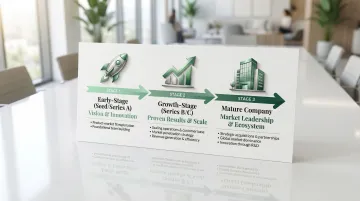
Positioning evolution by stage:
- Early-stage (Seed/Series A): Emphasize vision, innovation, and the urgency of the problem. Investors and early adopters want to see breakthrough thinking and a credible founding team.
- Growth-stage (Series B/C): Emphasize proven results, scale potential, and reliability. Buyers need evidence of successful deployments before they'll take the internal risk of recommending you.
- Mature companies: Emphasize market leadership, comprehensive solutions, and ecosystem partnerships. Position as the established, lower-risk choice.
These stage transitions often trigger specific positioning pivots: shifting from "innovative technology" to "proven solution," expanding from single product to platform or ecosystem, growing from regional player to global leader, and evolving from component supplier to end-to-end solution provider.
When to refresh your brand positioning
Signals that it's time to revisit positioning:
- Entering new markets or customer segments
- Launching new product lines that expand your offering
- Significant funding rounds that change your scale
- Major pivots in technology or business model
- Competitive landscape shifts (new entrants, consolidation)
- Regulatory changes that alter market dynamics
Ørsted's transformation is one of the clearest examples of strategic repositioning executed at scale. Originally DONG Energy (Danish Oil and Natural Gas), the company rebranded to Ørsted to reflect its strategic pivot from fossil fuels to renewables. The total rebrand allowed them to shed legacy associations and position fully as "the global leader in offshore wind," facilitating global expansion and substantial valuation growth. The key lesson isn't that they rebranded — it's that the rebrand followed a genuine strategic pivot, not the other way around.
Tesla Energy expanded from "electric cars" to "sustainable energy ecosystems" with their "Tesla Power Everything" positioning, integrating solar, storage (Powerwall/Megapack), and EVs into a unified narrative of energy independence. The brand evolution tracked the product evolution — which is exactly the right sequence.
Maintaining positioning consistency during growth
As teams grow and new stakeholders join, brand positioning tends to drift. Each new salesperson, new content writer, and new regional office introduces small variations that compound over time into a fragmented brand experience. Address this proactively through:
- Documented brand guidelines: Comprehensive style guides covering messaging, visual identity, and tone
- Regular team training: Onboarding sessions and quarterly refreshers on brand positioning
- Centralized brand management: A designated owner responsible for consistency at every external touchpoint
- Approval processes: Review mechanisms for customer-facing materials, especially at scale
- Templates and tools: Pre-approved presentation decks, email templates, and social media assets that reduce variance without slowing teams down
If your brand hasn't evolved since your last raise, or if you're approaching a funding round, partnership announcement, or conference and your current positioning doesn't reflect the company you've built, that gap is worth addressing before the moment arrives.
What if Design works with Seed to Series B climate and deep-tech startups on focused positioning and brand work. Connect with us to talk through where you are.
Frequently asked questions
What is a cleantech brand strategy?
A cleantech brand strategy defines how your clean technology company positions itself in the market, communicates value, and differentiates from competitors while grounding that differentiation in demonstrable technical and operational substance. It encompasses your target audience, competitive positioning, visual identity, and messaging architecture — and it should be specific enough that investors and buyers can clearly articulate what you do and why it matters after a five-minute interaction with your brand.
What are the main cleantech brand positioning strategies?
Four primary approaches: mission-driven (grounding the brand in a specific environmental problem and the founding team's stake in solving it), innovation-focused (leading with technological differentiation and IP), cost-efficiency (making the economic case as primary, with environmental benefits as reinforcement), and comprehensive solution (positioning as the lower-complexity, end-to-end choice for buyers who have been burned by integration challenges).
What is the 3-7-27 rule of branding?
This framework describes how users engage with brands across digital touchpoints: 3 seconds to form a visual impression through design and imagery, 7 seconds to process a messaging impression through your value proposition, and 27 seconds to engage with your brand story through content. Research from Nielsen Norman Group confirms users often leave web pages within 10-20 seconds, making those early moments critical for cleantech brands trying to establish both technical credibility and environmental relevance before a visitor clicks away.
How do cleantech companies balance technical credibility with emotional appeal?
Start with specific technical benefits and quantified outcomes to establish credibility with the analytical buyers who gatekeep cleantech decisions. Then connect those outcomes to the larger environmental and societal impact for the stakeholders — often founders, sustainability officers, and board members — who are motivated by mission as much as margin. The balance point varies by audience, which is why stakeholder-specific messaging matters.
When should a cleantech startup invest in professional brand positioning?
Before major fundraising rounds, market launches, or scaling efforts — including at pre-revenue stage, where brand quality directly affects your ability to attract investors and early talent. Match investment depth to your stage: seed companies need core positioning clarity and a functional visual identity, while growth-stage companies benefit from comprehensive brand systems that can hold up across enterprise sales cycles and multi-channel campaigns.
How long does it take to see results from brand positioning work?
The timeline depends on what you're measuring. Internal alignment — getting your team to describe the company consistently — can happen within weeks of structured positioning work. Investor presentation feedback typically improves within the first fundraising cycle after a brand update. Sales cycle impact is harder to isolate and usually takes 2-3 deal cycles (which in cleantech can mean 6-18 months) before meaningful signal appears. Forrester's research on B2B brand investment treats brand as a long-term asset, but most founders notice improvements in hiring quality and investor engagement within 90 days of a meaningful brand update.