UI/UX design services that close the gap between your product and your market
Most climate and deep-tech startups have the technology. What slows them down is a product experience that has not caught up — flows built fast, onboarding that confuses rather than converts, and interfaces that make investors and partners work harder than they should. What if Design brings research-backed UX strategy and execution to Seed through Series B companies, helping you reduce friction, accelerate user adoption, and build the kind of credibility that closes deals.
Our UX design services
From early research through dev handoff, every service is built around one goal: making your product easier to adopt, easier to use, and easier to sell.
Website UX design
We map how users actually move through your product, not how you intended them to. That means identifying where drop-off happens, where the flow breaks, and where a simpler path gets more users to the outcome faster. Deliverables include user journey maps, information architecture, wireframes, and usability test findings.
We translate your product into a visual interface that builds user confidence at every step. Component libraries, design tokens, and accessibility standards ensure your UI can scale without becoming inconsistent or difficult to maintain.
Poorly timed transitions and ambiguous feedback states are small problems that compound into user confusion. We define micro-interactions, animations, and transition logic that make your product feel coherent and predictable, then prototype them so your dev team has no ambiguity at handoff.
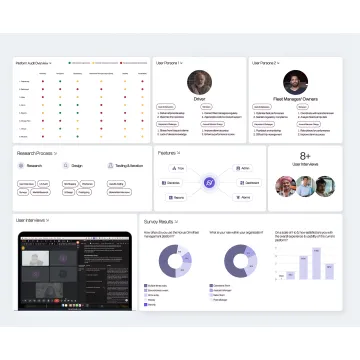
Before you build, we prototype. We run structured research sprints, build testable prototypes, and validate assumptions with real users. The goal is to reduce engineering rework by surfacing UX problems before they become code.
Your website is often the first place an enterprise buyer, investor, or partner forms a view of your company. We design and build websites that translate complex technology into clear, audience-specific messaging, with buyer journeys, high-fidelity design, and Webflow or Framer builds included.
When you have one shot — a conference launch, a partnership announcement, a funding round — the landing page needs to do real work. We structure content hierarchies, sequence trust signals, and design calls to action for the specific audience you are driving traffic toward.
Design that closes the gap between product and adoption
Climate and deep-tech startups often build product experiences the way they build the technology itself: fast, focused on function, and prioritized around what the engineering team can ship. That works for getting to market. It rarely works for getting to adoption. At What if Design, we approach UX as a strategic layer, not a visual one. We map where users lose confidence, where flows create friction, and where your interface is doing the opposite of what your sales team is telling prospects it does. Then we redesign it through structured research, sprint-based iteration, and dev-ready handoffs your team can execute without translation overhead. The result is a product experience that moves users to value faster, gives enterprise buyers more confidence, and builds a design foundation that scales as your product grows.
Success stories
Trusted by innovators
From Seed-stage climate tech startups to Series B deep-tech companies, we have helped product teams close the gap between where their UX is and where it needs to be to win pilots, enterprise buyers, and investor confidence.
"Working with What if Design has been transformative — faster feature roll outs, reduced development costs, and a fantastic user experience. They quickly understood our vision and offered proactive ideas"
Kent Costello
"They very quickly understood the kind of messaging that was important to us and how to translate that into a compelling visual experience. I can't recommend them enough!"
Keenan Johnson
"The extremely high quality of outputs with fast turn around times and availability of team at short notice has been perfect for our requirements"
Ayush Banerjee
"Working with What if Design has been transformative — faster feature roll outs, reduced development costs, and a fantastic user experience. They quickly understood our vision and offered proactive ideas"
Kent Costello
"They very quickly understood the kind of messaging that was important to us and how to translate that into a compelling visual experience. I can't recommend them enough!"
Keenan Johnson
"The extremely high quality of outputs with fast turn around times and availability of team at short notice has been perfect for our requirements"
Ayush Banerjee
"Working with What if Design has been transformative — faster feature roll outs, reduced development costs, and a fantastic user experience. They quickly understood our vision and offered proactive ideas"
Kent Costello
"They very quickly understood the kind of messaging that was important to us and how to translate that into a compelling visual experience. I can't recommend them enough!"
Keenan Johnson
"The extremely high quality of outputs with fast turn around times and availability of team at short notice has been perfect for our requirements"
Ayush Banerjee
The What if Design difference
Why choose What if Design?
Strategic design that moves at startup speed, grounded in user evidence, and built to scale with your product.
Research-driven
Every design decision starts with evidence. We run user research, analyze behavioral data, and align with your stakeholders before a single screen is designed.
Rapid iteration
We work in structured sprints with clear deliverable windows, including turnarounds as fast as 48 hours when you have a hard deadline to hit.
Scalable systems
We build component libraries and design systems your product team can own and extend, so there is no design debt six months from now when the product grows.
Cost efficient
Senior design strategy and execution at a cost that makes sense for your stage, without the overhead of building an in-house team.
Meet the design team
A team that brings architectural systems thinking and operational strategy to design, built for the complexity of deep-tech and climate products.
Akhila Kosaraju
Co-founder
Akhila brings architectural precision and systems thinking to digital design. Before co-founding What if Design, she was designing LEED-certified buildings and leading urban interventions exceeding $100M in value — projects that required understanding how people move through, interpret, and trust built environments. That same instinct shapes her approach to UX. She leads design strategy at What if Design, building product experiences that are coherent at scale and grounded in how users actually think. Her work spans enterprise SaaS platforms and consumer-facing applications, always anchored in research and focused on outcomes that are measurable, not just aesthetic.
Tejas Mahajan
Co-founder
Tejas combines strategic business thinking with design execution, bringing a growth-oriented perspective to What if Design's work. Before co-founding the company, he drove business growth for OYO across three countries and ran training programs reaching over 1,700 people across India. That experience gave him a clear-eyed view of what makes digital products succeed in complex, multi-market environments — and how design functions as a competitive lever, not just a surface. At What if Design, Tejas leads client strategy, translating business requirements into design briefs that keep the team focused on outcomes. His background in operations and growth means he understands the full customer journey, from first impression through conversion to retention. That perspective shapes how What if Design approaches every engagement.
Frequently Asked Questions
What services does a UI/UX designer provide?
UI/UX designers provide services across the full design process: user research, information architecture, wireframing, prototyping, visual interface design, interaction design, usability testing, design system creation, and ongoing optimization based on user feedback and behavioral data.
What does a user interface designer do?
A user interface designer creates the visual elements users interact with in digital products. That includes designing layouts, selecting typography and color systems, building icon sets and button states, establishing visual hierarchies, and ensuring the interface holds up across devices and accessibility standards.
How much should a UI/UX designer charge?
UI/UX design costs vary based on project scope and the experience level of the team. Freelance designers typically charge $50 to $200 or more per hour, while agencies range from around $10,000 for focused projects to $100,000 or more for complex enterprise engagements. What if Design offers senior-level design strategy and execution at a cost structured for Seed through Series B companies, without the overhead of building an in-house team.
How long does a typical UI/UX design project take?
Project timelines depend on scope and complexity. Simple landing pages can be completed in 1 to 2 weeks, while comprehensive website redesigns typically take 4 to 12 weeks. Complex product UX projects with structured research and testing phases may require 8 to 16 weeks. We also offer sprint-based delivery with turnarounds as fast as 48 hours for time-sensitive milestones.
Do you conduct user research as part of your design process?
Yes, and it is foundational to how we work. We conduct stakeholder interviews, competitive analysis, usability testing sessions, and behavioral data analysis to make sure design decisions are grounded in how users actually behave — not assumptions about how they should.
Can you work with our existing development team?
Yes. We provide detailed developer handoffs including design specifications, component documentation, animation specs, and all necessary assets. We also offer design support during development to resolve questions quickly and maintain implementation quality.
Do you provide design systems and style guides?
Yes. We build design systems that include component libraries, design tokens, spacing systems, typography scales, color palettes, and usage guidelines. These give your team a foundation to scale the product without accumulating design debt over time.
What tools do you use for UI/UX design?
We primarily use Figma for interface design and prototyping, and Webflow or Framer for production builds. We also use analytics platforms, heat mapping tools, and user testing software to ground design decisions in real behavioral data rather than assumptions.
Ready to close the gap between your product and your market?
Tell us where your product experience is falling short, and we'll share a clear view of what's creating friction and how to fix it.
Let's close the gap
Share what is not working in your product experience, and we will respond within 24 hours with a clear perspective on what is creating friction and how we would approach it.
For immediate assistance, feel free to give us a direct call at You can also send us a quick email at team@whatifdesign.in
For immediate assistance, feel free to give us a direct call at You can also send us a quick email at team@whatifdesign.in