You've spent the last 18 months proving the technology works. You have pilot data, a seed round closed, maybe a DoE grant or a strategic letter of intent from a utility. But when an enterprise buyer or investor lands on your website, they see something that reads like a research abstract and looks like it was built over a weekend.
That gap isn't a design problem. It's a signal clarity problem. Sophisticated buyers and climate-focused investors don't have time to decode dense technical language or navigate a site that buries its proof points. They form a judgment in seconds, and most early-stage climate tech sites don't survive that judgment.
This article reviews 11 SaaS design agencies worth evaluating in 2026, with particular attention to agencies that understand the specific challenges climate tech and deep-tech founders face when translating complex technologies into credible, investor-ready digital presences. Each has been assessed on SaaS portfolio depth, documented client outcomes, service range, and specialization.
TL;DR
- Reviews 11 design agencies for climate tech and deep-tech SaaS founders evaluating partners in 2026
- Each agency assessed on SaaS portfolio depth, documented outcomes, and relevance to technical founding teams
- Includes agencies that specialize in complex B2B products, plus context on where What if Design fits within the landscape
- Provides a framework for matching agency expertise to your company's stage, buyer context, and growth priorities
Overview of SaaS design agencies in 2026
SaaS design is fundamentally different from general web design, and climate tech SaaS adds another layer of complexity. A marketing site can look technically polished and still fail if it doesn't address the specific trust barriers that come with novel, often unproven technologies.
As a climate or deep-tech founder, you face a particular challenge: your buyers — utilities, industrial operators, asset managers, enterprise procurement teams — are slow to trust and require visible proof before engaging. The website isn't just a marketing channel. It's the first place a prospect goes to determine whether your company is worth their time, and in a sector where greenwashing has made buyers skeptical of unsubstantiated claims, what you show matters as much as what you say.
Specialized agencies bring expertise in onboarding optimization that delivers value within the first session — research consistently links this to significantly higher 30-day retention — alongside retention mechanics built through progressive disclosure, friction reduction, and feature adoption flows. They also design seamless subscription flows covering upgrade paths, billing experiences, and usage-based pricing, and build product-led growth experiences where the product itself drives conversion (top-performing PLG companies acquire users at dramatically higher rates than sales-led peers).
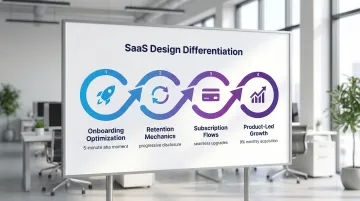
The best agencies connect product UX with marketing website design so that the user journey from homepage to dashboard is coherent and intentional.
The agencies below were selected for their track record in delivering documented results: increased activation, reduced churn, and improved conversion.
Best SaaS design agencies to partner with in 2026
We selected these agencies based on five criteria: SaaS portfolio depth, client results with documented outcomes, service range (product and website capabilities), pricing transparency, and specialization areas like climate tech or AI.
What if Design
What if Design is a strategic brand and website partner for US-based climate tech and deep-tech startups, from Seed through Series B. Founded in 2020 with teams in San Francisco and Bangalore, they work specifically at the intersection where technical depth meets investor-facing communication.
Where most agencies treat brand and website as static deliverables, What if Design builds them as tools for capital attraction, partner engagement, and early enterprise deals. Their focus is closing the credibility gap between where a company actually is and how it's perceived by the buyers and investors it needs to reach. For climate founders, that gap is often wider than in other sectors, because the technology is genuinely complex and the trust threshold for novel approaches is high.
Consider a Seed-stage deep-tech company with DoE validation and a pilot agreement signed with an industrial operator, but a website that reads like a research proposal. When a strategic partner or Series A investor evaluates them, the digital presence is the first filter — and one that often determines whether a follow-up call gets scheduled at all. Getting the brand and website right at this stage has a direct bearing on whether that conversation happens.
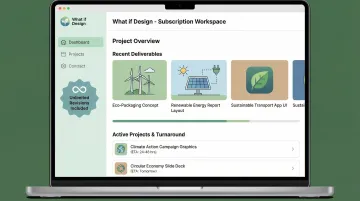
Because they work exclusively in cleantech and deep-tech, there's minimal ramp-up. They understand carbon capture, hydrogen, grid modernization, and climate intelligence without needing the foundational science explained. The agency offers solutions 3x more cost-effective than in-house senior designers, with turnaround times as fast as 48 hours for specific deliverables and full brand identities delivered within two to four weeks. Engagement models include fixed-scope projects with defined timelines and costs, and a flexible subscription-based partnership that allows companies to pause and resume services based on project needs, with unlimited revisions included.
| Category | Details |
|---|---|
| Key services | Brand identity, website design, product UX/UI, design systems, pitch deck design, marketing production |
| Notable clients | HYDGEN, Ribbit Network, Susteon, Pristyn Care, TATA1mg, Ministry of Health Saudi Arabia |
| Best for | Seed to Series B climate tech startups, green tech companies, and purpose-driven SaaS founders who need their digital presence to reflect the credibility their technology has already earned |
Clay
Clay is a San Francisco-based design agency specializing in branding and UX for enterprise SaaS companies. With a portfolio that includes Slack, Stripe, and Coinbase, they work at the intersection of strategic brand positioning and product design, creating enterprise software interfaces that balance functional complexity with usability. They're best suited if your product is at growth stage and needs to signal maturity and credibility to sophisticated buyers.
| Category | Details |
|---|---|
| Key services | Product UI/UX, website design, branding, design systems |
| Notable clients | Slack, Stripe, Coinbase, Linear |
| Best for | Enterprise SaaS needing premium brand positioning and visual consistency at scale |
MetaLab
MetaLab is a veteran product design studio that helped build foundational interfaces for tools like Slack and Coinbase. Founded in Victoria, BC in 2006, they specialize in zero-to-one product UX for startups and scaleups, grounded in user research and structured product thinking at the early stage.
MetaLab turns early ideas into fully-formed platforms. They're particularly strong at designing the foundational interfaces that define how users first interact with a new product category. When your first enterprise prospect runs a trial, that initial interface experience is often what determines whether they move forward to a paid contract or disengage.
| Category | Details |
|---|---|
| Key services | SaaS product design, research, prototyping, marketing design |
| Notable clients | Slack, Coinbase, Pitch, Amazon |
| Best for | Early-stage SaaS needing deep product strategy and UX structure from day one |
Ramotion
Ramotion is a brand-driven agency that integrates product UX with visual identity, well suited for SaaS companies scaling quickly across platforms. Based in San Francisco since 2009, they have worked with Salesforce, Descript, and Mozilla.
Their focus on design systems and iconography helps internal teams maintain consistency as products and teams grow. For enterprise buyers running vendor evaluations, visual and product consistency signals operational maturity and reduces perceived risk.
| Category | Details |
|---|---|
| Key services | Product UI/UX, branding, design systems, website design |
| Notable clients | Salesforce, Descript, Mozilla, Xero |
| Best for | SaaS companies needing unified product and marketing design across a growing surface area |
Superside
Superside is a creative-as-a-service platform offering scalable, subscription-based design for fast-moving SaaS teams. With a 24/7 global team of 500+ professionals, Superside delivers 12-hour turnaround times on creative assets through AI-assisted workflows, making them well suited for teams that need to move fast without building out internal creative capacity.
The subscription model lets SaaS companies scale creative output up or down without the hiring lag. For teams running campaigns around a product launch, a funding close, or a major conference, that speed-to-output is directly tied to your commercial timeline.
| Category | Details |
|---|---|
| Key services | Product UI/UX, website design, ads, creative production |
| Notable clients | Figma, Snowflake, Intuit, AWS |
| Best for | SaaS teams needing ongoing design support and fast iteration across multiple channels |
Eleken
Eleken is a Ukraine-based agency that places UX designers directly inside SaaS product teams on a flexible, subscription basis. With 100% SaaS focus and pricing starting around $3,800/month, they integrate into existing client workflows through tools like Slack and Jira.
This model gives early-stage startups dedicated design capacity without the overhead and commitment of a full-time hire. If you're heading into a first enterprise pilot and need your onboarding flows and product UX tightened quickly, embedded design capacity gets you there faster than a hire would.
| Category | Details |
|---|---|
| Key services | SaaS product UX/UI, website design, UX audits |
| Notable clients | SaaS startups across finance, AI, and logistics |
| Best for | Early-stage SaaS startups needing consistent, embedded design support |
Pony Studio
Pony Studio is a London-based agency with experience across a broad range of tech clients. Their work leans toward brand-forward design: products that are immediately recognizable and easy to pitch to investors, without sacrificing usability.
They're a strong fit if you need your product to look as credible as the company behind it, particularly at Series A when competitive pressure and enterprise expectations increase.
| Category | Details |
|---|---|
| Key services | Product design, website design, branding, illustration |
| Notable clients | Doctify, Agorapulse, Weavr |
| Best for | Series A and later SaaS companies that need differentiated brand design to stand out in crowded categories |
StanVision
StanVision is a Bulgaria-based, award-winning agency specializing in SaaS product and website design with Webflow expertise. They focus on reducing onboarding time, improving activation, and aligning product UX with marketing sites to create coherent user journeys.
As a Webflow Premium Partner, they offer combined design and development capabilities that reduce time between design approval and live site. When you have a hard deadline — a partnership announcement, a conference, a fundraise — that compressed timeline from design to live site is directly tied to hitting your commercial window.
| Category | Details |
|---|---|
| Key services | SaaS product design, Webflow development, branding, UX research |
| Notable clients | Primer, Rillet, Tolstoy, multiple funded fintech startups |
| Best for | SaaS companies needing fast, conversion-focused design with Webflow implementation |
Lollypop
Lollypop is a global UI/UX agency with 200+ designers delivering discovery sprints, mobile-first strategies, and rapid prototyping for SaaS products. Based in San Jose with global reach, they are well structured to handle enterprise-scale engagements while maintaining the speed needed for iterative product cycles.
Their mobile-first approach is particularly relevant for SaaS products where users split time across devices and need consistent experiences throughout. For enterprise buyers evaluating your product across multiple stakeholders with different device habits, a friction-free cross-device experience removes a common objection before procurement conversations begin.
| Category | Details |
|---|---|
| Key services | UI/UX design, prototyping, mobile apps, visual design |
| Notable clients | Intel, Cisco, Stanford, multiple SaaS companies globally |
| Best for | SaaS products needing mobile-first design and structured experimentation |
Lazarev
Lazarev is a San Francisco-based agency with 125+ international awards, specializing in B2B and AI-focused SaaS design. As a 3x Webby Winner, they bring documented expertise in complex data interfaces, AI/ML integration, and MVP development.
Their published portfolio reflects a focus on technically complex products where making dense information legible to end users is a primary design challenge. For AI or data-heavy products, how clearly your interface communicates value in a live demo often determines whether you advance in an enterprise evaluation.
| Category | Details |
|---|---|
| Key services | Product design, website design, AI/ML integration, Web3 design |
| Notable clients | Payoneer, HP, Boeing, PikaAI, NODO |
| Best for | B2B and AI SaaS companies launching MVPs or building interfaces for technically complex products |
Merge
Merge is a remote, Ukraine-based agency offering full-stack design and development under one roof. They specialize in vertical SaaS for fintech, AI, and Web3, with combined front-end, back-end, and design services.
This integrated model works well for startups that need both design and engineering but don't yet have the budget or headcount to keep those functions separate. Getting to a well-designed, functional product faster means you're in a stronger position for your first enterprise pitch or pilot negotiation.
| Category | Details |
|---|---|
| Key services | Front-end/back-end development, UI/UX design, DevOps, integrations |
| Notable clients | CoinLedger, Lox, various startups across industries |
| Best for | Startups needing combined design and development on tighter budgets |
How we chose the best SaaS design agencies
The evaluation process focused on SaaS-specific expertise rather than general design output, with additional weight given to agencies that demonstrate understanding of technically complex B2B products. Visual polish is a floor, not a ceiling. The agencies that matter if you're building a climate tech or deep-tech product are the ones that know how to handle long sales cycles, multi-stakeholder buying decisions, and the particular challenge of building trust for a technology category your buyers may not fully understand yet.
Key evaluation criteria:
- SaaS-specific portfolio work - Case studies showing dashboards, onboarding flows, feature adoption patterns, and subscription interfaces
- Documented results - Client evidence highlighting conversion improvements, churn reduction, and activation rate increases
- Service breadth - Agencies offering both product UX and marketing website design to support coherent user journeys
- Specialization areas - Distinct expertise in areas like climate tech, AI, or vertical SaaS
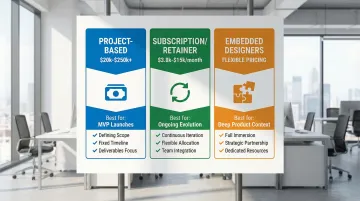
- Engagement flexibility - Multiple models (project-based, subscription, embedded) to match different company stages
When evaluating agencies for a climate tech or deep-tech product, watch for these patterns:
Agencies that haven't worked with technically complex products will over-index on visual polish while missing the messaging hierarchy that actually converts skeptical enterprise buyers. A strong general SaaS portfolio doesn't automatically translate to understanding how a utility procurement team evaluates vendors, or why a climate investor's trust threshold is higher than a typical B2B buyer's.
Watch for agencies that can't point to documented business outcomes — shortened sales cycles, improved enterprise conversion, successful funding rounds following a brand refresh — because they're selling deliverables, not results. The ramp-up cost of educating a generalist agency on your technology context is often invisible until it shows up in misaligned positioning and rework cycles.
The agencies here understand that SaaS design success is measured by activation rates, retention curves, and conversion metrics.
How to choose the right SaaS design agency for your needs
Start by defining the specific outcome you need this engagement to produce. If you're building in climate or deep-tech, that often means one of three things: closing the credibility gap before a hard deadline (a conference, a funding round, a partnership announcement), segmenting messaging for multiple distinct buyer types (enterprise operators, utilities, investors, policy teams), or building enough signal clarity that interested prospects understand your product before the first conversation. Different agencies are built for different problems.
Use this framework to evaluate potential partners:
Match agency expertise to your stage
Your product stage determines which agencies fit best:
- Pre-launch / MVP (Seed stage): Agencies like MetaLab or Lazarev have strong zero-to-one product experience. If you're a climate tech founder at this stage and also need to close the gap between how complex your technology is and how clearly buyers understand it, What if Design's Minimum Viable Brand offer is structured specifically for that moment.
- Growth stage (Series A): Scalable partners like Superside or Eleken offer subscription models suited to teams building out continuous design capacity. The priority at this stage shifts to segmented messaging and enterprise buyer trust.
- Enterprise-ready positioning: Agencies like Clay or Ramotion are well suited to sophisticated brand positioning at scale, particularly for products that need visual consistency across a large, multi-channel surface area.
Assess portfolio relevance
Look for similar SaaS business models (B2B vs. B2C, vertical SaaS, PLG products). Check for documented outcomes: "increased conversion by X%," "reduced churn by Y%."
Confirm they've worked through your specific challenges: onboarding complexity, feature adoption gaps, or retention drop-off.
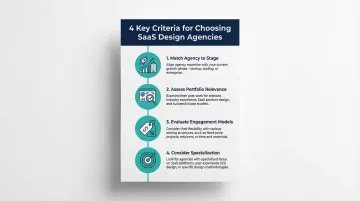
Evaluate engagement models
Different pricing structures suit different needs:
- Project-based ($20k-$250k+): Best for one-time redesigns or MVP launches with clear, defined scope
- Subscription/retainer ($3.8k-$15k/month): Suited for ongoing product evolution and continuous iteration
- Embedded designers: Works well for companies needing deep product context without hiring overhead
Consider specialization
Specialized agencies reduce ramp-up time significantly and prevent the category of expensive rework that comes from an agency misunderstanding the buyer environment. If you're in climate tech or deep-tech, this is particularly relevant.
A generalist agency doesn't know that your enterprise buyer has experienced years of greenwashing and is therefore skeptical of any environmental claim that isn't backed by documented proof. They don't know that utilities have 18-24 month procurement cycles and make decisions by committee, which changes what needs to be true about your messaging hierarchy entirely. They don't understand that a DoE-funded venture carries specific credibility signals that belong front-and-center, not buried in a footer.
Agencies like What if Design build specifically in this context. That domain familiarity means less explaining, fewer misaligned design decisions, and faster time to a brand and website that works for the buyers you're actually trying to reach. For AI-focused products or technically complex B2B SaaS, agencies like Lazarev have relevant documented expertise in making dense, data-heavy interfaces legible without oversimplifying the underlying product.
Conclusion
Choosing the right design agency comes down to one question: does this partner understand the specific context in which your buyers make decisions? Your context as a climate tech or deep-tech founder is distinct. Your buyers are often slow-moving institutions. Your technology is genuinely novel. Your trust threshold is higher than it is for most software categories. A design partner who has built for that environment brings real leverage. One who hasn't will spend your budget and your runway getting up to speed.
According to Amplitude's B2B product benchmarks, top-performing products retain customers at 6x the rate of median products, with early activation being the strongest leading indicator of long-term health. The same principle applies to your website and brand: the first impression sets the trajectory. If your digital presence doesn't immediately communicate credibility to the right audience, the conversion drop-off starts at the first page.
For climate tech and deep-tech founders at Seed through Series B, What if Design builds brands and websites that close that credibility gap and support the growth moment you're in, whether that's a funding round, a product launch, or a first enterprise partnership.
If your digital presence hasn't kept pace with where your company is headed, that's worth addressing before your next raise, pitch, or conference.
Frequently asked questions
What makes a design agency "SaaS-specific" versus general web design?
SaaS-focused agencies understand the full subscription lifecycle: onboarding, feature adoption, billing, and long-term retention. For climate tech and deep-tech SaaS specifically, specialization goes further. It means understanding multi-stakeholder buying decisions, how to communicate technical credibility without overwhelming non-technical buyers, and how to design for the trust deficit that novel technologies face with slow-moving enterprise buyers.
How much does it cost to hire a SaaS design agency in 2026?
Costs vary by engagement model and agency tier. Subscription models start around $3,800-$10,000/month, project-based work ranges from $20,000-$150,000+ depending on scope and complexity, and hourly rates span $50-$200+/hour based on location and experience level.
Should I hire an agency or build an in-house design team?
Agencies offer faster time-to-market and immediate senior expertise without hiring overhead, while in-house teams provide deeper product context over time. You'll likely use agencies during key growth phases (MVP launch, major redesigns) then transition to an internal team as you scale.
How long does a typical SaaS design project take?
Timelines vary by scope: MVPs and landing pages typically take 4-8 weeks, full product redesigns require 3-6 months, and ongoing partnerships operate on sprint cycles of 1-2 weeks. Agencies like What if Design can deliver full brand identities in as few as two weeks for founders with an approaching deadline.
What should I look for in a SaaS design agency portfolio?
Look for case studies with documented results (increased conversions, reduced churn, improved activation rates) and SaaS-specific work showing dashboards and onboarding flows. Avoid portfolios showing only polished static screens with no business context or stated outcomes.
Can one agency handle both product UX and marketing website design?
Yes, many agencies offer full-service capabilities covering brand, website, and product design. Agencies like What if Design, Clay, and Ramotion align the full user experience from first website visit to daily product use, so what you promise on the marketing site matches what users actually encounter.