The climate tech messaging challenge
You've validated the technology. You've run the pilot. You may have closed your seed or Series A. But your website still reads like a research paper, your messaging buries the ROI in technical specs, and investors are asking questions your materials don't answer cleanly.
This is one of the most common friction points for climate tech founders: the gap between how advanced the technology is and how clearly it communicates its value. It's not a science problem. It's a positioning problem.
Greenwashing scrutiny compounds this further. High-severity cases increased 30% in 2024, and 96% of companies with climate pledges exhibited at least one indicator of potential greenwashing. Every unsubstantiated claim now carries real reputational risk.
This guide breaks down how to build messaging that earns credibility with investors, converts customers who evaluate business outcomes first, and positions your climate mission as proof of differentiation rather than a substitute for it.
TLDR:
- Balance technical credibility with accessible communication across all stakeholder groups
- Lead with business value (cost, efficiency) before climate impact to engage B2B buyers
- Use specific, data-backed claims to avoid greenwashing accusations
- Tailor messages to investors (scalability), customers (tangible benefits), partners (mission)
- Shift from vision-focused (seed stage) to proof-focused (growth stage) messaging
Why climate tech brand messaging is different
The technical-accessible balance
Climate tech operates at the intersection of complex science and commercial viability. Your technology might involve advanced materials science, thermodynamics, or carbon sequestration chemistry, but your customers care about operational efficiency, cost savings, and reliability.
This creates a specific challenge: you must demonstrate deep technical credibility to investors and engineers while remaining accessible to business buyers who lack specialized knowledge. Go too technical and you alienate decision-makers; oversimplify and you lose credibility with the people whose sign-off you need.
The dual audience problem
You're simultaneously speaking to two groups with fundamentally different priorities:
Mission-driven stakeholders focus on:
- Long-term climate impact
- GHG reduction potential
- Environmental justice considerations
- Regulatory compliance
Profit-driven stakeholders focus on:
- Return on investment
- Risk mitigation
- Operational efficiency
- Competitive advantage
Research shows that while people care about sustainability, B2B buyers act on behalf of businesses that prioritize cost, efficiency, and safety. Climate credentials are rarely the deciding factor when procurement teams evaluate technology investments.
The practical solution is what's sometimes called a "mullet strategy": business value at the front (cost, speed, resilience), climate impact at the back (ESG goals, regulatory compliance).
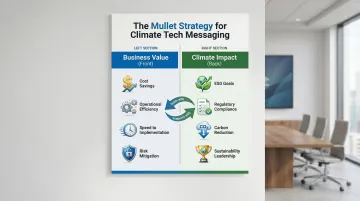
Rondo Energy demonstrates this well. Their messaging leads with economics: "They cost the least. They eliminate emissions... They are available at scale today."
Addressing skepticism and greenwashing concerns
Greenwashing scrutiny has never been higher. 96% of companies with climate pledges exhibited at least one indicator of potential greenwashing, such as lacking Scope 3 coverage or interim targets.
Vague claims like "eco-friendly" or "carbon neutral" without third-party verification invite immediate skepticism and, increasingly, regulatory exposure.
Building verifiable credibility means using specific, measurable claims backed by data, supported by third-party validation where available — ISO certifications and GHG Protocol compliance carry particular weight with investors and procurement teams. Transparent methodology for impact calculations matters too, as does the willingness to acknowledge scope and limitations rather than paper over them.
Demonstrating both impact and viability
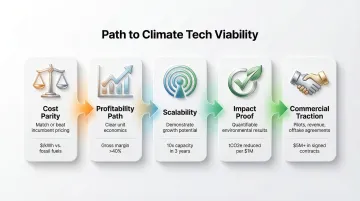
Investors now prioritize "policy-proof" business models, meaning solutions that are economically viable without subsidy support.
With 41% of investors flagging policy whiplash as a top concern heading into 2025, messaging that leans on regulatory tailwinds creates its own credibility problem. The question investors now ask first is: "Would this be a good business even without the ITC or PTC?"
Effective climate tech messaging demonstrates cost parity or better versus incumbent solutions, a clear path to profitability, and scalability potential — grounded in quantifiable environmental impact and commercial traction like pilots, offtake agreements, or early revenue.
Companies that lead with unit economics and scalability, rather than policy dependence, close funding rounds faster and at higher valuations.
The foundation: core messaging framework for climate tech
Your mission statement
Your mission statement should connect climate impact to business outcomes in one clear sentence. Avoid vague sustainability language in favor of specific, measurable goals.
Weak mission statement: "To create a more sustainable future through innovative clean technology solutions."
Strong mission statement: "To eliminate industrial emissions by delivering heat batteries that cost less than fossil fuel alternatives while achieving zero carbon output."
The difference comes down to specificity: the strong version names the problem, the audience, and the mechanism in a single sentence.
A strong mission statement names the specific environmental problem you're addressing, identifies your target market or beneficiary, and includes a measurable outcome. It connects environmental impact to business value directly — and it does all of this in one or two sentences, not a paragraph.
Your value proposition
Your mission sets the direction; your value proposition translates that into the terms your customers actually use when evaluating whether to buy.
Your value proposition explains what problem you solve, for whom, and why your solution is better. Lead with customer benefits rather than technology features.
Feature-focused (weak): "Our proprietary carbon capture technology uses advanced sorbent materials with optimized isotherms."
Benefit-focused (strong): "We reduce industrial carbon emissions by 90% while lowering energy costs 15%, using technology that integrates into existing facilities in weeks, not years."
Structure your value proposition to answer five questions: what specific pain point do you eliminate, who experiences it most acutely, what tangible benefit do they receive (cost savings, time savings, risk reduction), why is your approach superior to alternatives, and what makes adoption easy or low-risk.
Your brand story
Your brand story creates an authentic narrative connecting your founding to your climate mission. It humanizes your technology and builds emotional connection alongside rational credibility.
Essential story elements:
- The spark — What problem or insight led to founding the company?
- The journey — Key challenges overcome and lessons learned
- The team — Relevant expertise and unique qualifications
- Early traction — Initial wins, partnerships, or validation points
- The vision — Where you're headed and the impact you'll create
Credibility markers matter in climate tech, where skepticism runs high. Weave them naturally throughout your story: founder expertise from relevant industries or research institutions, strategic partnerships with established players, early customer wins or pilot results, and advisor or investor backing from respected names.
Example structure (illustrative): "After a decade in industrial process optimization, our founder recognized that 40% of industrial energy was wasted as heat. Existing heat recovery systems were either too expensive or too complex for most mid-size facilities to justify.
Two years of development produced a system that costs 60% less than incumbents and installs in a third of the time. The first pilot demonstrated 35% energy cost reduction, which led to contracts with three Fortune 500 manufacturers."
Your key messages
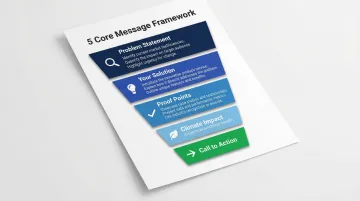
Once your story is clear, distill it into 3-5 repeatable messages that can be adapted across all communications, balancing enough simplicity to be remembered with enough substance to be credible.
Framework for key messages:
The problem statement
- Specific pain point your audience experiences
- Quantified impact or cost of the problem
- Why existing solutions fall short
Your solution
- How your technology addresses the problem
- Key differentiators from alternatives
- Tangible benefits customers receive
Proof points
- Customer results or case studies
- Technical validation or certifications
- Market traction or growth metrics
Climate impact (position as additional benefit, not primary)
- Specific environmental outcomes
- Measurable GHG reduction or resource savings
- Alignment with regulatory or ESG goals
Call to action
- Next step for your audience
- Clear path to engagement
- Risk mitigation or low-barrier entry point
Each message should condense to one sentence but expand to a full paragraph when needed. Test them with each stakeholder group to confirm they land.
Messaging for different stakeholder audiences
Messaging for investors
Investors in climate tech evaluate opportunities through financial viability, technical risk, and market timing. Your messaging must address their evaluation criteria directly while demonstrating both impact potential and venture-scale returns.
Emphasize:
- Path to venture-scale returns with large TAM (scalability)
- Cost parity or better versus incumbents, with clear profitability timeline (unit economics)
- Growing demand independent of policy support (market opportunity)
- Defensible technology, IP, or market position (competitive advantage)
- Beyond R&D into commercial traction (deployment readiness)
- Domain expertise to execute at scale (team capability)
Address investor concerns proactively. On policy risk, demonstrate viability without subsidies. On first-of-a-kind technical risk, lead with pilot data and engineering validation rather than projections. Show a clear path from current state to mass deployment, and articulate specifically why you'll win against alternatives — not just that you will.
Example investor-focused message: "We're capturing the $45B industrial heat market with technology that's already cost-competitive with natural gas. Our first commercial deployment reduced energy costs 23% with an 18-month payback, with no subsidies required. Three Fortune 500 manufacturers have signed LOIs for 2026 deployment, representing $12M in contracted revenue."
Messaging for customers
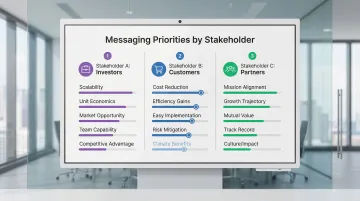
Customer messaging prioritizes tangible benefits, ease of adoption, and real-world results. The decision to lead with sustainability versus performance depends entirely on your buyer's primary motivations.
B2B buyers typically respond to business outcomes first, with sustainability as supporting context rather than the lead. Their internal stakeholders, budget approvals, and procurement committees all require a business case, not a mission statement. Lead with cost reduction or operational efficiency, risk mitigation or reliability improvements, competitive advantage or market differentiation, and ease of implementation with minimal disruption.
Climate benefits become additional value rather than the primary driver for most industrial buyers.
Example customer-focused message: "Reduce energy costs 20-30% while meeting your 2030 carbon reduction targets. Our heat recovery system installs in existing facilities with zero downtime and pays for itself in under two years. Fifty manufacturing facilities are already operating with an average 25% energy cost reduction."
For B2C or mission-driven buyers, the balance shifts. Lead with impact and values alignment, support that with performance and quality, and emphasize ease and accessibility.
Messaging for partners and talent
Strategic partners and top talent evaluate opportunities through different lenses than customers or investors.
For strategic partners, the emphasis falls on complementary capabilities and mutual value creation, market expansion opportunities, shared vision and values alignment, and a track record of successful partnerships — the proof that working together produces results for both sides.
Talent evaluates a company on mission-driven work with tangible impact, growth trajectory and career development, team culture and values, and competitive compensation and benefits.
Example talent-focused message: "Join a team eliminating industrial emissions at scale. We've grown from 12 to 45 people in 18 months, with three new commercial deployments launching this quarter. You'll work alongside PhDs and industry veterans solving hard technical problems that matter, with equity, competitive salary, and the satisfaction of measurable climate impact."
Adapting your core messages
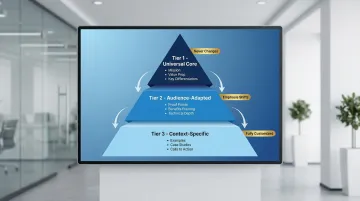
The examples above show different emphasis for each stakeholder, but all share common threads. Maintain brand consistency while tailoring to each audience by using a message hierarchy:
Tier 1 - Universal core (never changes): Company mission, primary value proposition, and key differentiators remain constant across all communications
Tier 2 - Audience-adapted (emphasis shifts): Proof points are selected for relevance, benefits are framed for each audience's priorities, and technical depth is adjusted for their level of sophistication.
Tier 3 - Context-specific (fully customized): Examples and case studies, calls to action, and supporting details all change based on context.
Successful climate tech companies like Kempower demonstrate this approach. Their "Powering Planet Cool" tagline unifies all communications, while specific messaging emphasizes operational reliability for infrastructure buyers and climate leadership for sustainability officers.
Common messaging mistakes climate tech companies make
Being too technical or jargon-heavy
Using complex scientific terminology alienates non-expert audiences. Terms like "stoichiometry," "isotherms," or "thermocatalytic conversion" might be precise, but they create barriers before the conversation even starts.
Research demonstrates that simplifying language removes barriers and makes climate change "more relatable, understandable, and actionable." High jargon density correlates with lower engagement outside technical diligence sessions.
This happens most often because technical founders default to the language they know best. It's not a lack of communication skill; it's a habit formed in environments where precision signals competence. The problem is that business buyers aren't in those environments.
The fix is straightforward: lead with outcomes, not processes. Use analogies to familiar concepts. When technical terms are necessary, define them. And build layered content — a simple overview for decision-makers with technical depth available for those who want to go deeper.
Example transformation:
- Before: "Our thermocatalytic process optimizes exothermic reactions through advanced sorbent materials."
- After: "We capture carbon emissions using materials that work like a sponge, absorbing CO2 from industrial exhaust and releasing it for storage or reuse."
Overpromising on climate impact without substantiation
Without specific, verifiable evidence, claims like "carbon neutral" or "net zero" invite accusations of greenwashing. Claims that can't be substantiated are increasingly treated as legal and reputational liabilities, not just marketing mistakes. Recent research found that 74% of industry claims about AI's climate benefits were unproven, and the same scrutiny is being applied across climate tech.
The correction is methodical: quantify impact with specific metrics (tons of CO2 reduced, percentage of emissions eliminated), provide the methodology and assumptions behind the numbers, include third-party verification when possible, and acknowledge scope and limitations honestly. Use present tense for current impact and future tense for projections — the distinction matters more than most founders realize.
Example transformation:
- Before: "We're solving climate change through revolutionary carbon capture."
- After: "Our technology has captured 50,000 tons of CO2 across three industrial facilities in 2025, verified by third-party auditors using ISO 14064 standards. At full deployment, we project 2M tons annually by 2028."
Neglecting business outcomes for mission-only messaging
Focusing exclusively on climate mission without demonstrating business viability creates a gap that investors and pragmatic customers step around quickly. It's not that the mission doesn't matter to them. It's that buyers operate inside organizations with budget approvals, procurement committees, and ROI requirements. The mission doesn't help them clear those internal hurdles.
Balance mission and business value by leading with business value in most contexts — clear ROI, payback periods, commercial traction, revenue. Position climate impact as an additional benefit, and address practical implementation concerns directly rather than hoping the mission sells itself.
Example transformation:
- Before: "Join us in the fight against climate change with our sustainable energy solution."
- After: "Reduce your energy costs 30% with 24-month payback, while eliminating Scope 2 emissions and meeting your 2030 carbon targets."
Building your visual brand identity
Climate tech companies with inconsistent visual identities lose credibility before investors finish reading their first slide. The visual system you deploy signals whether you understand your own audience. Many climate tech startups underinvest here not because they don't care, but because they're still operating in founder-built materials that haven't kept up with the funding they've raised or the traction they've earned.
Key visual elements
Your visual identity system includes four core components:
Logo system – Primary logo for presentations and marketing, secondary marks for social media and app icons, icon variations for digital use, and responsive lockups that adapt across formats.
Color palette – Primary colors that reflect your brand personality, secondary colors for visual hierarchy, WCAG-AA compliant combinations for accessibility, and documented application guidelines for consistent use.
Typography – Headline fonts that convey your brand character, body fonts optimized for readability across devices, hierarchy system for different content levels, and consistent sizing and spacing rules.
Imagery style – Photography approach (documentary for authenticity, aspirational for vision, technical for credibility), illustration style for complex concepts, iconography system for quick communication, and treatment guidelines for data visualization.
Aligning visual identity with climate tech positioning
These elements must work together to communicate both technical credibility and environmental commitment without falling into overused climate tech clichés.
| Avoid these clichés | Do this instead |
|---|---|
| Overused green color schemes and leaf imagery | Choose colors that reflect your unique brand personality and technical focus |
| Stock photos of wind turbines and solar panels (unless you manufacture them) | Use authentic imagery showing your actual technology and measurable impact |
| Overly corporate or generic tech aesthetics | Balance technical precision with human accessibility in your visual language |
| Inconsistent application across touchpoints | Maintain rigorous consistency across investor decks, websites, and product interfaces |
Working with climate tech design specialists
Most climate tech founders don't have time to manage a long agency onboarding process or spend the first three weeks explaining what a carbon removal pathway is before the first design brief. The onboarding overhead alone can consume the timeline.
The practical advantage of working with a team that already understands your sector is speed and positioning accuracy. You spend less time educating and more time refining the message.
What if Design works specifically with Seed to Series B climate and deep-tech companies. They typically complete brand strategy and visual identity in under 4 weeks, combining narrative development with visual system creation so the result holds up across investor presentations, customer websites, and partner materials. Their portfolio spans renewable energy, carbon capture, and EV infrastructure, without the overhead of hiring in-house design leadership at this stage.
Scaling your messaging strategy as you grow
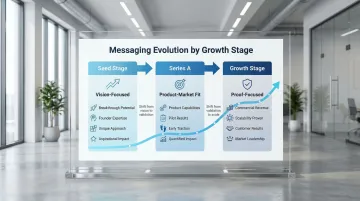
Evolution by growth stage
Your messaging needs evolve as your company matures. What works at seed stage falls flat at Series B.
Seed stage (vision-focused): Lead with the breakthrough and its potential, letting founder vision and expertise carry the narrative. The problem framing and your unique approach to solving it matter more than proof at this stage. Being aspirational about impact is not only acceptable — it's expected.
Example: "We're developing next-generation battery technology that will enable 1,000-mile range EVs at half the cost of current lithium-ion."
Series A (product-market fit): The emphasis shifts to product capabilities and early validation. Pilot results and initial customer traction replace the founder narrative. This is the stage to begin quantifying impact with real data — not projections, but actual numbers from deployments.
Example: "Our battery technology achieved 850 Wh/kg energy density in pilot testing, 40% higher than leading alternatives. Two automotive OEMs are currently evaluating our technology for 2027 vehicle programs."
Series B and growth (proof-focused): Commercial traction and revenue lead. Unit economics and scalability are the story. Customer results and retention rates demonstrate product-market fit at scale, and the positioning shifts to market leader or fast follower.
Example: "We're powering the next generation of EVs with battery technology deployed in 15,000 vehicles and contracted for 200,000 more. Our manufacturing process delivers 35% cost reduction versus lithium-ion at scale, with three automotive partners committed to multi-year supply agreements."
When to refresh versus maintain consistency
Maintain consistency when your core value proposition remains relevant, brand recognition is growing, and messaging is landing with target audiences — in short, when the strategy is working. Refresh when you've pivoted to new markets, the competitive landscape has shifted significantly, new milestones have changed your positioning, or current messaging isn't converting (test this with data, not instinct). Entering a new growth stage — seed to A, A to B — is itself a trigger for repositioning.
Strategic pivot points in 2025-2026: Climate tech messaging is shifting toward energy security, resilience, and domestic supply chains.
Some companies are adopting what the industry is calling "quiet climate" positioning: leading with energy security, operational resilience, and cost performance rather than foregrounding climate mission language. This isn't abandoning the mission. It's recognizing that the business case often needs to carry the conversation first, particularly when engaging industrial buyers, procurement teams, or investors navigating a politically volatile environment.
Building internal alignment
Once your external messaging is clear, turn inward. Everyone on your team should be able to explain your brand message consistently.
The practical toolkit includes a one-page messaging guide with key messages, elevator pitch templates at multiple lengths (30 seconds, 2 minutes, 5 minutes), a FAQ document, audience-specific presentation examples, and email templates for outreach.
Enabling the team means more than distributing the guide. Run messaging workshops with all customer-facing staff. Record founders delivering key messages so new hires have a reference. Run practice pitch sessions with real feedback, and update resources quarterly as the message evolves.
Measure consistency by reviewing sales calls and customer conversations, monitoring written communications, surveying customers on message clarity, and tracking which messages generate the most engagement. Adjust based on what's actually working.
Frequently asked questions
What makes climate tech brand messaging different from traditional tech messaging?
Climate tech messaging requires proving both technical functionality and measurable climate benefits, while demonstrating commercial viability to skeptical investors. You face heightened scrutiny around authenticity that traditional tech messaging doesn't encounter.
How can climate tech startups avoid greenwashing in their messaging?
Use specific, measurable claims with third-party validation. Replace "carbon neutral" with "reduced Scope 1 and 2 emissions by 10,000 tons CO2e in 2025, verified by [third party] using ISO 14064 standards." Acknowledge limitations openly.
What are the most common messaging mistakes climate tech companies make?
The three biggest mistakes are: using overly technical language that alienates business buyers, making vague sustainability claims without substantiation (greenwashing risk), and focusing exclusively on mission while neglecting business outcomes like ROI and operational benefits that drive actual adoption.
How should climate tech companies message differently to investors vs. customers?
Investors need scalability and unit economics, so emphasize TAM, competitive advantage, and path to profitability. Customers need tangible benefits, so lead with cost savings, efficiency gains, and implementation simplicity. Position climate impact as additional value for customers and core value for impact investors.
When should a climate tech company invest in professional branding and messaging?
Before Series A or when entering new markets, specifically when transitioning from founder-led vision to scalable execution. Professional branding accelerates investor conversations, improves customer acquisition, and enables consistent communications across every channel and touchpoint.
How technical should climate tech messaging be?
Lead with outcomes and benefits first, then layer in technical depth for audiences who want it. Your homepage should be accessible to business buyers; your technical documentation can go deep. Create tiered content: executive summary for decision-makers, technical specs for engineers, implementation details for operations teams.