
The convergence of SEO, storytelling, and UX
You've validated the technology. The pilot is running. Investors are paying attention. But when someone lands on your website, they leave before they understand what you actually do.
This isn't a content problem or a design problem in isolation. It's a signal problem. Climate tech founders are typically deep experts in their domain, which means the website often ends up reflecting how they think about the technology rather than how a buyer, investor, or partner needs to understand it.
Here's what that looks like in practice: a page that ranks well for a niche keyword but loses the visitor in the first paragraph because the copy reads like a technical specification. Or a site that looks polished but has no clear path for an investor trying to evaluate the opportunity quickly.
The fix isn't choosing between SEO, storytelling, or UX. It's understanding how these three disciplines work together, where climate tech companies consistently get the balance wrong, and what a more integrated approach looks like in practice. Nearly 60% of searches end without a click to an external site, which means when someone does click through to your site, every element needs to earn their attention.
TLDR: key takeaways
- Treating SEO, storytelling, and UX as separate workstreams is where most climate tech websites lose ground
- Narrative-structured content keeps visitors engaged longer, which correlates with better rankings across Google's core signals
- Core Web Vitals (LCP, INP, CLS) are confirmed ranking factors, meaning slow or unstable pages directly cost you search visibility
- Measuring all three disciplines together is the only way to understand what's actually driving or blocking performance
Understanding the three pillars: SEO, storytelling, and UX
What is SEO and why it matters
SEO is the practice of optimizing digital content so that search engines can understand it and surface it to the right users. At its core, it's about making your content discoverable and relevant to the people searching for it.
For climate tech and sustainability organizations, discoverability is the prerequisite for everything else. Even the most innovative carbon capture technology or groundbreaking renewable energy solution stays invisible without effective SEO in place.
What is storytelling in digital contexts
Storytelling uses narrative structure, emotional connection, and authentic voice to communicate brand purpose and value. Unlike technical copy that explains how something works, storytelling shows what changes for the person or organization using it, which is a meaningful distinction when your audience includes investors, procurement leads, and enterprise buyers who need to understand the business case before they care about the mechanism.
The difference matters:
- Technical framing: "Our platform reduces carbon emissions by 40%"
- Narrative framing: "When a mid-sized manufacturer partnered with us, their sustainability officer went from spending 60 hours monthly on compliance reporting to focusing on strategic initiatives, while cutting emissions by 40%"
The second version creates context, introduces a relatable character, and demonstrates what actually changed rather than listing a feature.
What is UX design and its core principles
While storytelling shapes how visitors understand your company, UX design determines whether they can accomplish what they came to do. For climate tech companies, this often means designing for multiple distinct audiences using a single website, where an investor, a procurement lead, and a technical partner all arrive at the same homepage but need to be routed toward very different information quickly.
Core principles include:
- User research to understand actual needs and behaviors
- Information architecture that creates logical content structures
- Visual hierarchy that guides attention to important elements
- Interaction design that makes interfaces intuitive
- Accessibility that ensures experiences work for everyone
Why these three disciplines must work together
Each discipline fails without the others in predictable ways. SEO without UX generates traffic that immediately bounces when visitors encounter slow or confusing pages. Strong UX without SEO means no one finds your carefully crafted experience in the first place. And storytelling without either lacks both the distribution to reach your audience and the structure to serve them once they arrive.
Research coordinating SEO with content relevance and user behavior analytics points to meaningful conversion improvements when these disciplines are treated as a unified system rather than separate optimization tracks.
For climate tech companies specifically, this integration matters more than in most industries. You're often explaining a novel technology to audiences who have never bought anything like it before, which means every touchpoint, from how you rank to how your content reads to how easy your site is to navigate, has to work in service of building trust and reducing friction.

How storytelling enhances SEO and UX
The psychology of story-driven content
Narrative structures keep users engaged longer, and that engagement has a direct effect on SEO performance. Research analyzing over 75 unique samples and 33,000 participants found that stories were more easily understood and better recalled than expository writing, with an effect size of more than half a standard deviation.
This matters for climate tech specifically because the instinct for technical founders is often to lead with how the technology works rather than what it enables. That approach produces content that reads well to an expert audience but loses investors, procurement teams, and potential partners within the first few paragraphs. Search engines pick this up through behavioral signals: longer page visits indicate that content satisfies user intent, while high bounce rates signal the opposite. Narrative-structured content consistently produces lower bounce rates and higher dwell time, two signals that correlate with stronger rankings.
Storytelling techniques that improve search rankings
This engagement advantage has a direct practical effect on SEO. When narratives unfold naturally, they cover the semantic range of a topic without forcing keywords, which is exactly what modern search algorithms are designed to reward.
Consider telling the story of how a solar installation company helped a homeowner reduce energy costs. You naturally include phrases like "residential solar panel installation," "monthly electricity savings," and "renewable energy tax credits," all without awkward keyword stuffing.
Modern search engines like Google use AI models including RankBrain and BERT to understand how words relate to real-world concepts. Story-based content naturally covers core concepts and their relationships, mapping to what experts call the "semantic space" that search algorithms reward.
Creating authentic narratives for purpose-driven organizations
Climate tech and mission-driven companies have a genuine advantage here, but it's easy to misuse. The purpose story is often the first thing founders reach for, partly because it's what they care about most deeply and partly because it feels safer than making specific claims before the technology has been fully proven at scale.
The risk is that the purpose story crowds out proof. Investors and enterprise buyers need to understand what you do, who you've done it for, and what changed before they care about why you started the company. Effective narrative frameworks for climate tech include:
- Origin stories explaining why founders dedicated themselves to solving specific environmental challenges
- Impact stories showcasing measurable real-world results with specific data and examples
- User transformation stories demonstrating before-and-after scenarios with relatable characters
- Vision stories articulating where the organization is heading and the broader change they're creating
Balancing keyword optimization with natural voice
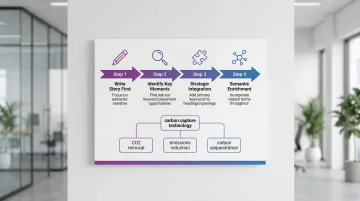
The order of operations matters here. Write the story first, focusing on what your reader actually needs to understand, then identify where your primary keywords belong naturally in the headings and opening paragraphs. Climate tech content often has an advantage with semantic coverage because technical terminology already creates rich keyword variation: if you're writing about carbon capture, you'll naturally include terms like CO2 removal, emissions reduction, carbon sequestration, and climate mitigation without forcing them. The problem arises when the storytelling is stripped out in an attempt to optimize, leaving copy that reads like a keyword brief rather than an explanation anyone would voluntarily read.
UX design principles that boost SEO performance
Page speed and Core Web Vitals
Google has formalized UX standards through Core Web Vitals, which are confirmed ranking signals measuring real-world user experience.
To be considered "Good," pages must meet these thresholds:
| Metric | What it measures | "Good" threshold |
|---|---|---|
| LCP (Largest Contentful Paint) | Loading performance | 2.5 seconds or less |
| INP (Interaction to Next Paint) | Responsiveness to interactions | 200 milliseconds or less |
| CLS (Cumulative Layout Shift) | Visual stability | 0.1 or less |
Meeting these thresholds isn't a nice-to-have. Google treats good Core Web Vitals as a prerequisite for search success, and the stakes are higher for climate tech companies competing for technical credibility with every touchpoint.
Mobile-first design and responsive experiences
Google uses mobile-first indexing, meaning the mobile version of your content determines your rankings. Mobile UX is now the primary ranking factor, not a secondary consideration.
Best practices include touch-friendly navigation with adequately sized tap targets, readable text without zooming (minimum 16px font size), optimized images that load quickly on cellular connections, and simplified forms that minimize typing on small screens.
Information architecture and site structure
Logical, hierarchical site structures serve two purposes at once: they help users navigate to what they need and help search engines understand how your content is organized and related.
The old "3-click rule" suggesting users will leave if they can't find information in 3 clicks is actually not supported by research. What matters is clear information scent: users should always feel oriented, understanding where they are and what options exist for moving forward.
Visual hierarchy and content formatting
Proper use of headings (H1, H2, H3), white space, bullet points, and visual breaks improves both readability and SEO. Visual hierarchy guides users through content while providing clear semantic structure for search engines.
Strategic formatting makes content scannable, so users can extract key information in under 30 seconds, which reduces bounce rates and improves the engagement signals that search engines monitor.
Accessibility as a UX and SEO advantage
An estimated 1.3 billion people (16% of the global population) experience significant disability. Beyond visual formatting, accessibility features expand your potential audience while strengthening SEO:
- Alt text for images helps screen readers and provides context for image search
- Proper heading structure aids navigation and semantic understanding
- Keyboard navigation ensures usability without a mouse
- Color contrast improves readability for all users
Internal linking and user journey design
Strategic internal linking improves both user navigation and search engine crawlability while distributing page authority throughout your site. Create contextual, value-adding links that support the user's learning journey rather than generic "click here" links.
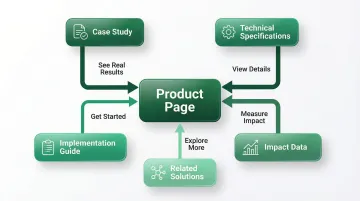
When designing for climate tech companies, linking from product features to case studies or emissions impact data creates natural user journeys while strengthening site architecture. This approach helps visitors understand complex technologies while improving how search engines crawl and index related content.
Creating story-driven content structures
The Hero's Journey framework for digital content
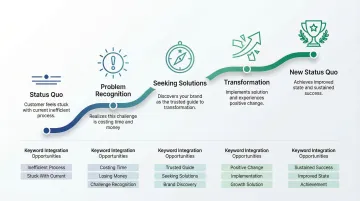
Adapt the classic Hero's Journey for web content by structuring information around transformation:
- Status quo — Establishes the current situation and challenges users face
- Problem recognition — Helps users understand the full scope of their issue
- Seeking solutions — Presents your approach as the guide helping them transform
- Transformation — Demonstrates the change your solution enables
- New status quo — Shows the improved state after implementing your solution
This framework naturally creates multiple content sections and engagement opportunities, and keywords integrate throughout the narrative arc without feeling forced.
Using case studies and customer stories
Real user stories do two things simultaneously: they give you compelling narrative material and generate long-tail keyword coverage that generic content can't replicate. Because case studies are grounded in specific projects, technologies, and outcomes, competitors can't copy them, which compounds their value as SEO assets over time.
Consider this example: when a climate tech company shares how a utility reduced grid instability by 30% using their energy storage solution, that story naturally includes industry-specific terms, captures location-based keywords, and surfaces use-case variations that attract highly qualified traffic.
Crafting compelling headlines and meta descriptions
Create headlines that incorporate keywords while promising clear value or creating genuine curiosity. Write meta descriptions as micro-stories: hook the reader, communicate the benefit, and include a call-to-action within 155 characters.
Example: "How one manufacturer cut emissions 40% in 6 months — discover the 3-step framework that transformed their sustainability program without disrupting production."
Measuring success: metrics that matter
Tracking the right metrics helps you understand what's working and where optimization efforts should be focused. The three categories below work together: SEO metrics tell you whether people can find you, UX metrics tell you what happens once they arrive, and storytelling engagement indicators tell you whether your content is doing its job.
SEO metrics to track
Monitor these foundational indicators to gauge search visibility: organic traffic (visitors from search engines, indicating overall SEO effectiveness), keyword rankings (your visibility for target search terms across search results), organic CTR (how compelling your titles and meta descriptions appear to searchers), backlinks (trust signals that search engines use to determine relevance and authority), and Domain Authority (Moz's comparative metric for benchmarking against competitors).
UX metrics to monitor
These behavioral signals reveal how users interact with your site: bounce rate (percentage of single-page sessions with no interaction), time on page (whether content engages users long enough to be valuable), pages per session (whether users explore beyond their entry point), task completion rates (whether users accomplish their intended goals), and Core Web Vitals (Google's technical performance scores measuring loading speed, interactivity, and visual stability).
Storytelling engagement indicators
Track these metrics to measure narrative impact: scroll depth (how far users read through your narrative content), social shares (whether stories resonate enough to prompt sharing), return visitors (whether content creates lasting impressions that bring people back), conversion rates from story-driven pages (whether narratives successfully drive action), and video plays and interactive element engagement (active participation with narrative experiences).
Common pitfalls to avoid
Over-optimizing at the expense of readability
Keyword stuffing is against Google's spam policies and degrades the reading experience for the people you're actually trying to reach. When you're faced with a choice between a minor SEO gain and a sentence that reads naturally, prioritize the human reader. Search engines have gotten increasingly good at recognizing content written for people rather than for bots, and the gap between keyword-stuffed pages and genuinely useful content continues to widen.
Creating beautiful designs that don't perform
Aesthetics matter, but not at the cost of performance. Google's ranking systems reward content that provides a good page experience, meaning even highly relevant content can underperform when the technical experience falls short.
Performance issues to watch for include slow load times that increase bounce rates, heavy animations that delay interactivity, mobile designs that don't scale properly, and excessive visual elements that distract from content.
Test performance throughout the design process, not just at launch.
Telling stories that don't align with search intent
Research search intent before deciding how deep to go with narrative. Someone searching "carbon accounting software pricing" needs specific cost information, not a founding story. Someone searching "how does direct air capture work" is in research mode and will engage with a more detailed explanation.
Climate tech companies often get this backwards, leading with mission and story on pages that target high-intent commercial queries, and providing sparse technical detail on pages that could be capturing early-stage researchers. Matching narrative depth to what users are actually looking for is one of the higher-leverage adjustments you can make to an existing content strategy.
Putting it together for climate tech websites
The integrated approach described throughout this article isn't theoretical. Climate tech companies that get this right, where their content ranks, reads clearly to non-technical audiences, and guides visitors toward a logical next step, consistently see better performance across the metrics that matter: lower bounce rates, longer session times, and conversion paths that actually work.
If your website hasn't evolved to reflect where your company is now, it's worth examining whether your content strategy, storytelling, and site experience are working together or pulling in different directions. At What if Design, we work with Seed to Series B climate and deep-tech startups to build websites that translate technical depth into clear positioning and convert the right visitors into meaningful conversations.
Frequently asked questions
How does storytelling improve SEO rankings?
Storytelling keeps users engaged longer, reducing bounce rates and increasing dwell time. Compelling narratives naturally incorporate keywords and semantic variations while earning more backlinks and social shares, all of which are key ranking signals.
What UX elements have the biggest impact on SEO?
Page speed (Core Web Vitals), mobile responsiveness, clear site structure, accessibility features, and strategic internal linking have the most direct influence. These elements improve both user experience and provide clear ranking signals to search engines.
How do you balance keyword optimization with natural storytelling?
Write the story first, focusing on value and natural flow. Then place primary keywords in headings and opening paragraphs, using semantic variations throughout rather than forcing exact matches. The goal is content that reads well for a human and covers a topic comprehensively enough that search engines understand what it's about.
What tools can help measure both UX and SEO performance?
Google Analytics and Search Console track organic traffic and keyword rankings. Hotjar or Microsoft Clarity analyze user behavior through heatmaps and session recordings. PageSpeed Insights measures Core Web Vitals for technical performance.
How long does it take to see results from an integrated approach?
UX improvements show immediate impact on user behavior metrics like bounce rate and time on page. SEO results typically take 3 to 6 months as search engines re-crawl and re-evaluate content based on new signals. Storytelling benefits appear gradually as brand recognition builds and content earns backlinks organically.
Can good UX compensate for weak SEO, or vice versa?
Neither can fully compensate for the other. Excellent UX without SEO means potential customers simply won't find you. Strong SEO without good UX drives traffic that leaves immediately, which eventually signals to search engines that your content isn't satisfying user intent. Sustained performance requires both disciplines working from the same strategy.