The renewable energy marketing challenge
Your technology works. Your pilot data is solid. But if you're a solar developer, battery storage company, or clean energy platform competing for enterprise contracts or investor attention, your marketing is probably doing less than it should.
The issue isn't that your product needs more features. It's that the way you're communicating it — to buyers, to partners, to investors — often lags behind the technical progress you've made. In a sector where buying decisions involve complex technology, significant capital, and 6 to 24 month sales cycles, that gap has real consequences: slower pipeline, harder closes, and competitive pressure from better-presented peers working with similar technologies.
This guide covers eight strategies renewable energy companies use to close that gap. From building a mission-grounded brand narrative to measuring what actually connects marketing activity to pipeline, each section addresses a specific, common failure point — and how to correct it.
TLDR: Eight strategies at a glance
These eight rules aren't all equally urgent at every growth stage. If you're pre-Series A, start with Rules 1, 2, and 6 — these build the brand foundation that makes every other investment work harder. At Series A and beyond, Rules 5, 7, and 8 compound the returns from that foundation. Rules 3 and 4 apply throughout: greenwashing exposure and educational content gaps cost you deals at any stage.
- Rule 1: Connect your technology to climate impact through mission-driven brand storytelling.
- Rule 2: Segment B2B and B2C audiences — they need different messaging and sales tactics.
- Rule 3: Use data-backed claims and third-party certifications to avoid greenwashing.
- Rule 4: Demystify complex renewable technologies with educational content.
- Rule 5: Focus on high-ROI channels — email ($44:1 ROI), LinkedIn for B2B, and SEO for leads — and treat brand and web infrastructure as the conversion multiplier across all of them.
- Rule 6: Build a visual identity that communicates both technical credibility and trustworthiness.
- Rule 7: Measure what connects marketing activity to pipeline, not just traffic and vanity metrics.
- Rule 8: Use strategic partnerships with utilities, associations, and financing organizations to extend reach without proportional spend.
Rule 1: Define your mission-driven brand story
Renewable energy marketing that leads with product specifications alone misses the trust-building work that actually moves buyers through a long sales cycle. Technical founders default to specs because that's where their confidence lives — but your buyer's decision process involves multiple stakeholders, internal champions, and approval layers that none of your specifications address directly.
The most successful renewable energy brands articulate a clear answer to two questions: what problem does your company exist to solve, and why is your specific approach the right one? This clarity gives both the technical evaluator who needs ROI justification and the organizational champion who needs to build internal alignment something concrete to carry forward.
The Ørsted transformation
Ørsted's journey from fossil fuels to renewable leader provides a useful example of mission-driven repositioning. In 2006, the company was one of Europe's most coal-intensive utilities, responsible for one-third of Denmark's carbon emissions.
By 2025, Ørsted achieved 99% renewable energy generation and reduced Scope 1-2 emissions by 98%, completing its transformation 21 years ahead of schedule.
This wasn't only an operational shift. It was a complete brand repositioning built on authentic commitment: the company divested its entire oil and gas business, rebranded from DONG Energy to Ørsted, and became the global leader in offshore wind with 10.2 GW installed capacity. The brand change followed the strategic change — not the other way around.
Building your brand narrative
Your mission-driven story should connect:
- Company origins to your specific market problem
- Technical capabilities to tangible, verifiable outcomes
- Customer benefits to the operational or financial goals your buyers actually report against
- Brand identity consistently across all touchpoints: messaging, visual design, and customer interactions
Building this narrative means auditing every external touchpoint — your website copy, your pitch deck, your LinkedIn presence, your sales one-pager — to check whether your stated positioning and your actual market differentiation are telling the same story. When they diverge, prospects notice, even if they can't articulate exactly why.
Rule 2: Understand and segment your target audiences
Renewable energy companies struggle when they treat all customers the same — yet their audiences span residential homeowners, commercial firms, utilities, governments, and nonprofits.
Each segment requires fundamentally different messaging, sales approaches, and value propositions.
B2B vs. B2C: critical differences
| Feature | B2B (commercial, utility, government) | B2C (residential) |
|---|---|---|
| Sales cycle | Long (6-12+ months) with complex procurement | Short to medium, often seasonal or incentive-driven |
| Decision makers | Multiple stakeholders: procurement, CFO, operations, sustainability officers | Homeowners and their partners |
| Key motivators | ROI, LCOE, risk mitigation, ESG mandates, grid reliability | Monthly savings, energy independence, environmental impact, home value |
| Relationship type | Long-term partnerships built on trust and reliability | Transaction-focused with loyalty opportunities |
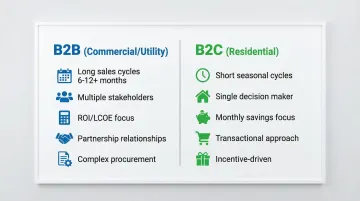
Understanding these differences is just the first step. Effective segmentation requires deeper research.
Audience research strategies
Build detailed customer profiles by examining:
- Demographics and firmographics: company size, industry sector, income levels, property ownership
- Pain points: rising energy costs, grid reliability concerns, or ESG reporting requirements
- Budget constraints: tax credits, PPAs, leases, and other financing mechanisms
- Decision-making processes: influencers, approvers, and their key evaluation criteria
Use databases like DSIRE to identify prospects eligible for specific incentives, and use NREL and SEIA research to understand demographic trends in renewable adoption.
For B2B audiences, create detailed stakeholder maps. Engineers need technical specifications, while CFOs need financial models and ROI projections — addressing both increases your close rate.
Rule 3: Avoid greenwashing at all costs
In renewable energy marketing, greenwashing poses particular dangers. Trust and authenticity are your most valuable assets, and false environmental claims destroy both — and in a sector that has already absorbed years of overpromising, buyers arrive skeptical by default.
The rising stakes
The FTC penalized Kohl's and Walmart a combined $5.5 million for falsely marketing rayon products as "bamboo" with unsubstantiated eco-friendly claims. If a large retailer with a dedicated legal team faces this exposure, a climate tech startup with bold emissions claims and limited third-party verification faces it too.
The stakes in clean energy are higher because enterprise and institutional buyers now explicitly verify environmental claims during procurement. A corporate sustainability officer reviewing your proposal will ask whether your impact numbers are audited. An enterprise procurement team will ask about your supply chain emissions. If your marketing makes claims your documentation can't support, you don't just risk regulatory scrutiny — you lose the deal.
Beyond individual sales cycles, greenwashing erodes trust across the entire sector, creating market-wide skepticism that makes every legitimate company's job harder.
Actionable guidance to stay authentic
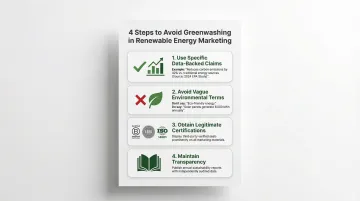
Use specific, verifiable claims backed by data:
- ❌ "Our solution is eco-friendly and sustainable"
- ✅ "Our solar installation reduced customer emissions by 4.2 metric tons CO₂ annually, verified by third-party audit"
Avoid vague environmental terms:
- ❌ "Green energy," "clean power," "sustainable solution" (without qualification)
- ✅ "100% solar-generated electricity with RECs retired annually"
Obtain legitimate certifications:
- B Corp certification
- LEED certification for facilities
- ISO 14001 environmental management
- Energy Star ratings where applicable
Transparency builds credibility. Don't hide your limitations:
- Where does your supply chain still produce emissions?
- What percentage of operations run on renewable energy?
- What's your roadmap for closing the gaps?
The FTC Green Guides set the standard for environmental marketing claims. Following them protects your reputation and maintains customer trust in an increasingly scrutinized industry.
Rule 4: Build educational content that demystifies technology
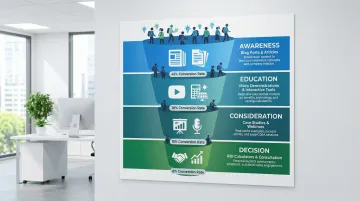
Content marketing is essential for renewable energy companies because your buyers often arrive without a working vocabulary for what you sell. Grid-scale battery chemistry, LCOE calculations, PPA structures, and demand response economics aren't common knowledge outside the sector. That knowledge gap creates friction at every stage of the sales process, from initial discovery through final approval.
Why education drives conversion
B2B buyers evaluating renewable energy technology frequently need foundational understanding before they can even frame the right questions for their internal approval process. Companies that publish consistent educational content — not marketing copy dressed up as education, but genuinely useful explanations — shorten the sales cycle by doing preliminary qualification work before a sales conversation begins.
SunPower achieved a 30% increase in lead capture rates through educational webinars and targeted content, while Tesla's educational social media campaigns drove a 23% increase in online inquiries. Both outcomes reflect the same principle: buyers who understand the technology before the first call convert at higher rates.
Effective content formats
Start with foundational content that addresses common questions and misconceptions:
Blog posts and articles:
- How net metering works and why it matters
- Solar ROI calculations for different regions
- Comparing battery storage technologies
- Understanding power purchase agreements
Case studies:
- Real-world energy savings with specific data
- Installation timelines and challenges overcome
- Financial performance over time
- Customer testimonials with measurable outcomes
Layer in visual and interactive formats to engage different learning styles:
Video demonstrations:
- Installation processes from start to finish
- Technology explainers using visual analogies
- Customer interviews and facility tours
- Maintenance and troubleshooting guides
Interactive tools:
- ROI calculators customized by region
- Energy savings estimators
- System sizing tools
- Financing comparison calculators
For deeper engagement with qualified prospects, use live formats:
Webinars and workshops:
- Technology deep-dives for technical audiences
- Financial modeling for decision-makers
- Regulatory updates and incentive changes
- Q&A sessions with experts
Simplification without oversimplification
The goal is making content accessible without stripping out the technical credibility that earns buyer trust.
Useful techniques:
- Analogies that relate complex concepts to familiar experiences
- Visuals and diagrams that clarify rather than decorate
- Plain language while maintaining technical accuracy
Address both the "how it works" and "why it matters for your operations" for every concept. Don't just explain photovoltaic cells — explain how they translate to lower monthly bills and reduced grid exposure.
If you're building content and visual systems to explain complex technology to non-technical buyers, we work with Seed to Series B climate companies on the brand and design infrastructure that makes educational content credible and effective.
Rule 5: Use digital channels where they actually convert
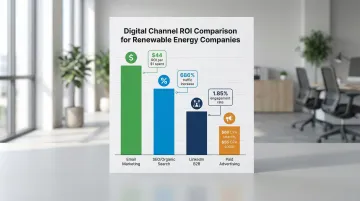
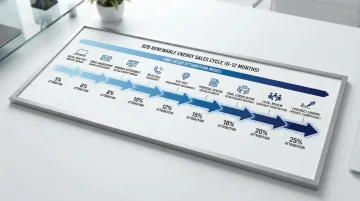
For a Seed or Series A climate company with a lean marketing budget, spreading spend across every available channel produces weak results everywhere. The real challenge is identifying which channels actually support your sales cycle — which, in most renewable energy B2B contexts, runs 6 to 18 months and requires multiple stakeholder touches before a contract is signed.
| Channel | ROI / performance benchmark | Best for | Time to results |
|---|---|---|---|
| Email marketing | $44 per $1 spent | Lead nurturing, long sales cycles | Immediate |
| Organic SEO | 686% traffic increase (case study) | Long-term lead generation | 3–6 months |
| LinkedIn (B2B) | 1.85% engagement rate | Thought leadership, B2B outreach | 1–3 months |
| PPC (search) | $68 avg. cost per acquisition | High-intent leads | Immediate |
| Brand and web design | Foundation multiplier | Converting traffic from all channels | One-time investment |
SEO and content optimization
Organic search visibility drives long-term lead generation without ongoing ad spend. One UK solar company achieved a 686% increase in organic traffic through targeted SEO, demonstrating its superior long-term value over paid channels for companies with extended sales cycles.
Focus on these high-value keyword categories:
- Industry-specific terms: "solar energy for warehouses," "commercial EV charging solutions"
- Location-based searches: "solar installers [city name]," "renewable energy [region]"
- Question-based queries: "how much do solar panels cost," "is wind energy reliable"
Optimization priorities:
- Website content and metadata
- Blog posts addressing common questions
- Local SEO for geographically-focused companies (Google Business Profile, local citations)
- Technical SEO (site speed, mobile responsiveness, Core Web Vitals)
Social media marketing
Platform selection depends entirely on your audience. LinkedIn delivers 1.85% engagement rates, the highest among social platforms for energy companies, making it the primary channel for B2B outreach.
Facebook and Instagram work better for residential customers, though organic reach is limited (Facebook averages just 0.12% engagement).
LinkedIn (B2B focus):
- Thought leadership articles on industry trends
- Regulatory updates and policy analysis
- Technology innovation announcements
- Company milestones and project completions
Facebook/Instagram (B2C focus):
- Customer success stories with visual before/after
- Behind-the-scenes installation content
- Educational posts on energy savings
- Paid ads targeting homeowners in high-electricity-cost areas
Email marketing
Email delivers $44 for every $1 spent, the highest ROI of any digital channel. It's particularly effective for nurturing leads through long sales cycles and maintaining customer relationships.
Segmentation strategies:
- Customer type: residential vs. commercial
- Lifecycle stage: awareness, consideration, decision, post-purchase
- Engagement level: active prospects vs. dormant leads
Content types:
- Monthly newsletters with energy tips and industry news
- Product updates and new service announcements
- Case studies and customer success stories
- Webinar invitations with clear value propositions
- Seasonal promotions tied to incentive deadlines
Paid advertising (PPC)
Paid search and display ads deliver faster results than organic strategies and allow precise targeting.
Average cost per acquisition is $68 for search ads and $55 for social ads in the energy sector.
Best practices:
- Start with modest budgets and scale based on performance data
- Track conversions carefully through the entire funnel
- Test ad copy and landing pages continuously
- Focus on high-intent keywords where prospects are ready to buy
- Use retargeting to re-engage website visitors who didn't convert
Brand and web infrastructure: the channel multiplier
There's one investment category that rarely appears in digital channel comparisons but affects the ROI of all of them: your brand and web infrastructure. Every channel above sends prospects to your website. If that destination doesn't convert — if the design looks underfunded, the messaging is generic, or the technology is unexplained — every dollar spent on SEO, PPC, and email underperforms.
For Seed to Series B climate companies, a professional visual identity and conversion-optimized web presence often delivers higher ROI than early paid advertising, because it compounds the effectiveness of every other channel. In a B2B sales cycle where a prospect might encounter your brand six to eight times before agreeing to a call, consistent and credible presentation across every touchpoint determines whether you make the shortlist.
Rule 6: Create compelling visual storytelling
In renewable energy, you're often selling something buyers can't see or touch — electrons moving through a grid, carbon credits representing avoided emissions, or software modeling energy flows across an interconnected system. Visual design does the translation work that data alone can't accomplish.
The power of visual communication
Effective visual storytelling includes:
- Infographics that simplify energy production trends, emissions reductions, and cost comparisons
- Video demonstrations of installations, system operations, and maintenance processes
- Photography that shows real impact: families using solar power, installation teams at work, communities powered by clean energy
- Data visualizations like real-time dashboards, savings calculators, and impact counters
Building visual credibility in a competitive market
These visual formats matter more when you're competing against established energy players with marketing budgets an order of magnitude larger than yours. Climate tech companies need cohesive visual identities that communicate both technical credibility and organizational trustworthiness, from brand to website to product interface.
Key elements of effective visual identity:
- Consistent brand systems across all customer touchpoints
- Website design that explains complex technology without requiring a glossary
- Product interfaces that make data actionable
- Visual guidelines that scale as the company grows
For climate tech companies that need to move fast — ahead of a funding announcement, a major conference, or a first enterprise pitch — a design partner with domain familiarity shortens the ramp time considerably. We work specifically with Seed to Series B climate and deep-tech startups, which means less time spent explaining the technology and more time building the brand infrastructure that supports growth.
Rule 7: Measure, analyze, and optimize continuously
Without a measurement framework, marketing decisions at a climate tech company become guesswork — especially with 6 to 12 month sales cycles where you won't see deal outcomes for months after a prospect first encounters your brand. The gap between marketing activity and closed revenue is long enough that many teams stop connecting the two. That's when spend drifts toward whatever feels active rather than what's actually working.
Focus on metrics that directly connect marketing activities to business outcomes.
Key metrics to track
Website performance:
- Traffic volume and sources
- Bounce rate and time on page (energy sector average: 2 minutes 45 seconds)
- Conversion rates by page and traffic source (median: 2.9%, top performers: 6.5%)
Lead generation:
- Lead volume by channel
- Lead quality scores
- Cost per lead (residential solar benchmark: $173)
- Lead-to-opportunity conversion rate
Sales metrics:
- Opportunity-to-close rate
- Sales cycle length
- Customer acquisition cost (residential solar: approximately $0.85/watt or $5,270 for a typical 6.2 kW system)
- Customer lifetime value
Channel performance:
- Email open rates, click rates, and conversion rates
- Social media engagement and follower growth
- PPC click-through rates and cost per acquisition
- Organic search rankings and traffic
ROI by channel:
- Revenue attributed to each marketing channel
- Return on ad spend (ROAS)
- Overall marketing ROI
Essential tools
- Google Analytics: track website traffic, user behavior, and conversions
- CRM systems like Salesforce or HubSpot: manage leads, pipeline, and sales attribution
- Marketing automation platforms: monitor email performance, campaigns, and lead scoring
- Social media analytics: use platform insights or tools like Hootsuite and Sprout Social
- SEO tools like SEMrush or Ahrefs: track keyword rankings, backlinks, and competitors
Multi-touch attribution for long sales cycles
B2B renewable energy sales cycles often span 6 to 12+ months with dozens of touchpoints. Moving beyond last-touch attribution models — which only credit the final interaction — gives you a more accurate picture of which channels actually drive pipeline.
Time-decay models (crediting recent touches more heavily) or position-based models (crediting first and last touches 40% each) better reflect the full customer journey. Integrating offline interactions (trade shows, sales calls, site visits) into your CRM captures the complete attribution picture.
Rule 8: Build strategic partnerships to amplify reach
No single company can address every customer need or market segment alone. Strategic partnerships give renewable energy companies credibility signals, expanded market access, and resource-sharing in a capital-intensive industry where all three are scarce at the early stage.
Partnership types and opportunities
Industry associations and trade groups:
- SEIA (Solar Energy Industries Association)
- AWEA (American Wind Energy Association)
- Regional clean energy organizations
- Benefits: credibility, networking, policy advocacy, shared marketing initiatives
Complementary technology providers:
- EV companies partnering with charging infrastructure providers
- Solar installers partnering with battery storage manufacturers
- Energy management software partnering with hardware providers
- Benefits: bundled solutions, cross-selling opportunities, expanded capabilities
Utilities and program administrators:
- Rebate and incentive programs
- Demand response partnerships
- Community solar programs
- Benefits: customer access, financial incentives, regulatory alignment
Financing organizations:
- Banks and credit unions
- Green lending programs
- PACE (Property Assessed Clean Energy) administrators
- Benefits: makes solutions affordable and removes purchase barriers
Community groups and nonprofits:
- Environmental organizations
- Community development corporations
- Faith-based groups
- Benefits: grassroots credibility, access to underserved markets, mission alignment
Once you identify the right partners, the next step is activating those relationships strategically.
Effective partnership approaches
Co-branded campaigns combine your marketing efforts:
- Joint marketing materials highlighting complementary solutions
- Shared case studies demonstrating integrated value
- Co-sponsored content (webinars, whitepapers, research reports)
Cross-promotion uses each partner's audience:
- Email list sharing (with permission)
- Social media mentions and content sharing
- Website referrals and backlinks
- Joint booth presence at trade shows
Collaborative pilot projects build credibility through action:
- Demonstration installations showcasing integrated solutions
- Research partnerships testing new technologies
- Community projects building local credibility
The most successful partnerships create genuine value for customers rather than just marketing convenience. Focus on relationships where the combined offering is meaningfully better than what either partner could deliver independently.
Building marketing that works at your stage
Renewable energy companies that grow consistently don't rely on isolated tactics. They build a clear brand foundation first — one that defines what they do, for whom, and what makes their approach credible — and then deploy digital channels, content, and partnerships on top of that foundation.
If your current website, messaging, or campaign strategy feels misaligned with where your company actually is, that gap is worth examining before your next major visibility moment. The companies that close enterprise deals, attract investors, and build market credibility faster are typically the ones that treat positioning as infrastructure, not as decoration. It's the work we do at What if Design — helping Seed to Series B climate companies build the brand foundation that makes every other investment work harder.
Frequently asked questions
What makes renewable energy marketing different from traditional energy marketing?
Renewable energy marketing balances rational concerns (ROI, performance, reliability) with the trust-building required for newer technologies that buyers haven't evaluated before. Unlike traditional energy marketing focused primarily on cost and reliability from established providers, it requires education-heavy approaches and faces heightened scrutiny around environmental claims.
How can small renewable energy companies compete with larger established players?
Focus on specific geographic areas or customer segments to build dominant local expertise. Use local SEO, specific proof points (pilot results, customer data, third-party audits), and strategic partnerships with community groups to extend reach without proportional ad spend.
What are the biggest mistakes renewable energy companies make in their marketing?
Common failure points include unverified environmental claims, jargon-heavy copy that alienates non-technical buyers, one-size-fits-all messaging across distinct B2B and B2C audiences, ignoring high-ROI digital channels like email and SEO, and failing to connect marketing activity to pipeline outcomes.
How much should a renewable energy startup budget for marketing?
Seed-stage climate tech companies typically invest 10-15% of revenue in marketing, while Series A companies allocate 7-12%. At early stages, the priority is establishing credibility infrastructure: a clear positioning foundation, a website that converts, and content that educates buyers before the first sales call. Paid advertising scales better once those foundations are in place. For climate tech specifically, professional brand identity and a conversion-focused web presence are often the highest-leverage investments at the Seed stage.
What metrics should renewable energy companies track to measure marketing success?
Track lead quality over quantity, cost per acquisition, conversion rates by channel, customer lifetime value, and revenue attributed to marketing. For B2B companies with long sales cycles, implement multi-touch attribution models that credit the entire customer journey, not just the final touchpoint.
How can renewable energy companies avoid accusations of greenwashing?
Use specific, data-backed claims with third-party verification, obtain legitimate certifications (B Corp, LEED, ISO 14001), and follow FTC Green Guides for environmental marketing. Avoid vague terms like "eco-friendly" or "green" without specific qualifications — and make sure every claim in your marketing can be supported by documentation your sales team can produce when asked.