Why sustainability branding matters more than ever
You've spent years building a carbon capture process, a hydrogen storage solution, or a grid optimization platform. The technology works. The pilot data is solid. But when you walk investors or potential partners through your website, the conversation stalls before it should.
The problem usually isn't the technology. It's that the brand is still speaking the language of the lab rather than the language of the market. Climate tech companies routinely sit on proof points that could close pilots, attract co-investors, or accelerate policy conversations, but those proof points are buried under technical specifications that only an engineering team finds compelling. The credibility gap between where your company is and how it's being perceived is a real obstacle to growth.
With only 20% of consumers believing brands accurately represent their sustainability efforts and 52% believing companies distribute misleading sustainability information, climate tech companies face a specific trust problem: how do you communicate your real environmental impact credibly, without triggering greenwashing accusations or losing the nuance of what your technology actually does?
This guide breaks down what sustainability branding means for climate tech companies specifically, what to look for in a branding consultant, and how the right brand strategy functions as infrastructure for funding, partnerships, and market adoption.
TLDR: Key takeaways
- Credible sustainability branding directly addresses the trust gap that slows partner conversations and fundraising cycles for climate tech companies
- Effective eco-branding pairs visual identity with transparent, certified messaging that makes environmental claims defensible
- Specialized consultants understand sector-specific challenges in climate tech, clean energy, and carbon capture that generalist agencies typically don't
- Climate tech companies with credible sustainability brands close pilots faster and raise capital with less re-explanation
- Products making sustainability claims grew 28% faster over five years compared to 20% for products without such claims
What is sustainability branding?
Sustainability branding, in the context of climate tech, means building a brand identity that makes your environmental claims defensible, your technology legible to non-technical audiences, and your company credible to the specific buyers, investors, and partners you're trying to reach.
Effective sustainability branding encompasses company values, operational practices, supply chain transparency, and measurable environmental impact treated as a unified system—not layered on top of existing messaging as an afterthought.
How it differs from traditional branding
Traditional branding focuses primarily on visual appeal, market positioning, and emotional connection with an audience.
Sustainability branding adds a layer of accountability that traditional branding doesn't require. Brands must demonstrate authentic environmental leadership through verifiable data and third-party validation, not directional intent or aspirational language. The bar has moved: buyers, investors, and regulators increasingly require specific, measurable environmental commitments rather than general claims about impact.
46% of consumers now purchase sustainable products specifically to reduce their environmental impact, and they expect proactive environmental leadership, not damage minimization statements.
Authentic branding vs. greenwashing
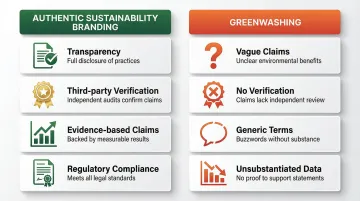
Distinguishing genuine sustainability branding from greenwashing requires meeting specific criteria. Authentic sustainability branding demands:
- Transparency: Backing all environmental claims with verifiable data
- Third-party verification: Certifications like B Corp, Climate Neutral, or organic standards
- Evidence-based claims: Specific, measurable impact statements rather than vague promises
- Regulatory compliance: Adherence to frameworks like the EU's Green Claims Directive, which prohibits unsubstantiated generic environmental claims
Enforcement intensity has increased significantly across the US, UK, and EU, with regulatory bodies scrutinizing environmental claims more closely than at any prior point. This makes working with consultants who understand compliance requirements essential for climate tech companies, particularly those making claims around carbon reduction, net zero, or lifecycle impact.
The role of sustainability branding consultants
Strategic brand development
Most climate tech companies arrive at a branding engagement with a fundamental positioning problem: the messaging was written by engineers, for engineers. That makes sense at the research stage, but it creates friction the moment you need to explain your technology to a procurement manager, a Series A investor, or a utility executive who has fielded a dozen similar pitches this quarter.
What's typically missing isn't more technical detail. It's a clear articulation of what changes for the buyer when they work with you, framed in their operational language rather than yours.
A brand audit in this context isn't about visual preferences. It's about identifying where your current messaging breaks down for each audience, which claims aren't supported by verifiable data, and where the gap between your internal operations and external communications creates risk. Sustainability branding consultants structure this process by evaluating existing brand messaging against regulatory requirements, identifying opportunities for differentiation in competitive sustainability markets, creating alignment between internal operations and external communications, and establishing measurable KPIs for brand performance and environmental impact.
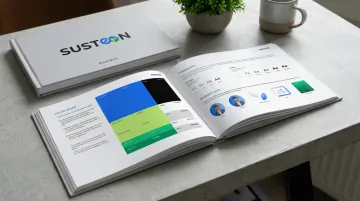
Visual identity creation
Once strategy is established, consultants create eco-conscious visual systems that communicate environmental values through:
- Color palettes: Nature-inspired greens, blues, and earth tones that signal growth, clean resources, and organic processes
- Typography: Clean sans-serif fonts conveying modernity and efficiency, optimized to reduce print resource consumption
- Imagery: Organic shapes, botanical illustrations, natural textures, and environmental photography
These visual systems extend to comprehensive brand guidelines ensuring consistency across all touchpoints: websites, product packaging, marketing materials, investor presentations, and trade show collateral.
Research shows that green and white packaging dominates organic sectors and builds trust among non-organic buyers, making color psychology a meaningful tool when applied with strategic intent rather than as default aesthetic shorthand.
Messaging and storytelling
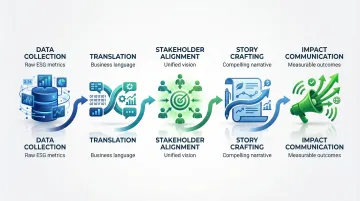
The common mistake in climate tech messaging is leading with how the technology works rather than what it changes for the people you're trying to reach. A carbon capture company's pitch to a corporate buyer needs to address their Scope 3 reporting obligations, not the geochemistry of the sequestration process. The same technology, described differently, reads as either a procurement decision or a research curiosity.
Effective sustainability messaging for climate tech companies:
- Leads with business impact for each specific audience rather than technical specifications
- Uses specific, actionable language instead of generic terms like "eco-friendly" or "sustainable"
- Provides comparative context for environmental claims with verifiable data
- Addresses what each stakeholder group actually needs: investors need market readiness and competitive positioning; enterprise buyers need operational ROI and integration clarity; policy partners need regulatory alignment
- Balances aspiration with realistic timelines and transparent acknowledgment of where the technology currently stands
Translating technical complexity into audience-specific narratives requires understanding both the science and the buyer's decision-making context, which is why generalist agencies rarely get this right without significant onboarding time.
Key elements of effective sustainability branding
Authentic visual identity
Color psychology: Strategic use of eco-symbolic colors reinforces sustainability messaging at a subconscious level. Green signals growth and environmental consciousness, blue conveys clean water and air quality, and earth tones communicate natural materials and organic processes.
Consultants must balance these associations with brand differentiation. Not every climate tech company should default to green. A carbon capture company and a grid analytics platform serve different buyers with different visual expectations, and a templated green-and-white palette can actually undermine credibility if it reads as generic sustainability signaling rather than specific sector expertise.
Typography choices: Modern sans-serif fonts project efficiency and forward-thinking innovation, which matters particularly for climate tech companies competing against legacy incumbents. Some consultants also consider print-efficient fonts that reduce ink usage in physical materials, which aligns brand production practices with stated environmental values.
Nature-inspired design elements
Nature-inspired design elements create immediate visual associations with environmental values when applied with specificity rather than as decoration. They work particularly well for companies where the connection is direct and technically grounded:
- Clean energy companies, where wind turbine silhouettes or solar panel patterns reflect the actual product
- Carbon capture technologies, where atmospheric and geological imagery maps to the physical process
- Sustainable materials companies, where textile textures or recycled content patterns make the material innovation visible
- Electric vehicle brands, where clean lines signal efficiency and reduced emissions without overstating
The distinction between effective visual identity and decorative greenwashing comes down to whether the imagery reflects actual environmental practices. Visual choices need to hold up to scrutiny from technically informed audiences.
Sustainable production practices
Effective sustainability branding needs to extend to how physical brand assets are actually produced. The gap between claiming environmental leadership and printing marketing materials with standard inks on virgin paper is the kind of inconsistency that surfaces quickly when buyers or journalists investigate. This means using eco-friendly materials—recycled paper, soy-based inks, biodegradable packaging—where physical collateral is required, and defaulting to digital-first approaches (presentations, web-based reports, electronic marketing materials) to reduce environmental footprint. Supply chain transparency matters too: working with printers and manufacturers whose own practices can be verified. And full lifecycle thinking—designing for longevity and eventual recycling rather than single-use applications—should shape every production decision.
Transparent communication
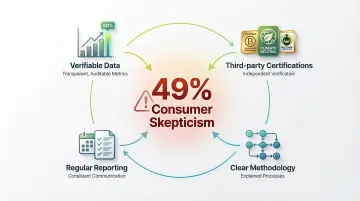
Transparency is where climate tech companies most consistently lose credibility. High-quality eco-labeling information, characterized by clarity and credibility, positively influences sustainable purchase intentions. The inverse is also true: vague or unverifiable claims are increasingly flagged by buyers, journalists, and regulators.
Brands must demonstrate transparency through:
- Verifiable data backing all environmental claims
- Third-party certifications: B Corp, Climate Neutral, LEED, or organic standards relevant to the sector
- Clear methodology explanations for carbon calculations and impact metrics
- Honest acknowledgment of where the technology is in its development and what claims can be made at the current stage
- Regular sustainability reporting with year-over-year comparisons that show progress rather than static snapshots
Companies that operate with this level of transparency don't just protect themselves from greenwashing accusations. They build the signal clarity that makes investor and partner conversations shorter and more productive.
How to choose the right sustainability branding consultant
Evaluate sector expertise: Look for consultants with proven experience in your specific industry. Climate tech, renewable energy, carbon capture, and sustainable materials each carry unique technical nuances, regulatory contexts, and audience expectations that take significant time to develop from scratch.
Review their portfolio for projects in your sector. A consultant who has worked with similar companies will understand investor expectations, procurement requirements, and the specific objections your buyers typically raise, without needing three weeks of onboarding.
Assess their own sustainability credentials: The best sustainability consultants operate according to the same standards they advise. Check for certifications like Design Declares or B Corp status, evidence of carbon-neutral operations, and whether their own business practices can survive the same scrutiny they're helping clients apply to their claims.
Review portfolio and case studies: Examine past work for strategic depth and measurable business outcomes, not just visual quality. Request examples from organizations at a similar funding stage and ask specific questions about results: Did the brand work help secure a funding round? Accelerate partnership inquiries? Support a product launch or conference moment?
Once you've assessed their track record, consider the practical fit. Determine whether you need full-service capabilities covering brand strategy, visual identity, web design, and pitch materials, or a more focused engagement. For seed-stage companies with a hard deadline around a conference, a fundraise, or a product announcement, turnaround speed matters as much as strategic depth.
Evaluate cost structure: Compare pricing models and understand the value relative to your stage. Global branding agency rates average $88/hour, with US agencies charging $116/hour and Western European agencies averaging $100/hour.
Common pricing structures include:
- Project-based fees for comprehensive brand identity work ($10,000 to $100,000 or more, depending on scope)
- Monthly retainers for ongoing creative support and continuous brand development
- Hourly rates for smaller engagements or specialized consulting
Specialized sustainability consultants may cost more than generalists, but the domain familiarity typically means less onboarding time, fewer rounds of correction on technical content, and faster delivery.
What if Design, for example, holds Design Declares certification and works exclusively with climate tech and deep-tech companies at seed to Series B stages. The team typically reaches a full brand identity in two to four weeks, significantly faster than the industry standard of eight to sixteen weeks, because there's no ramp-up time needed to understand the regulatory context, the buyer landscape, or the technical claims being made. Susteon's COO noted that the engagement "forced us to reflect and rethink our corporate strategy" and "brought the company messaging to the forefront," reflecting how strategic brand development functions differently from aesthetic design work.

The business impact of strategic sustainability branding
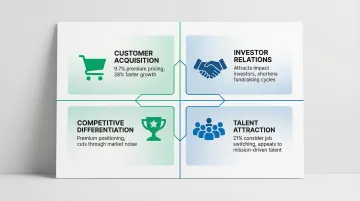
Customer acquisition and loyalty: Authentic sustainability branding affects both customer acquisition and retention in measurable ways. Consumers are willing to pay an average 9.7% premium for sustainably produced goods, and 47% actively purchase sustainable products. Products making sustainability claims achieved 28% cumulative growth over five years, compared to 20% for products without such claims. For climate tech companies, this growth differential compounds when credibility is established early.
This financial pattern extends from consumer markets into the investment community.
Investor relations and funding: Strong ESG positioning attracts impact investors and venture capital focused on climate solutions. Clear, credible sustainability branding helps climate tech companies shorten fundraising cycles by making the value proposition and environmental impact legible without extensive explanation. When investors can quickly assess your positioning, competitive differentiation, and proof points from your digital presence, the conversation shifts from orientation to evaluation.
Competitive differentiation: In competitive sustainability markets, strategic branding helps companies stand out in ways that technical specifications alone don't achieve. When 39% of global consumers rank environmental impact as extremely or very important in purchasing decisions, a credible sustainability brand becomes a market access requirement for companies where environmental performance is central to the value proposition.
Practically, this means commanding premium positioning in competitive markets without needing to justify it in every conversation, cutting through noise with environmental messaging specific enough to be credible, and building trust signals that better-capitalized competitors with generic positioning struggle to replicate.
Beyond market positioning, your brand directly affects who joins your team and stays.
Talent attraction and retention: Mission-aligned branding appeals to values-driven employees, which is particularly critical for climate tech startups competing for specialized talent against well-funded incumbents. 21% of employees have considered switching jobs to work for a more sustainable company, and 63% don't think their employers are doing enough to address climate change. A brand that accurately reflects your company's environmental commitments and operational integrity makes recruiting easier and reduces attrition among team members who joined because of the mission.
The gap between your technology's actual capability and how it's perceived by investors, buyers, and partners is a solvable problem. Companies that close pilots faster, raise with less friction, and build durable market positions are often not the ones with the most advanced technology. They're the ones whose brand does the translation work, so their team isn't re-explaining the same fundamentals from scratch in every conversation.
Frequently asked questions
What is sustainability branding?
Sustainability branding integrates environmental and social values into brand identity, visual design, and messaging. It requires verifiable impact data, transparent communication practices, and operational commitments that hold up to third-party scrutiny, not just directional language about environmental intent.
What does a sustainability branding consultant do?
Sustainability branding consultants develop strategic brand identities, create eco-conscious visual systems, craft audience-specific messaging for investors, buyers, and partners, and help companies avoid greenwashing through evidence-based claims and regulatory compliance.
How much do sustainability branding consultants charge?
Project-based fees range from $10,000 to $100,000 or more depending on scope. Hourly rates average $88 globally ($116/hour in the US), while monthly retainers provide ongoing support for continuous brand development.
How do I know if a sustainability branding consultant is authentic?
Look for consultants who hold sustainability certifications like Design Declares or B Corp status, demonstrate carbon-neutral operations, and focus primarily on sustainability and climate tech clients. Review their portfolio for evidence-based work that includes third-party certifications and transparent impact metrics rather than vague environmental language.
What certifications should I look for in sustainability branding?
Key certifications include B Corp (comprehensive social and environmental performance standards), Climate Neutral (carbon footprint measurement and offset), Design Declares (commitment to climate emergency action), and industry-specific certifications like LEED for built environment or organic standards for food and agriculture sectors.
How long does a sustainability branding project typically take?
Comprehensive brand strategy and identity development typically takes 8 to 16 weeks with most agencies. Consultants who specialize exclusively in climate tech and deep-tech companies can move significantly faster due to domain familiarity. What if Design typically delivers a full brand identity in two to four weeks for seed-to-Series B climate companies.