The distributed team brand consistency challenge
You've raised a Series A. You're operating across three markets. Your technology is genuinely differentiated. But walk into your marketing folder and you'll find five versions of the logo, two different color palettes in active use, and a pitch deck that predates your last funding round.
The issue isn't that your team doesn't care about brand consistency. It's that as climate and deep-tech companies scale quickly across distributed locations, the systems for managing brand assets rarely keep pace. What worked when you had eight people in one city breaks down the moment you have 60 people spread across four time zones, each creating materials for a different audience — investors, enterprise buyers, policy stakeholders, or channel partners.
This guide covers what marketing platforms need to manage brand guidelines effectively for distributed teams, the platform types available and their tradeoffs, and why the quality of your foundational brand work ultimately determines whether any platform delivers results.
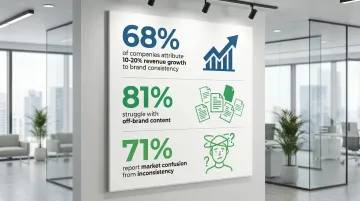
For companies in competitive sectors like climate tech, where buyers are skeptical and procurement cycles are long, every customer-facing touchpoint contributes to or erodes perceived credibility.
TLDR: Key takeaways
- Centralized brand management systems measurably reduce inconsistencies across distributed teams
- Modern platforms embed guidelines directly into workflows, removing the need to reference separate PDFs
- Companies with strong brand consistency grow significantly faster than competitors with inconsistent presentation, according to Lucidpress research
- Successful implementation requires quality foundational brand assets — technology alone cannot compensate for poorly structured guidelines
- Template systems with locked brand elements allow non-designers to create on-brand materials without design team involvement
What are brand guidelines and why they matter for distributed teams
When your marketing team spans three continents and five time zones, maintaining brand consistency becomes a daily operational challenge, not just a design aspiration. Brand guidelines are the comprehensive documentation governing your brand's visual and verbal identity.
They define how logos appear across contexts, which colors represent your brand (with specific HEX, RGB, and Pantone values), typography hierarchies, tone of voice, imagery standards, and usage rules for every application.
The distributed team challenge
Distributed teams face specific obstacles that make brand consistency harder to maintain. Time zone gaps prevent real-time collaboration and compound approval delays. Cultural differences influence how brand elements are interpreted and applied in local markets. Varying skill levels mean some team members lack the design knowledge to apply guidelines correctly — and without in-person oversight, brand violations can reach customers before anyone catches them.
The business impact of brand consistency
The operational cost of inconsistency adds up quickly. Consider what happens when distributed teams can't reliably locate current assets:
- Revenue impact: Research from Lucidpress found that consistent brand presentation correlates with meaningful revenue growth across B2B companies, with some studies citing figures as high as 33% uplift.
- Competitive position: Brands that manage consistency systematically grow faster than those that don't — the same Lucidpress data suggests a gap of 2.4 times growth rate between consistent and inconsistent brands.
- Customer trust: Edelman's Trust Barometer data consistently shows that consumer trust in brands remains fragile, and a poor brand experience accelerates attrition.
For climate tech and sustainability companies, inconsistency carries an additional layer of risk. Off-brand or contradictory messaging can read as greenwashing to buyers who are already skeptical of vendor claims in this space. Your buyers — whether utility procurement managers, enterprise sustainability leads, or institutional investors — are evaluating signal consistency as part of their due diligence.
Challenges of managing brand guidelines across distributed teams
Version control and updates
The most common failure point is distributed teams working from outdated materials, and this problem is particularly acute for climate tech companies that scale quickly after a funding round. A company that raised a Seed round and grew from 8 to 45 people in 12 months rarely has a centralized brand system in place when those new hires start creating materials.
Marketing teams in different regions unknowingly use old logo files. Product teams reference color values that changed six months ago. Sales decks feature discontinued taglines. Beyond the visual inconsistency, this creates real operational waste as teams recreate assets that already exist in updated form elsewhere, losing hours to duplication that could go toward actual campaign work.
Accessibility and findability
Even when current assets exist, your distributed team can waste hours trying to locate them. The typical search workflow involves checking multiple platforms in sequence:
- Figma for design files
- Google Drive for documents
- Slack channels for shared links
- Eventually asking a colleague who might know where the current version lives
This friction produces two predictable outcomes: you either give up and create something from scratch (likely off-brand), or you use whatever you found first (likely outdated).
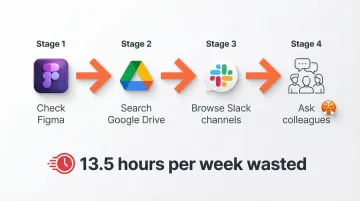
Research from Widen's State of Digital Asset Management found that teams spend an average of 13.5 hours per week on asset-related searches — roughly 34% of a typical workweek lost to finding files rather than using them.
Skill level variations
Distributed teams typically include members with very different design capabilities. A product engineer, a regional sales representative, and a content marketer may all need to create customer-facing materials, but they bring entirely different levels of visual literacy to the task.
Complex guidelines that work well for trained designers become barriers for everyone else. The consequence splits two ways: non-designers avoid creating materials altogether, pushing more work onto a design team that's already stretched; or team members do their best with what they have, producing off-brand outputs that reach customers before anyone reviews them.
Localization without fragmentation
Climate tech companies managing communications across multiple geographies face a specific tension: maintaining worldwide brand consistency while allowing local teams to adapt messaging for cultural and market relevance. For a company with enterprise customers in the US, utility clients in Europe, and government partnerships in Southeast Asia, the right tone and framing can vary considerably.
Successful brands solve this through defined flexibility — locking core elements like logos and primary colors while allowing approved variations in messaging, imagery, and secondary design elements. The challenge is building the system that enforces the lock while enabling the variation.
Approval bottlenecks
For climate tech companies managing communications to multiple stakeholder audiences — investors, enterprise buyers, policy stakeholders, and channel partners — approval bottlenecks compound because different content requires sign-off from different people. A piece aimed at a utility procurement manager reads differently from one targeting an institutional investor, and both may sit in different approval queues.
Brand guardians sitting in different time zones from content creators make this worse. A campaign created by a London team that needs sign-off from San Francisco leadership faces an automatic 8-hour delay at minimum. Under deadline pressure, teams bypass approvals entirely, and off-brand content reaches customers.
The solution isn't eliminating oversight. It's building systems that reduce the need for approval on routine, templated materials while maintaining governance over high-stakes or custom assets.
Key features marketing platforms need for brand guidelines management
Centralized brand asset libraries
Modern digital asset management (DAM) capabilities give you a centralized, definitive repository for all brand assets. When built properly, these systems provide:
- Searchable repositories with AI-powered visual search that locates assets by color, subject, or style — not just filename
- Automatic version control that archives old files while surfacing only current, approved assets to users
- Metadata tagging that makes assets discoverable by campaign, region, product line, or usage rights
- Rights management that tracks license expirations and flags assets before they're used inappropriately
Organizations using DAM systems report recovering significant time from asset searches — time that goes back to strategic and creative work rather than file hunting.
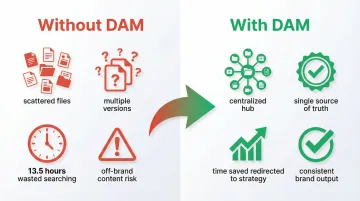
Once your team can reliably find current assets, the next challenge is ensuring they use them correctly. This is where how guidelines are delivered matters as much as what the guidelines say.
Living brand guidelines
Traditional PDF brand books create a specific kind of confusion: teams never know whether the version they have is current. A guidelines document emailed in January may have been updated twice by March, but teams working from the downloaded PDF have no way to know.
Modern platforms address this with interactive, web-based guidelines that update in real time. Instead of downloading a document and hoping it reflects the current brand, your team accesses a brand portal where guidelines link directly to downloadable assets and usage rules appear contextually alongside the assets they govern. Updates roll out immediately to all users as soon as they're published, and search functionality helps teams find specific guidance without scrolling through an 80-page document.
For example, when a sales rep downloads a logo, they immediately see the required clear space, minimum size specifications, and approved color variations — without having to cross-reference a separate document.
Access to current guidelines addresses the knowledge problem, but it doesn't solve execution. Your non-designer team members still need a way to create materials without designing from scratch.
Template systems with guardrails
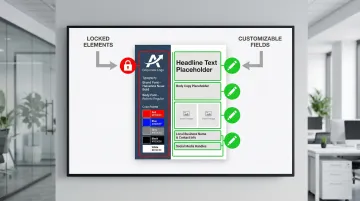
Template-based creation with locked brand elements allows non-designers to produce on-brand materials without design team involvement for every request. These systems work by separating what can be changed from what cannot. Core brand elements — logos, fonts, color schemes — are locked and cannot be altered regardless of the user's design knowledge. Editable fields like text, images, and local contact information can be customized within defined parameters. The output maintains brand standards automatically, regardless of who created it.
A regional sales representative can create a localized pitch deck without design skills or brand guardian approval. The template does the governance work so your design team doesn't have to.
Workflow integration
The platforms that actually get adopted are the ones that fit into existing workflows rather than requiring your team to learn a new system on top of everything else. Useful integrations include:
- Design tools (Figma, Adobe Creative Cloud) via plugins that pull approved assets directly into the active workspace, so designers never need to leave their environment to find brand files
- Collaboration platforms (Slack, Microsoft Teams) for approval notifications and quick sign-offs without switching to a separate tool
- Project management (Asana, Monday.com) to link assets directly to the campaigns using them
- Marketing automation (HubSpot, Marketo) so email templates automatically reference current brand standards
Embedding brand guidelines into the tools your team already uses is what separates platforms that get adopted from those that sit unused. As a secondary benefit, these integrations generate useful data about how your teams actually interact with brand assets.
Analytics and compliance tracking
Platforms with analytics give brand managers visibility they don't otherwise have:
- Usage tracking shows which assets are being used most and by whom
- Compliance monitoring flags potential brand violations before they reach an external audience
- Adoption reports surface which teams or regions are struggling with the guidelines, so you know where training is needed
- Campaign performance data connects specific assets to downstream campaign outcomes
This visibility allows brand teams to move from reactive enforcement to proactive support — identifying problems before they compound.
Types of platforms for brand guidelines management
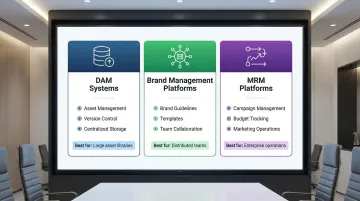
Digital asset management (DAM) systems
DAM platforms function as centralized hubs for storing, organizing, and distributing brand assets. Their strength is managing large, complex media libraries: powerful search, version control, and rights management at scale.
Widely used examples include Bynder, Brandfolder, and Frontify, each with different strengths depending on team size and asset complexity.
Best for: Enterprises with thousands of assets, complex rights management requirements, and global distribution needs where finding and managing files is the primary operational challenge.
Brand management platforms
These platforms combine DAM functionality with a more comprehensive set of team-facing features: interactive, web-based brand guidelines alongside the asset library itself, template creation tools that produce consistent outputs for non-designers, and collaboration features built specifically for distributed teams.
The result is a centralized brand portal where your team accesses both the assets and the rules governing their use in one location, without toggling between systems.
Best for: Organizations where brand consistency across distributed channels is the primary challenge, particularly those with significant variation in design skill levels across teams.
Marketing resource management (MRM) platforms
MRM solutions connect brand guidelines management to broader marketing operations, including campaign planning and execution workflows, budget management and financial tracking, resource allocation across teams and regions, and workflow automation for approval processes.
They suit organizations that need to connect brand management with financial planning — where knowing what was created, when, by whom, and at what cost matters as much as whether it was on-brand.
Best for: Large enterprises with complex marketing operations requiring integrated planning, execution, and financial accountability in a single system.
Design tool integrations
Many teams manage brand assets through plugins within tools like Figma or Canva, pulling approved files from a central library without leaving the design environment.
Pros: Reduces friction for designers, keeps approved assets within the tool they already use, and tends to drive higher adoption rates than separate brand portals.
Cons: Requires careful oversight to ensure assets stay linked to the source library. Without that connection, you risk designers pulling outdated versions or missing updated usage rules.
Best practices for implementing brand guidelines across distributed teams
Start with quality foundational design
Platforms distribute and manage what already exists. Before investing in any system, it's worth being honest about whether your current brand foundation is actually ready to be distributed at scale. A brand that works reasonably well when a few designers apply their judgment falls apart when dozens of non-designers follow a PDF — or worse, guess.
Before evaluating platforms, ensure your brand foundation includes:
- Clear, visual guidelines that show correct usage rather than just describing it in text
- Specific technical specifications: exact color values, licensed font files, spacing measurements
- Real-world examples of correct and incorrect applications across different contexts
- Strategic context explaining why specific elements matter, not just how to use them
This is where working with a design partner who already understands the climate tech sector makes a meaningful difference. What if Design builds brand foundations that scale for distributed teams — complete visual systems with technical specifications, usage examples, and strategic context built in from the start. See how we've approached this for climate and deep-tech clients.
Make guidelines accessible and actionable
Once your foundation is solid, the goal is embedding guidelines into daily workflows so that applying them correctly becomes the easiest option available to your team. Integrate guidelines directly into your asset library so the rules appear alongside the assets they govern. Use visual examples and pre-built templates rather than text-heavy instructions that require interpretation. Provide role-specific guidance — a designer needs different information than a regional sales representative — and create quick-reference materials for the tasks your team performs most often.
Train and onboard thoroughly
Even well-designed systems require structured onboarding to get consistent adoption across a distributed team. Effective programs include onboarding sessions for new team members that cover both the brand guidelines and the platform, short video tutorials walking through the most common tasks and workflows, role-specific training addressing the real differences in how designers, marketers, and sales teams use brand assets, and ongoing support through designated brand champions or accessible support channels.
Effective training focuses on use cases teams actually encounter: how to find the current logo file, how to resize a social post template, how to request a custom asset when a template doesn't fit the need. Rules-first training creates resistance; outcome-first training creates adoption.
Establish clear governance
With training in place, governance should reduce the volume of materials requiring human review — not add gates to every output:
- Clear ownership of brand standards and platform administration, so there's always someone accountable
- Tiered approval workflows calibrated to risk level: a sales rep localizing a pre-approved pitch deck template requires no approval; a custom asset for a major conference requires review
- Exception processes for legitimate cases where brand flexibility is genuinely needed
- Regular audits to identify compliance gaps and find opportunities to simplify guidance
The goal of brand governance is making the right output the default, not policing every creative decision.
The role of design quality in brand guidelines success
No platform compensates for weak brand guidelines. Technology distributes and scales what already exists — deploy unclear guidelines at scale, and every team in every region will struggle with the same foundational problems, just faster and across more markets.
The agencies that build useful brand systems balance strategic depth with practical application. They construct guidelines that work for trained designers and non-design team members equally — where the system does the guidance work, not the person applying it.
This foundation matters most for distributed teams, where design quality directly determines consistency across locations and departments.
For climate tech and deep-tech companies, this is where domain familiarity in a design partner becomes a practical advantage, not just a marketing claim. What if Design works with Seed to Series B climate and deep-tech companies to build brand foundations that hold up across distributed teams. The approach covers:
- WCAG-AA compliant color systems that ensure accessibility is built into the foundation rather than retrofitted later
- Comprehensive design tokens that create consistent application across digital products and marketing materials
- Atomic design systems that allow designers and developers to work from the same components efficiently
- Timelines that support agile product roadmaps without months of research before a single deliverable
This strategic foundation typically costs significantly less than the first year of a senior in-house design hire, while producing guidelines that teams will actually use rather than ignore. When your brand foundation is built to scale from the start — with proper technical specifications, clear usage guidance, and components your developers can implement consistently — distributing it through any platform becomes a manageable operational step rather than a continuous scramble.
See examples of our climate tech brand work at whatifdesign.co.
Frequently asked questions
How do you ensure consistency with brand guidelines across multiple requests?
Use centralized platforms with template systems that lock core brand elements (logos, fonts, colors) while allowing controlled customization in designated fields. Implement tiered approval workflows where minor template customizations require no approval, while custom or high-stakes assets trigger a review process.
What is the difference between brand guidelines and a brand style guide?
Brand guidelines are comprehensive documents covering both strategic elements (mission, values, voice) and visual rules, and they explain why elements are used the way they are. Style guides focus on visual execution specifically — logo usage, colors, typography — and serve as a technical reference for designers rather than a strategic document for the broader organization.
How often should brand guidelines be updated?
At minimum, review them annually, with targeted updates triggered by rebrands, major product launches, or market expansions. Modern living guidelines hosted in digital platforms can update continuously, so teams always access the current version without a formal re-distribution process.
Can small teams benefit from brand guidelines management platforms?
Yes. Platforms scale to team size, and even a small team benefits from centralized access and version control. The time recovered from asset searches and the reduction in off-brand content creation tend to deliver a clear return regardless of organization size.
What happens when local markets need to adapt global brand guidelines?
Build defined flexibility into your guidelines: lock the core elements (logos, primary colors, key messaging) while allowing approved local variation in secondary elements, imagery, and market-specific copy. Template systems enable this practically by controlling which fields are editable and which are fixed.
How do you measure the ROI of brand guidelines management platforms?
Track time recovered from asset searches, reduction in off-brand content reaching external audiences, faster campaign launch cycles, and reduced asset recreation costs. Research from Lucidpress links strong brand consistency to meaningfully faster growth rates, providing a directional revenue correlation that most marketing leaders can connect to specific business outcomes.