You've raised your seed round. Your pilot is running. You're hiring your first team members. And your brand still looks like it was put together over a weekend.
If you're like most climate tech founders, that gap is familiar. The technology is real, the traction is building, but the brand and website haven't kept pace with the business. Investors and partners visit your site and have to work to understand what you actually do. That friction costs you.
The issue isn't aesthetics. It's signal clarity. When your brand guidelines don't exist or haven't been properly defined, every team member, agency, and partner communicates something slightly different about who you are. In an industry where trust takes years to build and greenwashing scrutiny is high, inconsistency is a liability, not just an inconvenience.
This guide breaks down what brand guidelines actually need to contain for climate tech companies, why the stakes are higher than in most other sectors, and how to build a system that grows with your organization without requiring a 6-month agency engagement.
TLDR:
- Brand guidelines are the operational system that keeps your messaging consistent across teams, partners, and channels, not just a design document
- For climate tech startups, inconsistent brand signals read as operational immaturity to investors and enterprise buyers
- Consistent brand presentation can increase revenue by up to 23%; teams using design systems complete tasks 34% faster
- Climate tech guidelines need to address audience layering, claim substantiation, and technical translation, not just visual standards
- A lightweight set of guidelines can be built in 4-6 weeks; a full system typically takes 8-12 weeks
What are brand guidelines?
Brand guidelines document how an organization presents itself visually and verbally across every touchpoint. They translate strategic brand decisions into practical standards that keep messaging consistent across internal teams, partner agencies, and external communications.
Strategic foundation vs. tactical execution
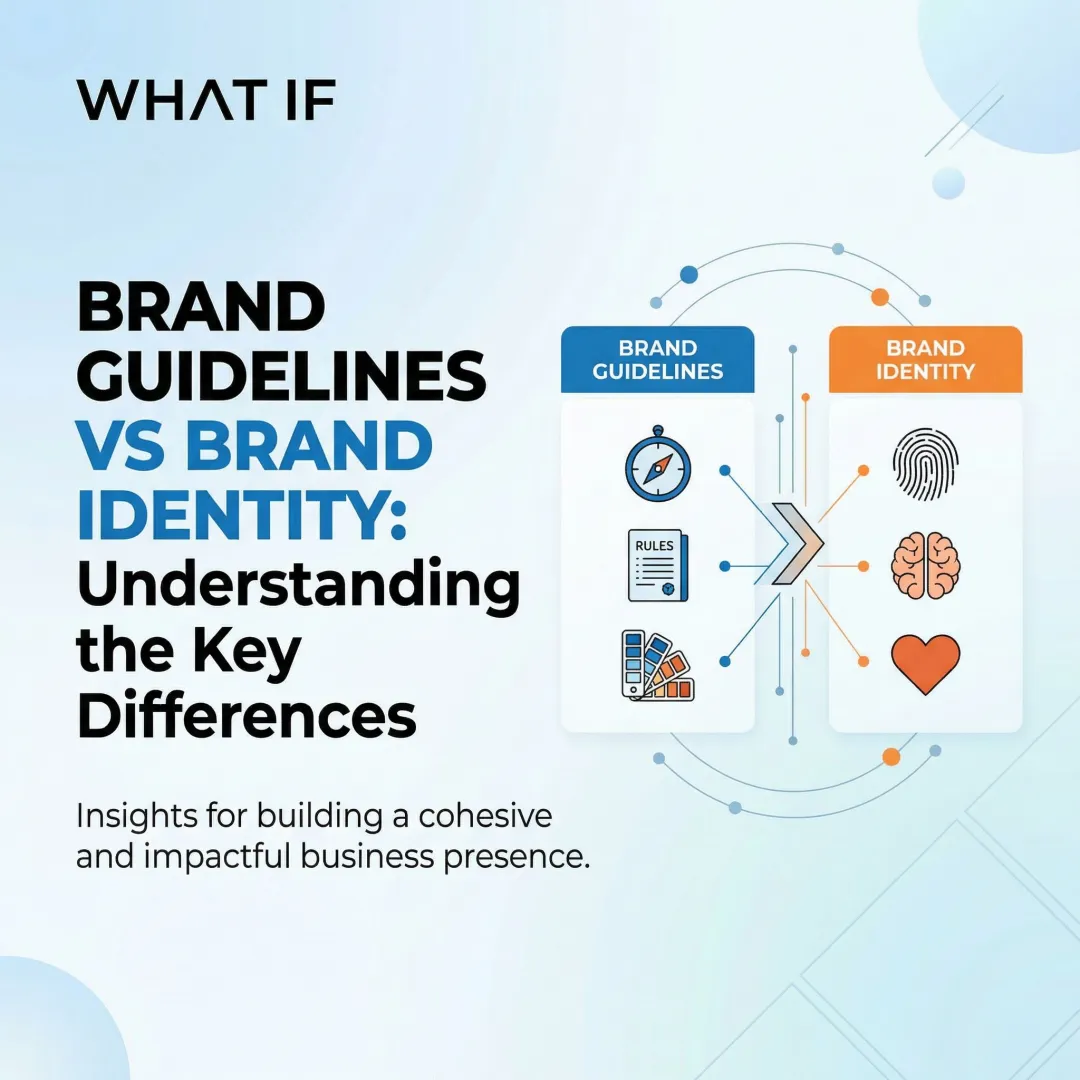
Brand guidelines and brand strategy are different things, and conflating them is a common early-stage mistake. Strategy defines who you are, what you stand for, and why your technology matters in the market. Guidelines document how to express that strategy consistently across every piece of communication.
For your climate tech startup, this distinction matters more than you might realize. You might have clear conviction about your positioning, but if your pitch deck, website, LinkedIn page, and conference materials all tell slightly different stories, investors notice. Guidelines are the operational system that prevents that drift.
Get this wrong and you're creating friction at the exact moment an investor or enterprise buyer is forming their first impression — a gap that no amount of follow-up can fully repair.
Unique considerations for climate tech organizations
Brand guidelines for climate tech companies have to solve problems that most standard brand frameworks weren't built to handle:
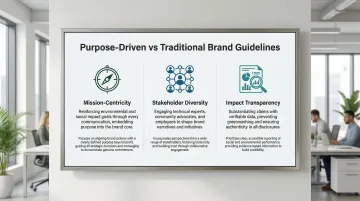
Audience layering: You need to communicate credibly with regulators, enterprise buyers, impact investors, and technical partners, often through the same website. Guidelines need to define how tone and hierarchy shift across those contexts without the core positioning changing.
Proof requirements: In an industry where greenwashing scrutiny is high, vague claims like "eco-friendly" or "sustainable" don't just undermine credibility. They create regulatory exposure. Your guidelines need to define exactly what claims you can make, at what level of specificity, and what substantiation is required before any claim goes public.
Technical translation: As a climate tech founder, you're likely a deep domain expert who defaults to technical precision over clarity. Your guidelines need to encode the translation layer, defining how complex science gets communicated as a business case, not a research paper.
Each of these gaps has a direct commercial cost: misaligned tone with an enterprise buyer, an unsubstantiated claim flagged in procurement, or a technical explanation that loses a non-specialist decision-maker can each stall an evaluation before it reaches a pricing conversation.
Why brand guidelines matter for climate tech organizations
Building trust and credibility
At seed or Series A, your brand inconsistency probably isn't obviously broken. The website exists. There's a logo. The pitch deck has been updated recently. But when you zoom out, your investor deck reads differently from your website, your LinkedIn page uses different language than your one-pager, and no one on the team agrees on exactly how to describe the technology to a non-technical buyer.
Research shows that 97% of B2B marketing leaders consider brand marketing essential for building awareness and consideration. For climate tech specifically, the stakes are higher because the sales cycles are longer, the buyer skepticism is deeper, and the credibility gap between early-stage companies and established players is more visible.
Climate tech companies face specific trust requirements that generic brand guidelines don't address. Proof visibility matters first: investors and enterprise buyers want to see pilots, funding milestones, research partnerships, and technical validation upfront. If those proof points are buried in a PDF or missing from the website entirely, that signals either inexperience or something to hide. Claim discipline matters equally — inconsistent messaging across channels signals that internal teams aren't aligned, which is a red flag for investors doing diligence. Your guidelines set the standard for what can be said, by whom, and at what level of specificity. And for companies making environmental claims, regulatory compliance is non-negotiable: brand guidelines must encode the standards set by frameworks like the CMA Green Claims Code and the FTC Green Guides. If you claim it, you need to prove it. If you can't prove it, you don't claim it.
Consider what happens when a procurement manager Googles your company after an initial meeting: if your website claims "industry-leading emissions reduction" with no supporting data, and your LinkedIn uses different language entirely, you've created doubt precisely when you need to be building it.
For investors conducting rigorous ESG due diligence, brand consistency serves as a proxy for operational discipline, signaling that your organization has robust processes and can execute at scale.
Differentiation in a crowded market
The climate tech market is projected to reach $115.4 billion by 2030, and within that growth, differentiation is becoming harder, not easier. When your seed-stage company is addressing the same problem as three other well-funded startups, the quality of your brand and messaging is part of how you win.
You might focus on technology differentiation while underestimating how much a better-presented competitor shapes buyer perception. If their website is cleaner, their messaging is clearer, and their visual identity signals maturity, enterprise buyers and investors default to them first, even if your technology is stronger. Guidelines give your team the system to close that gap consistently across every touchpoint.
Picture a shortlist of two at a corporate sustainability team: your technology and a competitor's are functionally comparable, but their materials tell a coherent story end to end. Buyers in that position default to the cleaner signal. Guidelines are what prevent that outcome.
Team and partner alignment
As you grow past 10 people, brand consistency starts breaking down in predictable ways. Your technical co-founder describes the product one way. Your business development hire frames it differently. The agency you brought on for the conference sprint interprets the brief loosely. By the time the message reaches an enterprise buyer, it's a composite of four different explanations.
In a procurement evaluation, this surfaces as a buyer who has seen your website, your BD deck, and a partner brief that each describe the technology slightly differently. That inconsistency signals internal misalignment — and it can stall a pilot conversion or delay contract signature.
Guidelines give everyone, including contractors, partners, and future hires, a single reference point for how to describe what you do, who you do it for, and what proof you can offer. This is especially important in climate tech, where the technology is complex enough that even small inconsistencies in how it's explained can undermine credibility.
Efficient scaling through documentation
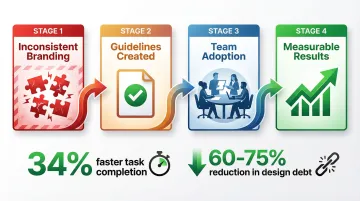
Documented guidelines reduce decision fatigue and speed up content creation. Teams utilizing design systems complete tasks 34% faster than those without standardized frameworks. Mature systems can reduce design debt by 60-75%.
For a small climate tech team, that efficiency matters because your design capacity is almost certainly limited. Every hour spent debating logo placement or rewriting the product description from scratch is an hour not spent on technology development, fundraising, or customer acquisition. Guidelines are the operational system that redirects that energy. That redirected time compounds directly into commercial output: faster turnaround on investor materials, quicker response to enterprise RFPs, and less lag between a customer request and a credible answer.
Fundraising and growth advantages
For your seed or Series A company, consistent branding directly affects investor confidence. During due diligence, investors review your website, your pitch deck, your LinkedIn presence, and any public materials. When those assets tell the same story in the same visual language, it signals operational maturity. When they conflict, it raises questions.
A realistic scenario: a lead investor's analyst compares your pitch deck and website on the evening before a partner meeting and finds different product positioning in each. It rarely kills a round, but it generates a correction round in the Q&A that shifts focus away from your commercial traction at the moment it matters most.
Strong brands also help with hiring and partnerships. Technical talent in the climate space has options, and when your company looks credible and well-organized, you attract better candidates. Strategic partners and pilot customers make similar assessments before committing. Your brand is often their first point of evidence.
Essential components of brand guidelines
Mission, vision, and values
Your mission, vision, and values are the foundation of your guidelines, but they need to do more than sit in a slide deck. The common failure here is listing values that sound good but don't actually inform any design or messaging decisions downstream.
Document these elements at the start of your guidelines and explicitly map them to communication standards. If your technology is built on radical transparency in emissions measurement, that value needs to show up in your messaging tone, in your website copy, and in how you present proof points, not just in a "who we are" section that no one reads after launch.
Connect each value directly to a design or messaging decision so that your team understands the strategic reasoning behind creative choices, rather than treating the values section as boilerplate. When your values show up in your messaging rather than sitting in a doc no one reads, they become part of the credibility signal that enterprise buyers pick up during evaluation — the difference between a company that claims to measure what matters and one that demonstrably does.
Brand story and positioning
Your brand story is the narrative thread that connects your technology to the problem it solves and the people who need it solved. For your climate tech company, this is harder than it sounds because there are usually multiple legitimate stories competing for the same space: the technical innovation story, the market opportunity story, and the impact story.
Your guidelines need to resolve that tension by documenting which story leads in which context:
- Investors: Lead with market scale, commercial traction, and technology defensibility. Environmental impact supports the case but rarely closes the round on its own.
- Enterprise buyers: Lead with operational outcomes. What does your technology change about their process, cost, or compliance exposure?
- Partners and integrators: Lead with complementarity. What can they do with you that they can't do alone?
The version of your story that lives on your website will be a compressed version of all three, which is why you need clear rules for what gets prioritized where. Without those rules, every external presentation becomes a negotiation about which story to lead with — and buyers who've engaged with your materials more than once will notice the drift.
Once you've established your positioning, translate these strategic decisions into visual language.
Visual identity system
The visual identity system is the most externally visible part of your brand. The components below aren't just design decisions; each one carries a signal about your company's maturity and credibility.
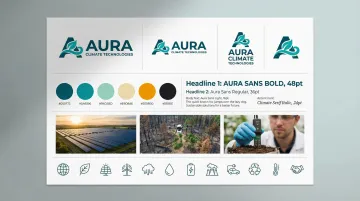
Logo variations and usage rules: Specify primary logos, secondary marks, minimum sizes, clear space requirements, and incorrect usage examples. Indicate when to use full-color versus monochrome versions. Climate tech companies often under-specify this, leading to distorted or color-wrong logo uses across conference materials and partner assets.
Color palette with accessibility requirements: Establish primary and secondary colors with complete technical specifications (HEX, RGB, CMYK, Pantone). Ensure WCAG-AA compliance with minimum contrast ratios of 4.5:1 for normal text and 3:1 for large text. One climate-tech-specific note: avoid defaulting to an all-green palette because it signals "sustainability brand" rather than "credible technology company." Many of the most trusted climate tech brands use neutral primaries with intentional accent colors, which communicates maturity and differentiates from the commodity green-logo landscape.
Typography system: Define primary and secondary typefaces with clear hierarchies for headlines, subheadings, body text, and captions. Specify font weights, sizes, and line spacing for different applications.
Photography and illustration style: For climate tech organizations, photography guidelines should address how you balance human context with technical credibility. Imagery that only shows nature or abstracted science can undermine the business-case framing. Specify lighting preferences, composition conventions, and how to represent the technology itself, not just its downstream outcomes.
Iconography and graphic elements: Create consistent icon sets for technical concepts, ensuring visual clarity across presentations, websites, and reports. Climate tech organizations benefit from visual systems that balance technical credibility with accessibility, particularly when presenting to enterprise buyers who may not share your domain depth.
Every visual element an enterprise buyer encounters before your first meeting — your website, your one-pager, your deck — is forming part of their evaluation. A coherent visual system signals that you can manage complexity, which matters to buyers assessing whether you can deliver at their scale.
Voice and tone guidelines
Your brand voice is the consistent personality that shows up across every communication, regardless of channel or audience. This is where your guidelines are most likely to fall short: defining voice in abstract terms without giving your team enough to actually apply it.
Define 3-5 core characteristics, but pair each with a concrete example. If "technical yet accessible" is one of your attributes, show what that looks like in an investor brief versus a product one-pager versus a website homepage. The attribute alone isn't enough.
Provide concrete examples showing how tone adapts across formats. In technical whitepapers, your tone should be formal, data-driven, and precise. On social media, lead with what's most relevant to that specific audience's context. In investor materials, stay confident and grounded in traction and market evidence. With enterprise buyers, keep it outcome-oriented, procurement-aware, and low on jargon.
Your core voice stays constant. Tone adapts based on who you're talking to and what decision they need to make. Getting this right for enterprise buyer communications — especially in procurement contexts where multiple stakeholders are reviewing the same submission — can meaningfully affect whether your response gets shortlisted.
Messaging framework
Document your key messages, value propositions, and proof points. This is where most climate tech companies have the largest gap between what exists and what's needed:
- Core positioning statement: Your primary value proposition in one specific sentence, not a mission statement
- Message pillars: 3-5 key themes that support your positioning, each connected to a concrete proof point
- Proof points: Specific data, pilot results, partnerships, or published research backing each pillar
- Claim substantiation standards: Exact rules for which claims your organization can make, at what level of measurement, and what verification is required before any claim appears externally
Include explicit claim discipline standards in this section. Terms like "eco-friendly," "carbon neutral," or "sustainable" without specific context don't just undermine credibility with sophisticated investors and enterprise buyers, they create real regulatory exposure. This is especially important if you're operating across multiple markets with different regulatory standards. A tightly constructed messaging framework also shortens your sales cycle: when everyone on your team answers "what do you actually do?" in the same specific language, buyers move through qualification faster and with more confidence.
Application examples
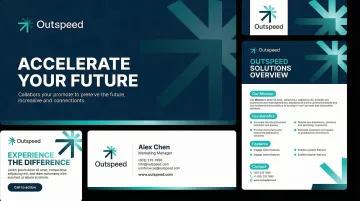
Show your guidelines in action across the formats your team actually uses: digital (websites, email, social media), print (brochures, reports, business cards), video (title cards, lower thirds), and presentations (slide templates, data visualization).
Visual examples transform abstract standards into concrete implementations. For climate tech teams without dedicated in-house designers, these examples are the difference between guidelines that get used and guidelines that get filed away. When your BD team can pull a correctly formatted one-pager in five minutes rather than rebuilding it from scratch, they're responding at the right moment — not a day after it.
Creating brand guidelines: step-by-step process
Conduct brand discovery and audit
Begin with research across your stakeholder groups. Speak with leadership, team members, customers, partners, and investors to understand current perceptions and where they diverge from your intended positioning. Analyze how companies at a similar stage and in adjacent climate tech verticals present themselves, looking for differentiation opportunities rather than patterns to copy. And catalog existing logos, color palettes, templates, and messaging to assess where standards have drifted and what's actually being used in the field.
This discovery phase reveals the gap between current state and desired brand perception. For climate tech startups that have been focused on technology development, that gap is often larger than founders expect. Understanding exactly where that gap sits is what lets you prioritize the assets buyers and investors encounter first — and close those gaps before worrying about anything else.
Define your brand strategy first
Guidelines document strategy, they don't create it. For climate tech founders, the common mistake here is assuming that a visual identity and a set of messaging rules is the same thing as strategic positioning. It isn't.
Before building your guidelines, your team needs to have answered a harder set of questions:
- Positioning: How does your technology actually change the buyer's world, and why would they choose you over the status quo or a competitor at a similar stage?
- Primary and secondary audiences: Who makes the purchase decision, who influences it, and who needs to trust you before the deal gets to the decision-maker?
- Proof points: What do you have that a skeptical enterprise buyer or diligent investor would treat as credible evidence? This includes pilots, published research, partnerships, and funding milestones.
- Differentiation: What do you do that a competitor with a larger marketing budget can't easily claim?
Without answers to those questions, your brand guidelines will be a well-designed container with no real substance inside — and nothing will change when a prospect evaluates you.
Develop visual and verbal systems
Once strategy is defined, build and test brand elements in iteration. Design multiple logo concepts and color palette options, testing each against the audience contexts your technology actually operates in. Test typography combinations for readability across the formats your team uses most: pitch decks, technical reports, websites. Draft your messaging frameworks and pressure-test them with representative stakeholders, particularly anyone from outside your industry. Then refine based on feedback, checking that elements work cohesively rather than in isolation.
Involving diverse stakeholders throughout development ensures your guidelines reflect real-world needs and have organizational buy-in before they're launched. Materials built from a tested system hold up across every buyer touchpoint, from the first website visit to the final procurement submission.
Document everything clearly
Organize your guidelines with a logical structure, searchable format, and abundant visual examples. The failure mode here is creating a document so comprehensive that no one uses it, or so thin that it fails to maintain consistency.
Structure your documentation in organized sections:
- Foundation: Mission, vision, values, brand story
- Visual identity: Logo, color, typography, imagery
- Verbal identity: Voice, tone, messaging frameworks
- Applications: Templates and examples across media
- Governance: Review cycles, approval processes, contact information
A well-organized system means your team spends less time hunting for files and more time responding to inbound interest — which matters when an enterprise lead needs something same-day.
Create tools and templates
Provide ready-to-use templates for the formats your team uses most: presentation decks (investor pitches, sales presentations, internal reports), social media graphics (post templates for different platforms), email signatures (consistent formatting for all team members), one-pagers (product sheets, company overviews), and document templates (reports, proposals, case studies).
Templates increase adoption by making on-brand content easier to create than starting from scratch, which is particularly valuable for climate tech teams operating without in-house design support. When an unexpected RFP lands or a warm intro needs a same-day response, having ready templates means your team shows up prepared rather than apologetically.
Implementing and maintaining brand guidelines
Successful implementation requires a structured rollout, especially when your team is distributed or working across multiple time zones. Start with a training workshop for internal teams and any external partners before launch — cover what the guidelines are, why the standards exist, and how to apply them to the materials your team actually produces. Announce the new guidelines with clear messaging about what's changing, what the timeline is, and who to contact with questions. Then phase the rollout: start with your highest-visibility assets — website, pitch deck, and core one-pagers, the materials most likely to be reviewed during a funding conversation or enterprise evaluation — before expanding to every touchpoint. This lets you get feedback on real usage before locking everything down.
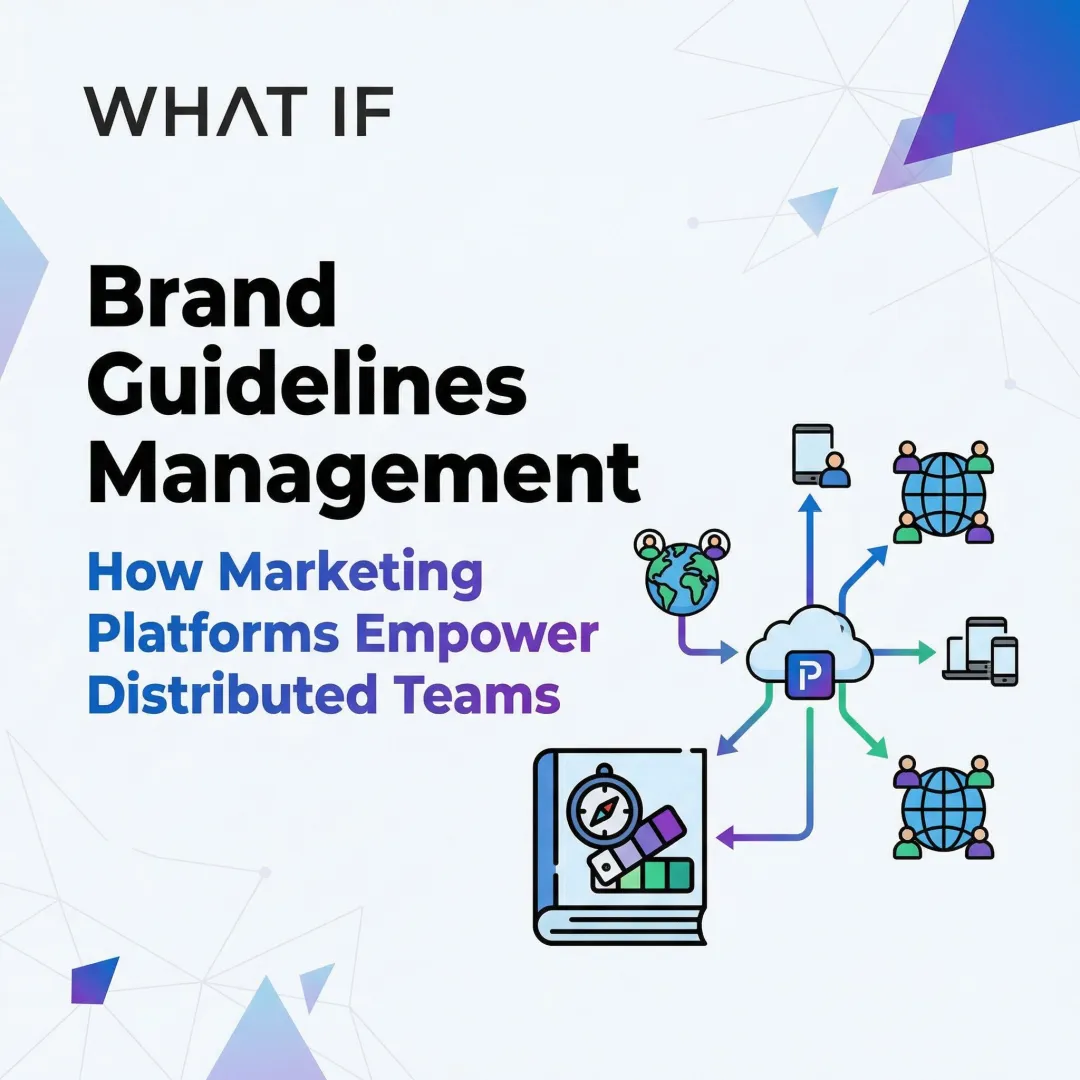
Once rolled out, make the guidelines accessible and practical. Store them in a cloud platform, internal wiki, or dedicated brand portal where everyone on the team can find them — using digital formats that allow easy navigation, version control, and direct asset downloads. Avoid static PDFs that create version confusion and make updates cumbersome.
Treat your brand guidelines as a living document that evolves with your organization, not a one-time deliverable.
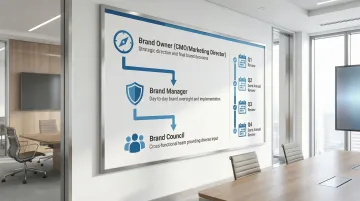
Establish review cycles (quarterly or semi-annually) and clear governance structures. Assign a brand owner — typically your CMO or marketing director — as the ultimate decision-maker. A brand manager handles the day-to-day work: managing asset libraries and approving applications. A brand council, made up of a cross-functional group, reviews major brand decisions. A clear brand owner also gives enterprise partners and investors a named point of contact for questions about your materials, which is a small but visible signal of organizational maturity.
Update your guidelines when product launches, organizational changes, market shifts, or consistent feedback patterns indicate the standards need refinement.
Common challenges and solutions
"We're too early for this"
If you're raising your seed round, you're probably focused on technology development, customer pilots, and the next funding milestone. Brand guidelines feel like a Series B problem. They usually aren't.
The moment you're presenting to enterprise buyers or institutional investors, inconsistency becomes visible. If your pitch deck was designed by your co-founder, your website was built by a contractor last year, and your one-pager was made in a hurry before a conference, it shows. Not catastrophically, but enough to create questions about operational maturity that your technology shouldn't have to compensate for.
Take a simple example: your co-founder's pitch deck describes your product as a "carbon intelligence platform" while your website calls it "emissions monitoring software." To a sharp investor, that's not a naming inconsistency — it's a signal that your team isn't aligned on what you're building.
Even a lightweight set of guidelines covering logo usage, color codes, approved messaging, and one reusable template reduces that friction. According to Frontify's brand guidelines research, consistent brand presentation can increase revenue by up to 23%. That's not a luxury metric. That's a growth lever.
Balancing flexibility with consistency
If you're managing multiple product lines, market segments, or geographic markets, rigid guidelines can feel like a straitjacket. This concern is legitimate, but it's usually a sign that the guidelines were designed too narrowly.
The solution is to separate what's fixed from what's flexible, and to document that distinction explicitly. Your logo, core color palette, and primary positioning statement are fixed. The photography style for a technical whitepaper can differ from the imagery on your investor landing page. The tone for a utility buyer in the Southeast differs from the tone for a government procurement audience. Build that flexibility into the guidelines rather than leaving it to interpretation.
Done well, this flexibility means a utility procurement team and a government grants evaluator can each receive materials that feel specific to their context — while your core credibility signals stay consistent across both.
Maintaining consistency across distributed teams
If you're at seed or Series A without an in-house design team, consistency breaks down fast. One person creates a presentation, another updates the website, a third puts together materials for a conference sprint, each working from slightly different files and slightly different memory of what the brand is supposed to look like.
Centralizing your assets is the operational fix. This means a shared library of approved logos, color codes, typography files, and approved templates that anyone on the team can access, not a folder buried in someone's personal Google Drive. Pair that with self-service templates for your most common formats, pitch deck, one-pager, email signature, so non-designers can produce on-brand materials without needing a designer in the loop for every request.
Brand guidelines are the clearest signal that your company has moved from founder-led to operationally mature. When your website, pitch deck, partner materials, and social presence all tell the same story, in the same voice, with the same visual language, that consistency reads as competence. In a market where trust is hard to build and even harder to sustain, competence is your most valuable signal.
If your team is navigating these challenges without in-house brand expertise, What if Design works with seed-stage and Series A climate tech companies to build guidelines that translate directly into stronger materials and cleaner buyer interactions. View our work to see how this applies to early-stage companies in carbon capture, clean energy, and climate intelligence.
Frequently asked questions
How long does it take to create comprehensive brand guidelines?
Typical timelines range from 4 to 12 weeks, depending on scope. If you're documenting and refining brand elements that already exist, the process can move in 4 to 6 weeks. A full brand build from strategy through guidelines typically runs 8 to 12 weeks. If you're working toward a specific deadline, a conference, a funding announcement, or a product launch, timelines can be compressed without sacrificing the essentials if you're clear about priorities from the start.
Do we need to rebrand completely to create brand guidelines?
No. In many cases, your existing brand elements, logo, color palette, core messaging, are the right foundation. The issue is usually that those elements haven't been documented and the standards have drifted as your team has grown. Guidelines can codify what's working and establish clear rules for the gaps. That said, a proper discovery process sometimes reveals that the existing visual identity is actively working against your positioning, particularly if your brand was built before your technology was validated or your target market was clearly defined. In that case, selective refinement is worth it.
How detailed should our brand guidelines be?
Scale detail to your organization's size and the complexity of your stakeholder landscape. A 10-person startup might need 20 to 30 pages covering the essentials, while a 100-person organization with multiple product lines or distinct buyer segments might require 50 to 100 pages. Prioritize depth where inconsistency is causing the most visible problems, typically messaging and visual identity, before expanding to edge cases.
Who should be involved in creating brand guidelines?
Key stakeholders include leadership for strategic direction, marketing and communications for implementation, design for visual execution, and program or product teams for audience insight. In climate tech, involving your technical team early is important to ensure that the translated messaging is accurate, not just accessible. Broader input during development increases adoption after launch.
How do we ensure people actually use our brand guidelines?
Make the guidelines accessible in searchable digital formats, not buried PDFs. Provide templates that make on-brand content easier to create than starting from scratch. Run a training session that explains the reasoning behind each standard, not just the rules themselves, and assign a brand guardian who can answer questions and flag inconsistencies as they emerge.
How often should we update our brand guidelines?
Review your guidelines at least annually, with updates triggered by major organizational changes (new funding round, product expansion, new market entry) or consistent feedback that the standards aren't working. Treat them as a living document and make minor updates as needed, rather than waiting for a scheduled review to fix something that's clearly broken.