You've built something real. You have a sustainability roadmap, carbon reduction targets, and a supply chain you've spent years cleaning up. But when a potential investor, partner, or enterprise buyer looks at how you communicate that work, it reads like a compliance report: dense with metrics, light on meaning, and easy to dismiss.
The problem isn't the data. As a climate tech founder, you're typically rigorous on measurement but underinvested in narrative. ESG numbers without context don't build trust; they create skepticism. When stakeholders can't connect to the purpose behind the metrics, even strong performance gets written off as greenwashing.
This piece breaks down how to close that gap: the structural elements of credible ESG storytelling, how to build a narrative framework that holds up across audiences, and what brands that have done this well actually did differently.
TLDR: key takeaways
- Connect metrics to real people and environmental outcomes to make ESG data legible
- Share challenges alongside successes for authentic storytelling
- Use visual and digital formats to make ESG impact accessible
- Effective stories engage multiple stakeholders with tailored messaging
Why ESG storytelling matters beyond compliance
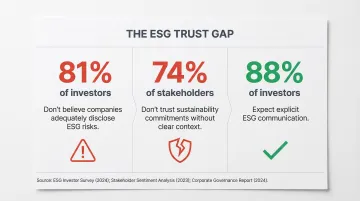
ESG reporting has evolved from voluntary disclosure to regulatory requirement. 88% of institutional investors now expect companies to explicitly communicate their ESG efforts, with over 60% preferring narrative explanations alongside quantitative data.
Yet compliance alone doesn't build stakeholder trust or engagement.
For climate tech and deep tech startups, the pressure is more acute than for established corporations. You're asking stakeholders to trust a technology that hasn't been proven at commercial scale yet. Your ESG story isn't just a reporting obligation; it's a credibility signal that investors use to separate companies with genuine operational discipline from those running on narrative alone.
The gap between measurement and communication creates significant reputational risk. 81% of institutional investors believe companies do not adequately disclose ESG-related risks, and nearly three out of four don't trust companies to achieve sustainability commitments without clear storytelling context. You risk backlash and skepticism when your stakeholders can't connect with the purpose behind your metrics.
The narrative infrastructure gap
You've likely invested heavily in ESG measurement systems: data collection platforms, carbon accounting software, supply chain tracking tools. But the storytelling capabilities needed to give those systems legitimacy remain underdeveloped. This gap creates what you might call narrative fragility: when stakeholders can't connect to the purpose behind the metrics, even strong ESG performance becomes vulnerable to skepticism and backlash. Consider a climate tech startup entering procurement conversations with a large industrial buyer: the technical data package is solid, but without a narrative that explains what the emissions trajectory means and why it holds up, the procurement team can't advocate internally for your solution.
The business case is clear. 74% of investors consider narrative-driven ESG information "very important" when allocating capital, while 71% of employees rate ESG storytelling as a top factor in choosing an employer.
Sustainability-marketed products grow twice as fast as conventional ones, and the payoff for closing the narrative gap extends well beyond compliance: stronger hiring pipelines, faster commercial traction, and more credible fundraising conversations.
The five essential elements of effective ESG stories
Authenticity and transparency
Credible ESG narratives acknowledge both achievements and ongoing challenges rather than presenting only successes. Transparency about setbacks and lessons learned builds trust more effectively than polished narratives that read like marketing collateral.
When you communicate honestly about your ESG journey, you earn stakeholder trust even when you fall short of targets. Disclosing your methodologies, assumptions, and limitations in ESG data is not weakness; it's the foundation of credibility. Patagonia's Footprint Chronicles openly maps supply chain complexity rather than presenting a sanitized picture — and that transparency is precisely what makes their environmental claims credible to enterprise buyers and investors during due diligence.
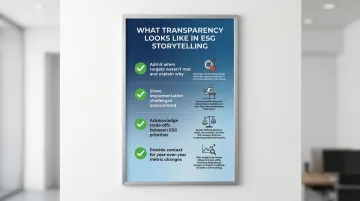
In practice, this means admitting when targets weren't met and explaining why, sharing the challenges encountered during implementation, acknowledging trade-offs between different ESG priorities, and providing context for year-over-year changes in metrics.
Human connection
Effective ESG stories put people at the center: employees whose roles changed, communities that were directly affected, or individuals driving the work from inside your organization. Data earns attention, but human stories build belief.
Find and share stakeholder voices that illustrate the real-world impact of ESG initiatives. Go beyond executive quotes to include frontline employees, community members, and people experiencing the direct effects of your ESG programs.
The most credible voices come from people closest to the work: employees implementing sustainability initiatives on the ground, community members affected by your operations, supply chain workers benefiting from improved labor standards, and customers using your products to meet their own sustainability targets. Ørsted's project-level stories — seagrass planting and 3D-printed biodiversity reefs — gave institutional investors and energy procurement teams something concrete to reference when evaluating the company's just transition commitments.
Context and meaning
A "20% emissions reduction" becomes meaningful when you tell the story of the facility transformation that achieved it: the solar installation, the team that managed it, the complications they worked through. Adding the "why" and "how" behind data turns abstract numbers into narratives stakeholders can understand and remember.
Connect ESG metrics to broader sustainability goals: planetary boundaries, just transition principles, or UN Sustainable Development Goals. 45% of sustainability reports now align strategy to SDG criteria. This framework helps stakeholders see how your initiatives connect to larger environmental and social objectives, not just your own compliance calendar. Interface built the 'climbing Mount Sustainability' narrative around their technical achievements — giving enterprise buyers a frame they could use in internal procurement conversations, not just a data point to file away.
Specificity over generalities
Use concrete details, specific examples, and tangible outcomes instead of abstract commitments and vague aspirations. Avoid generic terms like "eco-friendly" or "sustainable" without defining what they mean in your specific operational context.
Focus storytelling on one or two initiatives in depth rather than superficially covering all ESG activities. A detailed case study of one project creates more credibility than a laundry list of every initiative you touched.
Replace vague claims with specific details:
- No: "Committed to reducing our environmental footprint"
- Yes: "Reduced Scope 1 and 2 emissions by 50% by retrofitting three manufacturing facilities with renewable energy systems"
In a competitive RFP or procurement evaluation, the second example is what gives your internal champion something defensible to take to a decision maker — vague commitments rarely survive the internal advocacy test.
Consistency across time
Beyond what you say and how you say it, when and how often you communicate matters too.
ESG storytelling builds credibility through consistency: aligning past commitments with current actions and future goals. Show progression rather than disconnected annual reports that read like standalone documents.
Create narrative continuity that demonstrates how this year's achievements build on last year's foundation and connect to next year's targets. This longitudinal approach helps stakeholders understand your ESG journey as a coherent story rather than a collection of isolated data points. Ørsted's multi-year narrative — from DONG Energy's fossil fuel dependence through to Science Based Targets validation — is what allowed institutional investors to track and trust their transformation rather than re-evaluate credibility from scratch with each annual report.
Building your ESG narrative framework
Developing a comprehensive ESG narrative strategy requires alignment with company values, stakeholder priorities, and material ESG issues.
Start with a materiality assessment that identifies ESG topics most relevant to both your business model and your stakeholders' priorities. For a climate tech startup, this looks different from a Fortune 500 annual report: you're likely prioritizing emissions intensity, water use, supply chain transparency, or workforce equity, depending on your technology vertical. This foundation shapes every narrative decision that follows — including which metrics you lead with in a commercial due diligence process or an enterprise RFP response.
Framework development process:
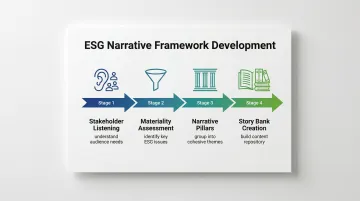
- Run stakeholder listening sessions to understand what each audience actually needs to see and what questions they're trying to answer
- Identify material ESG issues through peer benchmarking, industry trends analysis, and stakeholder engagement
- Translate material issues into narrative pillars that group related topics into cohesive themes
- Create an ESG story bank containing impact stories, employee testimonials, community voices, and visual content
Track evolving concerns through ongoing engagement rather than treating materiality as a one-time exercise. Stakeholder advisory councils provide regular strategic input, quarterly surveys surface shifting priorities, open feedback channels capture real-time concerns, and annual materiality reviews ensure the overall framework stays current.
Your narrative framework should acknowledge both financial materiality (impact on the company) and impact materiality (impact on the world). This dual lens becomes especially critical as regulations like the Corporate Sustainability Reporting Directive (CSRD) increasingly require double materiality reporting. For enterprise buyers who are themselves subject to CSRD supply chain reporting requirements, your ability to articulate both dimensions is increasingly a vendor qualification threshold, not just a reporting nicety.
Bringing ESG stories to life through visual and digital storytelling
The power of visual communication
Visual storytelling makes ESG impact immediately accessible. Research consistently shows people retain significantly more from visual content than from text alone, with studies suggesting retention rates of up to 65% for visual information after three days compared to roughly 10-20% for written content. For complex ESG data, this gap in comprehension is significant.
Photography, infographics, data visualization, and video translate complex ESG data into clear narratives. For climate tech companies asking investors to trust an unproven technology, the visual layer isn't optional: it's often what separates a stakeholder who understands your progress from one who defaults to skepticism.
Effective visual formats for ESG content:
- Real-time data dashboards showing live progress toward disclosed targets
- Photo essays documenting community or environmental impact on the ground
- Infographics that break down supply chain improvements or emissions reduction pathways
- Short-form social content that translates a complex initiative into a single insight
- Employee and beneficiary video testimonials
- Behind-the-scenes documentation of sustainability programs in action
The digital format matters here too. Static PDF reports work for regulatory filings, but interactive web-based reports allow continuous updates throughout the year. Stakeholders who care about your progress don't want to wait 12 months for the next snapshot.
Digital platforms and multimedia
Modern ESG storytelling uses multiple formats to engage different audiences across different channels. Video testimonials and virtual site tours create emotional connection; interactive data dashboards allow stakeholders to explore progress on their own terms; photo essays document on-the-ground impact; and short-form social content brings complex topics to audiences who will never read a full report. During an enterprise evaluation, an interactive progress dashboard that your buyer can share with their sustainability team carries more weight than a PDF filed away after a single read — it keeps your momentum visible throughout a procurement cycle.
Brand identity and ESG alignment
ESG storytelling should be integrated into overall brand identity and visual language rather than treated as separate "sustainability content."
When ESG narratives exist in isolation, they feel like afterthoughts rather than genuine commitments. A design partner who understands both the technical domain and the communication challenge can do significant work here: translating dense ESG data into visual systems that investors and enterprise buyers can follow without a sustainability background. It's a consistent pattern in What if Design's work with climate tech clients — the data exists, but the visual and narrative infrastructure to make it legible doesn't.
Accessibility and inclusivity
Design ESG communications for accessibility: plain language, multiple formats, translations, to reach diverse stakeholder groups. Adhering to Web Content Accessibility Guidelines (WCAG) 2.2 ensures content is accessible to people with disabilities.
In practice, this means alt text for all images and infographics, a color contrast of at least 3:1 for graphics, captions and transcripts for video content, and plain language translations of technical information.
Tailor narrative formats to different audiences: infographics for consumers, detailed case studies for investors, social content for employees. Each stakeholder group has distinct information needs and preferred communication channels. For procurement teams and institutional investors, clearly formatted and accessible ESG content often determines whether your materials reach a decision maker or stall at the analyst level.
Measuring the impact of your ESG narrative
Traditional disclosure metrics don't capture whether your ESG stories are actually landing with the audiences that matter.
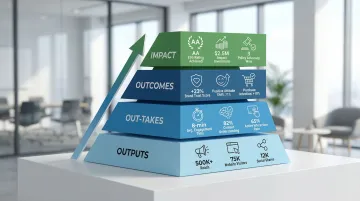
Move past compliance by using the AMEC Integrated Evaluation Framework, which tracks narrative effectiveness from initial reach through to real business outcomes.
The framework tracks four levels of effectiveness:
- Outputs: Reach metrics including website visitors, social shares, and content downloads
- Out-takes: Audience attention, understanding, and engagement with your ESG content
- Outcomes: Measurable shifts in stakeholder attitude, trust, or intention toward your brand
- Impact: Business results like reputation improvement, increased investment, or demonstrated social change
Apply this framework by tracking specific engagement indicators: website traffic to ESG content and time spent on sustainability pages, social media engagement rates on ESG posts, employee participation in sustainability programs, and download rates for ESG reports and resources.
Conduct periodic stakeholder perception research to measure whether your narratives are building the trust and credibility you're targeting. Monitor investor feedback on ESG disclosures, employee advocacy metrics, and sentiment analysis of public responses. Combining these qualitative and quantitative measures reveals which stories are working and which need refinement. When your investor feedback shifts from questions about methodology to requests for expanded partnership, that's the Outcomes level of the AMEC framework in action — a direct signal that your narrative is shortening the distance to a commercial milestone.
Real-world examples: brands leading with ESG storytelling
Patagonia: radical transparency and activism
Patagonia builds its ESG narrative around founder Yvon Chouinard's authentic voice, anchored in their "Earth is our only shareholder" mission.
Their Footprint Chronicles connects supply chain data directly to individual products, letting customers trace each item's environmental and social impact.
The Worn Wear program uses storytelling to normalize repair and reuse — sharing stories of well-loved gear used for decades, challenging conventional consumption habits, and featuring real customers to demonstrate that durability is a core value, not a marketing claim.
Key techniques: Founder authenticity, product-level transparency, customer activism platform, visual documentation of supply chain
For your own ESG storytelling, the key lesson is that product-level transparency is a commercial differentiator — it gives procurement leads something specific to reference when defending supplier selection internally.
Interface: the "moonshot" narrative
While Patagonia focuses on individual product stories, Interface demonstrates transformation at scale.
Interface framed their sustainability journey as "Mission Zero" (1994-2019) and now "Climate Take Back", missions that guide the entire business strategy. They transformed from a petroleum-intensive carpet manufacturer to a carbon-negative flooring leader, reducing GHG intensity by 96%.
Their storytelling approach translates complexity into action. They use clear metaphors like "climbing Mount Sustainability" with "Seven Fronts" that employees could understand and act upon. By blending design aesthetics with hard data on carbon negativity, Interface makes technical achievements accessible and compelling.
Key techniques: Transformation arc, mission-driven framing, technical achievements translated through design, employee engagement focus
For a climate tech company pitching enterprise buyers over multiple quarters, a clear mission narrative gives your commercial conversations a consistent frame that carries from initial discovery through contract negotiation.

Ørsted: the "black to green" transformation
Ørsted's narrative centers on their profound business transformation from coal-dependent DONG Energy to a global renewable energy leader. They successfully transitioned from 85% fossil fuels to becoming the world's most sustainable energy company, validated by the Science Based Targets initiative.
Their storytelling focuses on specific projects: 3D-printed reefs supporting biodiversity and seagrass planting initiatives that make abstract environmental goals tangible. They explicitly address the "just transition," ensuring workers and communities are supported during the shift to green energy.
Key techniques: Business transformation story, project-level storytelling, just transition emphasis, science-based target validation
For companies at an earlier stage, Ørsted's approach shows that third-party validation through Science Based Targets converts a compelling transformation story into a procurement-ready credential.
Closing: from data to narrative
The companies in these examples share one characteristic: they treated ESG communication as a strategic function, not a reporting obligation. Each invested in the narrative infrastructure to make their data legible, human, and consistent over time.
For climate tech startups, the same principle applies at a different scale. You don't need a Footprint Chronicles-level production to build stakeholder trust. You need clarity on what's material, specificity in how you tell it, and consistency across the channels your audiences actually use.
If your ESG communication is technically solid but not translating into stakeholder confidence, that's typically a positioning and narrative problem. What if Design works with climate and deep tech companies to build the communication infrastructure that turns rigorous sustainability work into credible, investor-ready messaging.
Frequently asked questions
How do we avoid greenwashing when telling ESG stories?
Support claims with verifiable data and third-party validation. Be transparent about both achievements and limitations, and avoid vague terms like "eco-friendly" without clear definitions tied to specific metrics.
What's the difference between ESG reporting and ESG storytelling?
ESG reporting provides standardized data disclosure for regulatory compliance and institutional investors. ESG storytelling translates that same data into accessible narratives that help employees, customers, and prospective partners understand what it actually means for the business and the world it operates in.
Who should be responsible for ESG storytelling in our organization?
Build a cross-functional ESG committee with representatives from sustainability, communications, marketing, and design teams. This ensures diverse perspectives, prevents siloed narratives, and produces more credible, consistent stories.
How often should we update our ESG stories?
Share updates continuously rather than relying on annual reports alone. Regular social media posts, quarterly newsletters, and real-time project updates demonstrate ongoing commitment more effectively than a single annual document.
What storytelling formats work best for different ESG topics?
Video works well for community impact stories, infographics simplify environmental data, and written case studies suit governance topics. Match the format to both content complexity and your audience's preferred communication channels.
How can smaller companies with limited resources develop effective ESG narratives?
Start with authentic employee stories, simple visual content, and focus on one or two material ESG issues rather than trying to cover everything. Authenticity matters more than production value, and a well-told story about a single initiative will do more for your credibility than a superficial overview of ten.