Introduction: LEED Certification and Renewable Energy in Green Building
Buildings consume approximately 30% of global final energy and generate 26% of energy-related emissions. With the climate crisis accelerating, LEED certification has emerged as the definitive framework for sustainable building design.
Developed by the U.S. Green Building Council, LEED has certified over 195,000 projects across 186 countries, representing 29 billion square feet of high-performance space designed to save more than 120 million metric tons of CO2 emissions.
This guide covers LEED fundamentals, the seven certification categories, renewable energy integration strategies, and practical implementation guidance for architects, developers, and building owners pursuing sustainable design excellence.
TLDR:
- LEED uses a point system across seven categories: Certified (40-49 points) to Platinum (80+ points)
- Energy and Atmosphere holds the most points, rewarding on-site renewables and efficiency improvements
- "Reduce-then-produce" strategy maximizes ROI by cutting demand before adding renewables
- LEED v5 (2025) mandates full electrification and 100% renewable energy for Platinum certification
- Certified buildings command rental premiums of 3-6% and energy savings of 20-40%
Understanding LEED Certification: Fundamentals and Framework
What LEED Is and How It Evolved
LEED (Leadership in Energy and Environmental Design) provides a structured framework for designing, constructing, and operating high-performance green buildings.
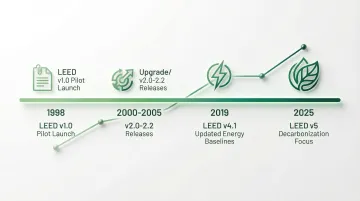
Since its 1998 pilot launch, LEED has evolved through multiple versions:
- 1998: LEED v1.0 Pilot launch
- 2000-2005: Releases of v2.0, v2.1, and v2.2
- 2019: Launch of LEED v4.1 with updated energy baselines
- 2025: LEED v5 introduces decarbonization focus with five-year development cycles
The Point-Based System
Projects earn points across multiple categories to achieve certification:
| Certification Level | Points Required |
|---|---|
| Certified | 40-49 points |
| Silver | 50-59 points |
| Gold | 60-79 points |
| Platinum | 80+ points |
Three Core Rating Systems
LEED offers three primary rating systems:
- LEED BD+C (Building Design and Construction): For new construction and major renovations requiring complete design integration
- LEED O+M (Operations and Maintenance): For existing buildings operational for at least one year, focusing on performance improvement
- LEED Zero: Verifies net-zero performance in Carbon, Energy, Water, or Waste over 12 months
Certification Timeline and Process
The certification process involves four stages:
- Registration: Submit project details and fees through LEED Online
- Application: Complete documentation and pay review fees
- Review: GBCI conducts preliminary review (20-25 business days)
- Certification: Receive final decision and plaque
The typical timeline takes 12-18 months from registration to certification, depending on project complexity.
Integrative Design as Foundation
LEED emphasizes cross-discipline collaboration beginning in pre-design. Teams must create a LEED action plan early to determine certification targets and credit selection.
This ensures architects, engineers, and sustainability consultants maximize renewable energy opportunities from day one.
The Seven Categories of LEED Certification
LEED organizes credits into seven primary categories, with Energy and Atmosphere containing the highest point allocation.
Location and Transportation (LT)
Site selection impacts renewable energy potential. Projects earn points for:
- Proximity to transit and services
- Reduced parking footprint
- Electric vehicle charging infrastructure
- Protection of sensitive lands
Sustainable Sites (SS)
Site assessment requirements include evaluating solar exposure, wind access, and geothermal potential. Projects must demonstrate:
- Heat island reduction strategies
- Rainwater management
- Light pollution reduction
- Site development that protects habitats
Water Efficiency (WE)
Water conservation directly reduces energy consumption through decreased pumping, heating, and treatment demands.
Projects earn credits for:
- Indoor water use reduction (20-40% below baseline)
- Outdoor water use reduction through native landscaping
- Water metering systems
- Cooling tower water management
Energy and Atmosphere (EA) — Most Points Available
This category drives decarbonization and offers the highest point potential across all LEED categories.
Energy Performance Requirements
According to the USGBC's LEED v4.1 BD+C Guide, projects must achieve minimum 5% improvement over ASHRAE 90.1-2016 baseline. Greater efficiency earns up to 18 points.
Renewable Energy Credits
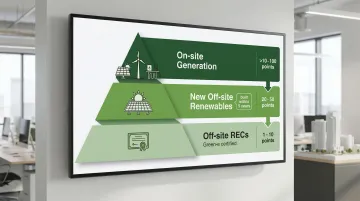
Projects earn points through a tiered system:
- Tier 1: On-site generation (solar PV, wind, geothermal)
- Tier 2: New off-site renewables (built within 5 years)
- Tier 3: Off-site renewables/RECs (must be Green-e certified)
LEED v4.1 introduced dual metrics requiring projects to demonstrate performance against both cost and greenhouse gas emissions. High-performance building envelopes reduce heating and cooling loads, allowing smaller renewable systems to achieve net-zero targets.
Materials and Resources (MR)
Embodied carbon reduction is central to this category. Key credits include:
- Environmental Product Declarations (EPDs)
- Material ingredient disclosure
- Construction waste diversion (75%+ from landfill)
- Use of recycled and regional materials
Indoor Environmental Quality (EQ)
Renewable energy systems enable advanced building systems that improve occupant health:
- Advanced air filtration and ventilation
- Thermal comfort systems
- Daylight-responsive lighting controls
- Low-emitting materials and finishes
Innovation and Regional Priority (IN)
Earn bonus points for:
- Exceptional renewable energy performance beyond credit requirements
- Innovative integration strategies (BIPV, solar thermal combined systems)
- Regional grid decarbonization contributions
- LEED AP participation (1 point)
Renewable Energy Integration in LEED Projects
The "Reduce-Then-Produce" Strategy
USGBC guidance emphasizes energy efficiency first. Reducing baseline energy use by 10% before adding renewables maximizes ROI and credit potential by:
- Lowering capital costs for smaller renewable systems
- Improving payback periods
- Increasing points earned per dollar invested
- Achieving higher certification levels with less equipment
Solar Photovoltaic Integration
Common solar configurations include:
- Rooftop systems: Standard crystalline silicon panels generating 15-20 watts per square foot
- Building-Integrated Photovoltaics (BIPV): Solar modules replacing traditional materials in facades, skylights, and canopies
- Solar canopies: Parking structure installations providing shade while generating power
LEED Contribution: On-site solar retains all environmental attributes (RECs), earning maximum points in the Renewable Energy credit while supporting Energy Performance optimization.
Geothermal Heat Pump Systems
Ground-source heat pumps use stable subsurface temperatures (50-60°F) to deliver heating and cooling at 300-500% efficiency.
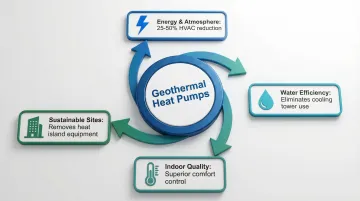
These systems impact multiple LEED categories:
- Reduce HVAC energy by 25-50% (Energy and Atmosphere)
- Eliminate cooling tower water use (Water Efficiency)
- Provide superior comfort and humidity control (Indoor Environmental Quality)
- Remove outdoor equipment that contributes to heat islands (Sustainable Sites)
Additional Renewable Options
Wind Turbines: Viable for sites with average wind speeds exceeding 12 mph, typically rural or coastal locations.
Biomass Systems: Combined heat and power (CHP) from sustainable biomass sources, requiring careful documentation of fuel sourcing.
Renewable Energy Certificates (RECs): Off-site RECs must be Green-e certified and sourced from the same country or region to prevent double-counting.
Path to Net-Zero and LEED Zero
Renewable energy systems support LEED's decarbonization focus by enabling net-zero energy buildings. LEED Zero certification verifies 12-month performance with nearly 100 projects representing 23 million square feet certified as of 2022.
When selecting renewable energy sources, follow this priority hierarchy:
- On-site generation
- Local generation (community solar)
- Off-site generation (PPAs)
- Energy Attribute Certificates
- Carbon offsets
LEED Certification Levels and the Path to Platinum
Four Certification Tiers
Certified (40-49 points): Entry-level projects demonstrating basic sustainability practices, typically achieving 10-15% energy savings.
Silver (50-59 points): Moderate renewable energy integration, often including rooftop solar covering 15-25% of annual consumption.
Gold (60-79 points): Substantial renewable energy systems (30-50% of annual use), advanced building envelope, and comprehensive water efficiency measures.
Platinum (80+ points): Highest performance tier requiring exceptional renewable energy integration and efficiency.
LEED v5 Platinum Requirements
New mandatory requirements for Platinum certification include:
- Full Electrification: Elimination of on-site combustion except emergencies
- 100% Renewable Energy: All electricity from renewable sources
- Low Embodied Carbon: Mandatory reductions in material carbon footprint
- Industry Best Practices: Achievement of top-tier energy efficiency
Cost Premiums and Financial Returns
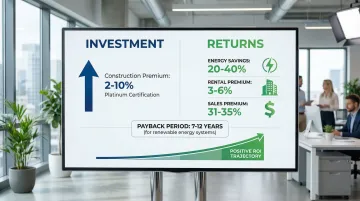
These ambitious requirements come with financial considerations, but the investment typically delivers strong returns:
- Construction premiums range from 2-10% for LEED certification, with Platinum projects at the upper end
- Gold and Platinum buildings achieve 20-40% energy savings compared to code-compliant baselines
- Certified properties command rental premiums of 3-6% and sales premiums reaching 31-35%
- Renewable energy systems typically pay back in 7-12 years through combined energy savings, incentives, and increased property values
Implementing LEED Standards: A Practical Guide
Step-by-Step Process
- Goal Setting: Define certification level target and assemble team including LEED AP, architects, engineers, and renewable energy consultants
- Preliminary Energy Modeling: Establish baseline performance and identify efficiency opportunities before sizing renewables
- Integrated Design Charrettes: Enable cross-discipline collaboration to optimize building orientation, envelope, systems, and renewable energy integration
- Renewable Energy System Design: Size solar, geothermal, or wind systems based on reduced energy demand from efficiency measures
- Commissioning: Verify all systems perform according to design intent through third-party commissioning authority
- Performance Verification: Monitor actual energy consumption and generation for 12 months post-occupancy
Role of LEED Accredited Professionals
LEED AP with specialty credentials demonstrate advanced knowledge in green building practices.
Including a LEED AP on the project team provides:
- 1 Innovation point toward certification
- Streamlined documentation and submission processes
- Fewer review cycles through first-time compliance
- Expert guidance on credit optimization strategies
Practical Tips for Building Owners
These strategies help building owners navigate the LEED process effectively and maximize their investment.
Use the 40/60 rule for mixed-use projects—if a rating system applies to more than 60% of gross floor area, use that system. This simplifies certification and reduces documentation complexity.
Financing options to consider:
- PACE (Property Assessed Clean Energy) financing for renewable energy systems
- Green bonds for large-scale projects
- Utility rebates for efficiency upgrades and on-site generation
- Federal tax credits (30% ITC for solar through 2032)
Energy management systems track performance, verify savings, and support LEED O+M certification through continuous improvement. Install these early to establish baseline data.
Start LEED planning during conceptual design to maximize renewable energy opportunities and minimize costly design changes. Early engagement with LEED consultants identifies the most cost-effective path to certification.
Frequently Asked Questions
What are the 7 criteria for LEED certification?
LEED evaluates projects across seven categories: Location and Transportation, Sustainable Sites, Water Efficiency, Energy and Atmosphere, Materials and Resources, Indoor Environmental Quality, and Innovation/Regional Priority. Projects need at least 40 points for Certified level.
What is the difference between LEED v4 and LEED v4.1?
LEED v4.1 offers more flexible compliance pathways, updates energy thresholds to ASHRAE 90.1-2016, and adds social equity credits. It also integrates GHG emissions metrics for energy performance evaluation.
What is the 40/60 rule for LEED?
The 40/60 rule guides rating system selection for mixed-use projects. Use a rating system if it applies to more than 60% of gross floor area, don't use it if less than 40%, and choose what fits best between 40-60%.
What is the ISO standard for renewable energy?
ISO 50001 provides a framework for energy management systems including renewable energy integration. USGBC recognizes ISO 50001 as an Alternative Compliance Path for LEED O+M projects, allowing organizations to leverage existing energy management frameworks for LEED compliance.
Climate tech companies and renewable energy developers often need to communicate LEED expertise to investors and clients. What if Design helps sustainability organizations translate technical achievements into clear brand strategy, UX/UI design, and web development that drives market adoption.