Climate tech companies face a design paradox: the products meant to solve environmental problems often create significant impact during development. Design decisions determine over 80% of a product's environmental impact throughout a product's lifecycle, making green design technology critical for any sustainability-focused organization.
The stakes are rising fast. Regulations like the EU's Ecodesign for Sustainable Products Regulation are tightening, while consumer preferences shift increasingly toward sustainability. Companies that fail to integrate environmental considerations into their design processes risk regulatory penalties, market irrelevance, and missed cost-saving opportunities.
The built environment and manufacturing sectors account for nearly 40% of global carbon emissions. Green design technology transforms design from a creative function into a deliberate decarbonization tool. The climate companies that build it in from the start — not as a compliance checkbox, but as a core design constraint — are the ones that reduce retrofit costs, satisfy procurement requirements earlier, and position themselves ahead of tightening regulations.
TL;DR
- AI, digital twins, and advanced materials minimize environmental impact from the earliest design stages
- Adopting these approaches delivers 10-50% material reductions and 20-32% energy savings
- Companies see 12-15% valuation premiums from sustainable design practices
- Implementation requires deliberate commitment, cross-functional collaboration, and integration of tools like BIM-LCA and generative design
- Regulatory frameworks like the EU Green Deal are making sustainable design mandatory, not optional
What is green design technology?
Green design technology integrates environmental sustainability principles with modern digital tools throughout the product development lifecycle.
Unlike traditional approaches that address environmental concerns retrospectively, green design technology embeds sustainability from the earliest conceptual stages through production, use, and end-of-life disposal.
Defining green design vs. green design technology
Traditional green design focused on material selection and waste reduction—choosing recycled materials or designing for recyclability. Green design technology amplifies these principles through computational power, data analytics, and emerging technologies.
This evolution includes:
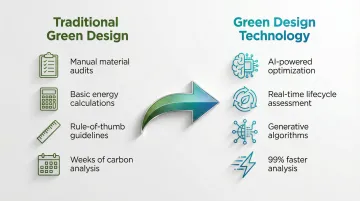
- Traditional green design: Manual material audits, basic energy calculations, rule-of-thumb sustainability guidelines
- Green design technology: AI-powered material optimization, real-time lifecycle assessment, generative algorithms exploring thousands of sustainable design variations simultaneously
These digital tools transform what's possible. Where designers once spent weeks manually calculating carbon footprints, AI-driven simulation now cuts environmental analysis time by up to 99% compared to traditional methods.
The three pillars of green design technology
Materials optimization
Technology enables designers to analyze thousands of material combinations instantly, while generative design algorithms reduce part weight by 10-50% while maintaining structural integrity.
Airbus used generative design to create a bionic partition for the A320 that was 45% lighter than traditional designs, potentially saving 500,000 metric tons of CO2 annually across their fleet.
Energy efficiency
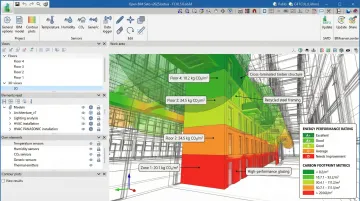
Advanced simulation tools predict energy performance before physical production. Building Information Modeling (BIM) integrated with energy analysis software allows architects to test dozens of configurations—window placement, insulation types, HVAC systems—identifying the optimal combination for energy efficiency.
Lifecycle thinking
Digital twins and lifecycle assessment (LCA) tools enable designers to model a product's entire environmental journey. Rather than optimizing for one phase, technology reveals trade-offs across extraction, manufacturing, transportation, use, and disposal, enabling fully integrated decision-making across the entire product lifecycle.
In practice, what we see most often is climate tech founders optimizing for a single phase — usually manufacturing — and missing the extraction and end-of-life costs that increasingly appear in enterprise procurement checklists.
Why green design technology matters today
The business case for sustainable design
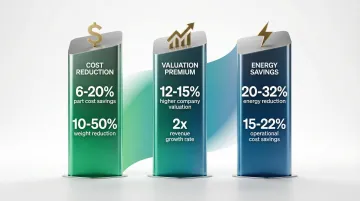
Green design technology delivers measurable financial returns. McKinsey research shows generative design reduces part costs by 6-20% and weight by 10-50%. One power-tool manufacturer cut a bracket's weight by 26% and cost by 8% through algorithmic optimization.
Beyond direct cost savings, companies with over 50% green revenues enjoy valuation premiums of 12-15% compared to conventional competitors. Green revenues have grown twice as fast as conventional revenues since 2020.
Material efficiency directly impacts bottom lines. BIM-based green building design achieves 20-32% energy savings and 18-30% carbon footprint reduction, translating to operational cost reductions of 15-22% over building lifetimes.
In our experience, founders who quantify these savings early — before the investor meeting, not after — use them as proof of business model durability, not just operational efficiency.
Regulatory drivers and compliance
Regulatory frameworks are tightening globally, making green design non-negotiable:
Key regulations reshaping design requirements:
- EU ESPR mandate: Products sold in the EU must meet durability, reparability, and upgradability standards, with Digital Product Passports tracking material origins and carbon footprints
- UK building standards: Low-carbon heating systems required from 2025, with Energy Use Intensity targets of 35-40 kWh/m²/year for new homes
- Whole Life Carbon reporting: Large buildings over 1,000 m² must measure and report complete lifecycle emissions
Early adopters avoid retrofit costs and penalties while positioning themselves ahead of enforcement.
Market differentiation through sustainability
Environmental credentials now drive purchasing decisions. Transparency about sustainability practices builds customer trust, while verifiable data from lifecycle assessments provides competitive differentiation.
Third-party certifications and environmental product declarations turn green claims into verifiable proof. Lifecycle data gives buyers something concrete to point to — measurable impact, not just intent. And in competitive markets, that kind of specificity reads as innovation leadership.
Climate urgency and corporate responsibility
The UK's built environment alone accounts for 25% of national emissions. Design decisions made today determine emission trajectories for decades.
This creates both responsibility and opportunity. Designers can eliminate future emissions through technology choices made now, translating climate action into practical product and system decisions.
Key technologies reshaping green design
Artificial intelligence and machine learning
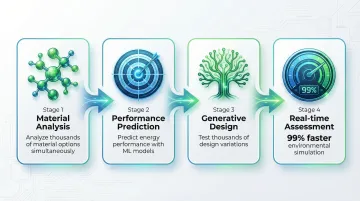
AI optimizes material selection by analyzing performance characteristics, cost, availability, and environmental impact across thousands of options simultaneously.
Machine learning models predict energy performance with exceptional accuracy, identifying design inefficiencies that manual analysis would miss.
Generative design algorithms explore vast solution spaces, testing thousands of design variations against sustainability criteria. The results often surprise even experienced designers: organic, "bionic" forms that minimize material while maximizing strength.
Key capabilities include:
- Testing thousands of design variations against multiple sustainability criteria
- Discovering material combinations beyond traditional design approaches
- Generating optimized geometries that balance strength and resource efficiency
Bespoke ML models cut environmental simulation times by up to 99%, enabling real-time carbon screening during design rather than post-hoc assessment.
Digital twins and simulation
Digital twins create virtual replicas of products or buildings, allowing designers to test environmental impact before physical production. These simulations answer critical questions: How does changing insulation affect energy use? What happens if we substitute this material?
The technology supports building design, product lifecycle analysis, and circular economy planning. You can test environmental scenarios before committing to physical production, compare material substitutions and their lifecycle impacts, and optimize building performance across multiple variables — all before a single physical prototype is built. Research validates that BIM-driven digital twins optimize demolition waste management, enhancing efficiency and closing material loops.
Advanced sustainable materials
Innovation in materials science produces bio-based alternatives, recycled composites, and carbon-negative options. Carbstone produces CO2-negative building blocks that absorb CO2 during curing, verified through Environmental Product Declarations.
Digital material databases help designers identify and specify sustainable alternatives. Standards like EN 15804+A2 require separate reporting of biogenic carbon stored in timber and biomass. This allows architects to accurately credit carbon storage in mass timber projects.
Life cycle assessment (LCA) tools
Digital LCA tools quantify environmental impact from raw material extraction through end-of-life disposal. Integration with design software like Revit transforms weeks of manual data entry into automated processes, enabling informed decision-making in real-time.
New AI tools use Large Language Models to semi-automatically match BIM elements with LCA datasets, solving a major bottleneck in early-stage assessment.
Building information modeling (BIM) and parametric design
BIM enables collaboration on sustainable building projects through shared environmental data. All stakeholders — architects, engineers, contractors — work from a single model that tracks carbon footprints, energy performance, and material specifications.
Parametric design optimizes for multiple conflicting variables at once. Research on adaptive building envelopes achieved 69% improvement in daylight performance and 38% improvement in air changes per hour through parametric analysis, balancing daylighting against thermal gain.
Real-world applications across industries
Green architecture and construction
Net-zero buildings use BIM technology for integrated energy modeling and system coordination. According to a Page case study, architecture firms use One Click LCA integrated with Revit to lower embodied carbon by creating custom transportation impacts that accurately measure carbon costs of material sourcing.
Passive design strategies are optimized through simulation before construction begins:
- Building orientation for optimal solar exposure
- Natural ventilation systems to reduce HVAC loads
- Thermal mass placement for temperature regulation
Design technology reduces construction waste and embodied carbon by identifying material efficiencies and prefabrication opportunities.
Sustainable product design
Industries from consumer electronics to fashion apply green design technology to create products designed for disassembly and circular economy principles.
Interface's CQuest™GB carpet tile backing demonstrates this approach: it's net carbon negative (cradle-to-gate) and verified via EPD, with a "ReEntry" process that reclaims products at end-of-life for reuse as raw materials.
Climate tech and clean energy solutions
Beyond buildings and products, green design technology shapes renewable energy systems, carbon capture technologies, and sustainable transportation.
We've applied these principles directly — working with Susteon, a carbon capture startup, to build a brand and website that made their technology legible to enterprise buyers without requiring a technical briefing first. That kind of translation work is what shortens the sales cycle for deep-tech climate companies.
Implementing green design technology in your organization
Building internal capabilities
Training existing design teams on sustainability principles and new tools is foundational.
Cross-functional collaboration between design, engineering, and sustainability teams breaks down silos and embeds environmental thinking throughout development processes.
The LEED Green Associate and LEED AP credentials remain standards for demonstrating green building competency, requiring 15-30 hours of continuing education every two years to stay current with evolving standards.
Choosing the right tools and partners
Evaluate green design software based on:
- Interoperability: Data exchange via IFC or gbXML standards
- Database quality: Access to verified EPD databases
- Standards compliance: Adherence to ISO 14040/44 and EN 15978 for LCA
- Automation: Features that match BIM elements to LCA datasets automatically
For climate tech companies without in-house design expertise, partnering with a specialized agency is often the fastest path to credible output.
We focus on climate and deep tech specifically — which means we understand the translation problem between technical founders and the buyers or investors they're trying to reach. That sector knowledge changes the quality of the work.
Starting with quick wins
Begin with material audits identifying high-impact substitution opportunities. Conduct energy modeling for existing products to establish baselines. Pilot design-for-disassembly initiatives on single product lines.
Measure and communicate impact to build organizational momentum. Track metrics like embodied carbon (kg CO2e/m²), energy intensity (kWh/m²/year), and material efficiency (percentage reduction vs. baseline).
Integrating sustainability into design processes
Once you've proven value with pilot projects, scale up.
Embed green design criteria into design briefs, specifications, and evaluation metrics. Make sustainability a requirement, not an afterthought. Leadership commitment and clear sustainability targets signal that environmental performance matters as much as cost and functionality.
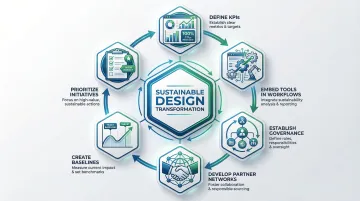
BCG identifies six enablers for sustainable design transformation: defining KPIs, embedding tools in existing workflows, establishing governance, developing partner networks with suppliers and academia, creating baselines, and prioritizing initiatives based on environmental improvement and customer value.
The future of green design technology
Emerging trends will make sustainable design even more powerful and accessible. AI-designed biomaterials—awarded the 2024 Nobel Prize in Chemistry—accelerate discovery of novel compounds with superior environmental profiles. Companies like Ginkgo Bioworks engineer microbes for biofabricated materials, optimizing bioproduction to reduce impact.
Key technologies reshaping green design:
- Blockchain verification — Digital Product Passports provide permanent proof of sustainability claims and complete product tracking, addressing the "perception-reality gap" in green marketing
- Augmented reality visualization — Stakeholders experience environmental impacts in immersive ways; New Balance shortened physical prototyping from 45 days to 7 days, dramatically reducing material waste
- Quantum computing optimization — Handles millions of data points to optimize complex supply chains and design zero-waste systems, with investment accelerating rapidly
Green design technology will become increasingly accessible, making sustainability the default rather than the exception. As tools mature and costs decline, even small organizations will access sophisticated environmental optimization capabilities.
If your climate tech company is working to translate complex technology for buyers who need to trust it before they procure it, the design decisions you make now will determine how fast you move. Let's turn your technical depth into positioning that investors and enterprise buyers understand immediately.