
The positioning crisis facing startups
You've built a genuinely differentiated climate or deep-tech product. Your pilot results hold up. You've raised a meaningful round. But when investors or potential partners land on your website, they still can't tell, in plain terms, what you do or why it matters to them.
That's not a product problem. It's a positioning problem.
CB Insights found that 42% of startups fail due to "no market need" — but for climate and deep-tech startups, this rarely means there's no demand. It usually means the product was never clearly positioned around the problem it solves for a specific buyer. Startups with clear differentiation secure valuations 52% higher than peers who let the market define them.
This guide breaks down the four pillars of strategic positioning, a minimum viable positioning framework you can start using immediately, and the mistakes that keep technically strong startups stuck competing on price rather than value.
TLDR: key takeaways
- Strategic positioning defines where you compete and how you differentiate — it's a business decision, not a marketing task
- Leadership misalignment kills growth through confused messaging and wasted resources
- "Minimum viable positioning" helps pre-PMF startups test market hypotheses before committing significant resources
- Strong positioning increases deal sizes by 145%, shortens sales cycles, and improves conversion rates by 18%+
- For climate and deep-tech startups, positioning must work across multiple audience types simultaneously: investors, enterprise buyers, partners, and policymakers often have fundamentally different needs from the same product
- Visual identity only reinforces positioning credibility when the underlying strategic frame is clear first
Why strategic positioning is make-or-break for startups
The positioning paradox: why founders obsess over product but ignore market position
Founders constantly track MRR, CAC, LTV, and feature velocity. They A/B test button colors and optimize conversion funnels.
Yet they neglect the strategic question that determines whether any of it matters: "Where do we play and how do we win?" This oversight explains why technically superior products lose to inferior competitors, and in climate tech it's particularly common because the founding team's real expertise is the science, not the sales motion.
Positioning shapes four critical business outcomes. Customer perception — how buyers categorize you — determines which alternatives they compare you against. Pricing power flows directly from differentiation: clear positioning justifies premium pricing while ambiguous positioning forces discounting. Competitive set is a choice: strategic positioning lets you choose your battlefield rather than fighting where incumbents are strongest. And talent and capital attraction follow, because investors and employees join companies with clear, compelling market positions.
These outcomes translate directly to financial performance. A 1% improvement in price realization through value positioning yields an 8.7% increase in operating profits.

The hidden cost of positioning by default
When you don't proactively choose your market position, the market assigns one to you, and it's usually based on the first impression you made rather than your actual strengths.
Consider what happens without strategic positioning. Sales teams create inconsistent messaging for different prospects while marketing generates leads that don't match the product's actual strengths. Product teams end up building features to compete on dimensions where the company has no advantage. And pricing becomes arbitrary — based on what customers will pay rather than the value actually delivered.
Companies with clear strategic positioning demonstrate 20% higher resource productivity because focused teams waste less time chasing irrelevant opportunities.
The longer you wait, the more expensive repositioning becomes. Early-stage startups can pivot in weeks. Growth-stage companies require months and risk confusing existing customers. Mature companies face years of restructuring and real brand damage.
Positioning vs. marketing: understanding the strategic difference
Positioning is the strategic foundation that informs all marketing, sales, and product decisions. Treating it as a marketing function is one of the most common ways early-stage startups lose strategic clarity.
| Aspect | Positioning | Marketing |
|---|---|---|
| Nature | Strategic business decision | Tactical execution |
| Timeframe | Long-term (12-36 months) | Campaign-based (weeks to months) |
| Focus | Defines market category and competitive context | Executes messaging within defined position |
| Ownership | CEO and leadership team | Marketing team |
| Outputs | Target segment, value proposition, differentiation strategy | Campaigns, content, ads, events |
As positioning expert April Dunford explains, positioning answers five foundational questions: What are the competitive alternatives? What unique attributes do you have? What value do those attributes deliver? Who cares most about that value? What market category makes that value obvious?
For technical founders in climate and deep-tech, this distinction matters in a specific way. When the CTO is writing the homepage copy, what gets published is usually a technology description, not a positioning statement. The result is a website that accurately describes the product but doesn't answer the questions an investor or enterprise buyer needs answered before they'll take a meeting.
Marketing without clear positioning is directional effort without a destination. You can run campaigns, write content, and hire sales reps, but if the core question of where you compete and how you win hasn't been answered, none of it compounds.
The four pillars of effective startup positioning
Pillar 1: internal alignment - getting leadership on the same page
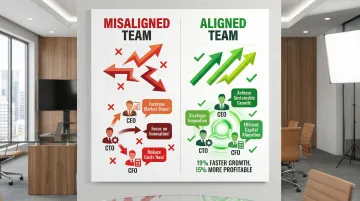
In climate and deep-tech startups, leadership misalignment is particularly acute. The CTO is describing the technology architecture. The CEO is pitching the market opportunity. The business development lead is positioning around regulatory tailwinds. None of them are wrong, but without explicit alignment, those three framings reach prospects as three different products.
Without explicit positioning alignment, this misalignment shows up in confused customer conversations: sales describes the product one way, marketing another, and the product team a third. Prospects sense the inconsistency and lose confidence.
Research shows that highly aligned companies grow 19% faster and are 15% more profitable than misaligned peers, with statistically significant improvements in qualified lead generation, conversion rates, and customer retention.
Tactical exercise: forced-choice positioning workshop
Gather your leadership team and force explicit choices:
- Target segment: which single customer segment do we serve first? (Not "small to mid-size businesses" — name a specific vertical, company size, and use case)
- Primary value: what is the one outcome customers hire us to deliver? (Not three outcomes — one)
- Competitive alternative: what would customers do if we didn't exist? (This reveals your true competition)
- Unique advantage: what can we do that competitors structurally cannot replicate?
Surfacing disagreements early is essential because hidden misalignment doesn't stay hidden when it reaches customers.
Pillar 2: competitive differentiation - identifying unique advantages competitors can't replicate
Features are the easiest thing for competitors to copy. What creates durable competitive positioning is structural advantage: something they cannot replicate without rebuilding core systems, redoing regulatory work, or investing years into vertical expertise.
Framework for identifying unfair advantages:
- Regulatory positioning: compliance certifications or licenses that create barriers (e.g., SOC 2, GDPR-specific architecture, industry-specific accreditations)
- Technical architecture: foundational technology choices that enable capabilities competitors can't match without rebuilding from scratch
- Market access: exclusive partnerships, distribution channels, or network effects
- Vertical expertise: deep domain knowledge that takes years to build
- Execution model: operational approaches that create structural cost or quality advantages
CarbonCure is a useful example of regulatory positioning done well. Rather than competing on the technology's CO2 mineralization efficiency alone, they positioned the company as a generator of high-quality, verifiable carbon credits. That dual framing (technical solution plus financial instrument) created a competitive position that would take years of regulatory work and market validation for any competitor to replicate. For climate tech startups, this kind of regulatory moat is often more durable than any product feature.
For climate tech startups broadly, regulatory compliance and impact measurement often provide stronger differentiation than technology alone. Positioning around "permanence" of carbon removal or "verifiability" of sustainability metrics creates defensible market positions that competitors can't shortcut.
Pillar 3: customer value communication - articulating specific outcomes, not generic benefits
Generic benefit statements create commodity positioning, while specific outcome articulation is what justifies premium pricing and shortens enterprise sales cycles.
Generic (commodity): "Improve operational efficiency"
Specific (premium): "Reduce FX risk management time from 12 hours to 2 hours weekly for finance teams at $50M+ B2B SaaS companies"
Value-based messaging generates 18%+ more conversions than price-based incentives. The research shows that explaining why a product is the right choice outperforms discounting.
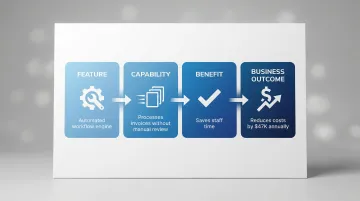
Framework: features to business outcomes
| Feature | Capability | Benefit | Business outcome |
|---|---|---|---|
| Automated workflow engine | Processes invoices without manual review | Saves staff time | Reduces invoice processing costs by $47K annually |
| Real-time compliance monitoring | Flags regulatory issues before submission | Prevents violations | Avoids $250K+ in potential regulatory fines |
| Integrated carbon accounting | Tracks Scope 1-3 emissions automatically | Simplifies ESG reporting | Reduces sustainability reporting time from 40 hours to 4 hours quarterly |
Translate every product capability into measurable business outcomes. This specificity justifies premium pricing and shortens sales cycles by making ROI obvious.
Pillar 4: market context - positioning against established alternatives
Customers never evaluate your product in isolation. They compare it to existing alternatives: competitors, manual processes, or the status quo. In climate and deep-tech, the status quo is often a 20-year-old incumbent solution or, more honestly, doing nothing at all.
Strategic positioning requires understanding the customer's current solution and explicitly positioning against it. This context determines which features matter and which are irrelevant.
Positioning maps: visualizing your unique position
Create a two-axis matrix showing how you differ from alternatives. Plot one axis around a dimension where you're strong — say, "Vertical specialization" — and the other around a dimension competitors emphasize, like "Feature breadth."
Plot yourself and 3-5 alternatives. Your goal is to occupy a distinct position that appeals to your target segment.
Climeworks positioned its Direct Air Capture technology as "premium, permanent carbon removal" rather than competing with cheaper, temporary offset solutions. This positioning attracted sustainability-conscious buyers like Stripe willing to pay 10x more for verified, permanent removal.
Design's role in reinforcing strategic positioning
Strategic positioning remains abstract until design makes it tangible. At What if Design, this is where we spend most of our time with climate and deep-tech founders — translating a positioning that's clear internally into visual assets that communicate it immediately to investors and buyers. Visual identity, brand consistency, and intentional UX decisions are what make positioning credible to someone seeing your company for the first time.
Positioning and design need to align across every touchpoint. The homepage must communicate positioning within the first five seconds. The pitch deck's story arc should reinforce differentiation and target segment. UX decisions in the product interface should reflect positioning — premium vs. accessible, technical vs. simple. And marketing materials need visual consistency that signals professionalism and credibility.
For companies positioning around verified environmental impact, design determines whether that claim reads as credible or performative. Generic stock photos of wind turbines undermine the signal. Specific impact metrics, real project photography, and a visual hierarchy built around your actual differentiation create a presence that holds up in front of a sophisticated buyer or investor. For a climate tech company positioning around verified impact, every design decision either reinforces or undercuts that claim.
Common positioning mistakes that stall growth
Mistake 1: trying to be everything to everyone
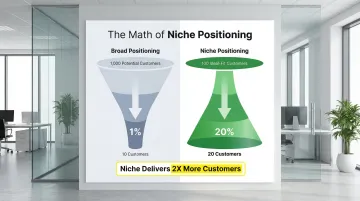
For climate tech startups especially, broad positioning is tempting because the technology genuinely applies across multiple sectors. A carbon accounting platform could serve logistics companies, manufacturers, financial institutions, and retailers. Trying to position for all of them simultaneously produces messaging that none of them find compelling, because the value proposition has to be generic enough to speak to everyone.
When startups expand positioning too broadly, they create unmarketable products that try to serve too many segments, resulting in unclear messaging that resonates with no one.
Geoffrey Moore's "Crossing the Chasm" framework emphasizes the beachhead strategy: dominating a specific niche segment before expanding to adjacent markets. Startups that fail to define a narrow beachhead struggle to gain the momentum needed for mainstream adoption.
Why niche outperforms broad in practice:
The counterintuitive dynamic here is that shrinking your addressable pool often increases your absolute close rate. When you're one of 20 vendors pitching a mid-market manufacturer, you're noise. When you're the only platform built specifically for Scope 3 reporting for Tier 1 automotive suppliers, you're the obvious choice. Deal sizes tend to be larger, sales cycles shorter, and churn lower, because buyers who selected you for a specific reason stay for that reason.
Mistake 2: positioning on price instead of value
Competing primarily on pricing signals lack of unique value and attracts price-sensitive customers who churn at the first cheaper alternative.
The damage extends beyond immediate revenue. SaaS companies that rely on heavy discounting (30%+) face 30%+ higher revenue churn and profit margins 15% lower than value-positioned competitors. Customers who buy on price leave on price. Customers who buy on value stay for results.
Price-based positioning also creates a ceiling on growth. Once you've established yourself as the affordable option, raising prices requires a full repositioning effort, not just a pricing page update.
Mistake 3: ignoring positioning until it becomes a crisis
Treat positioning as a founder priority from day one, not a marketing layer added after product launch. Waiting until positioning becomes a crisis (slowing growth, increasing competitive pressure, or failed fundraising) makes repositioning significantly more difficult and expensive.
Optimal timing for positioning work:
- Pre-launch: define positioning hypotheses
- Early traction (0-10 customers): test through customer conversations
- Pre-PMF: iterate monthly or quarterly based on feedback
- Post-PMF: formalize before major marketing investment
- Growth stage: revisit semi-annually as market shifts
Early positioning work is strategic exploration. When you address it late, after customers have already formed expectations and content has proliferated, it becomes expensive damage control.
Building your minimum viable positioning (MVP)
The MVP positioning framework for early-stage startups
Just as startups build MVPs for products, they need minimum viable positioning to test market hypotheses without overthinking perfection. This approach lets you validate positioning assumptions quickly before committing significant resources.
The three components work together. Start with Minimum: take a stab at your target segment, even if you're uncertain. Then make it Viable: craft enough messaging to test with real prospects. And actually use the Positioning in your assets and customer conversations — otherwise you're theorizing, not testing.
Positioning will change multiple times before product-market fit, so prioritize rapid learning over perfection. Spending six months developing "perfect" positioning wastes time you could spend testing hypotheses with real customers.
Step 1: define your beachhead market segment
Select an initial target segment based on four criteria: problem urgency (how painful is the problem you solve?), budget availability (can they afford your solution?), decision-maker accessibility (can you reach buyers efficiently?), and competitive intensity (how crowded is this segment?).
Evaluation framework:
| Segment | Problem urgency (1-5) | Budget (1-5) | Accessibility (1-5) | Competitive intensity (1-5) | Total score |
|---|---|---|---|---|---|
| Enterprise manufacturing | 5 | 4 | 2 | 5 | 16 |
| Mid-market logistics | 4 | 3 | 4 | 3 | 14 |
| Small construction firms | 3 | 2 | 5 | 2 | 12 |
Target the highest-scoring segment, weighing problem urgency and accessibility most heavily. Narrow is better than broad — depth of understanding, word-of-mouth concentration, and efficient resource allocation all favor focused positioning.
Step 2: identify your 3 core differentiators
Guide your team through identifying the top 3 unique advantages that matter most to your beachhead segment.
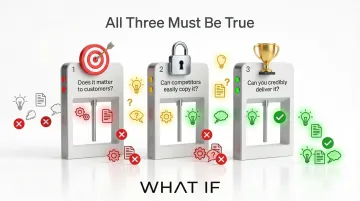
Filtering framework (all three must be true):
- Does it matter to customers? (Solves a real problem or delivers meaningful value)
- Can competitors easily copy it? (Structural advantage, not just features)
- Can you credibly deliver it? (Proven capability, not aspirational)
For climate tech startups specifically, the filtering question of "can competitors easily copy it?" often turns on regulatory work and verification partnerships rather than product features. A carbon removal company that has spent three years building MRV infrastructure has a structural advantage that a competitor with better software can't bypass.
For climate tech startups, strong differentiators often sound like: "Only solution with pre-certified EU Taxonomy alignment" (regulatory compliance), "Tracks Scope 3 emissions with 95% accuracy vs. industry standard 60-70%" (sustainability metrics), or "Verified carbon removal with 1,000-year permanence guarantee" (impact measurement).
Avoid generic differentiators like "easy to use," "great customer service," or "innovative technology." These claims are unverifiable and don't create meaningful differentiation.
Step 3: craft your positioning statement
Once you've identified your differentiators, use this template to create a concise positioning statement:
"For [target segment] who [problem/need], [product name] is a [market category] that [unique value proposition]. Unlike [competitive alternatives], we [key differentiator]."
The following are illustrative templates to show how the structure works in practice. Fill in brackets with your actual specifics.
Example 1 (Vertical SaaS — illustrative template): "For mid-market logistics companies managing perishable goods shipments, [your product] is a unified logistics platform that provides real-time visibility across all carriers. Unlike generic TMS solutions, it's built specifically around cold-chain compliance monitoring, reducing spoilage-related chargebacks by [X]%."
Example 2 (Climate tech — illustrative template): "For enterprises required to report Scope 3 emissions who lack supplier data, [your product] is an automated emissions accounting platform that estimates Scope 3 with 95% accuracy using spend data. It delivers audit-ready reports in 48 hours rather than the 3 months your sustainability team is spending today."
Example 3 (Deep tech — illustrative template): "For direct air capture operators who need cost-effective CO2 concentration, [your technology] is a modular sorbent system that reduces capture costs by [X]%. It retrofits existing DAC infrastructure with minimal downtime, avoiding the capital cost of full system replacement."
Step 4: test and iterate based on customer conversations
Validate positioning through customer discovery interviews, sales calls, and website analytics.
Track a handful of signals across your conversations. Ask prospects to explain back what you do — if they struggle, your positioning is unclear. Note which alternatives they mention, because that reveals how they're actually categorizing you. Track objection patterns, since consistent concerns signal positioning mismatches. And watch your conversion funnel: how many discovery calls convert to demos, demos to trials, trials to customers?
Pre-PMF startups should review positioning monthly or quarterly, adjusting based on consistent feedback patterns. Don't change positioning based on one conversation, but if 5+ prospects express the same confusion or objection, your positioning needs refinement.

Implementing and testing your positioning strategy
Cascading positioning across all customer touchpoints
Positioning must be consistently reflected across every customer interaction. The website homepage needs to pass the 5-second clarity test — can visitors immediately understand what you do and who it's for? Your pitch deck's story arc must reinforce target segment, problem, and differentiation. Sales presentations should highlight differentiated capabilities through discovery questions and demo flow. Product onboarding must deliver on the positioning promises made before the sale. Customer support language needs to reinforce value, not just resolve tickets. And all marketing campaigns must speak to the same target segment and value proposition.
If your website says "enterprise solution" but your sales team pitches to startups, neither segment will trust you. Inconsistent messaging confuses prospects and weakens your positioning signal at exactly the moment when clarity matters most.
Positioning consistency checklist:
- [ ] Homepage headline matches positioning statement
- [ ] Pitch deck opens with target segment and problem
- [ ] Sales demo emphasizes differentiated capabilities
- [ ] Product UI reflects positioning (technical vs. simple, premium vs. accessible)
- [ ] Support documentation uses consistent terminology
- [ ] Marketing content addresses beachhead segment specifically
Once you've aligned your touchpoints, track whether your positioning actually works.
Measuring positioning effectiveness
The metrics that indicate positioning success show up in your commercial performance. Strong positioning justifies premium pricing, so watch your average deal size. Clear positioning shortens time-to-decision, so track sales cycle length. Effective positioning attracts qualified prospects, reducing your lead-to-customer conversion effort and your CAC. And differentiated positioning wins more head-to-head battles — your competitive win rate is the most direct signal that your positioning is landing.
Companies that shift from feature-based to outcome-based positioning with specific, measurable value propositions often see significant improvements — sometimes 100%+ gains in both deal size and conversion rates.
To measure positioning impact accurately, compare cohorts before and after the change, tracking the same metrics for 90 days on each side. Control for seasonality and concurrent campaigns, and isolate positioning from other variables like pricing or product updates.
The role of design in positioning execution
Once positioning is defined, design translates strategy into visual assets that communicate differentiation. Visual consistency and intentional UX decisions reinforce positioning credibility.
For climate tech startups, design determines whether sustainability positioning feels authentic or performative. The generic approach undermines credibility: stock photos of solar panels and wind turbines, vague environmental messaging, generic green color schemes. The differentiated approach signals seriousness: specific impact data visualization, authentic project photography, and thoughtful color palettes aligned with brand positioning.
For example, when a climate tech company positions around "verified impact measurement," design elements should emphasize data transparency, precision, and scientific rigor. When positioning emphasizes "accessible sustainability tools," design must prioritize simplicity and approachability over technical complexity.
When and how to evolve your positioning
Recognizing when positioning needs to change
Watch for these signals that your positioning needs updating. Slowing growth — win rates declining or sales cycles lengthening — is usually the first sign. So is increasing competitive pressure from new entrants positioning directly against you. If your product capabilities have expanded beyond what your original positioning communicates, you've created a gap between what you can deliver and what the market expects from you. Shifting market dynamics, including regulatory changes and economic conditions, can make previously valid positioning suddenly misaligned. And if inbound leads consistently fall outside your ICP, your positioning is attracting the wrong buyers.
Distinguish between tactical messaging tweaks and fundamental positioning pivots. Updating a homepage headline is tactical. Changing your target segment or market category is strategic.
Once you've identified the need for a positioning shift, the challenge becomes execution without alienating your existing customer base.
How to evolve positioning without confusing existing customers
Managing positioning transitions requires deliberate communication:
- Internal alignment first: ensure leadership agrees on new positioning before external changes
- Communicate to existing customers: explain how the evolution benefits them specifically
- Update materials consistently: change all touchpoints within a compressed timeframe (2-4 weeks, not 6 months)
- Train sales teams thoroughly: equip them with new messaging, objection handling, and competitive positioning
- Monitor customer feedback: track confusion or concerns and address proactively
Real-world example: horizontal to vertical pivot
Userlist evolved from "email automation" (crowded, generic category) to "customer messaging for SaaS" (specific, differentiated category).
They applied April Dunford's positioning framework through customer interviews, identifying that their unique value was SaaS-specific features like event tracking and cohort analysis. The repositioning clarified their value proposition and differentiated them from horizontal tools like Mailchimp.
The transition succeeded because they communicated clearly to existing customers, updated all materials simultaneously, and trained their team on new messaging before launch.
Frequently asked questions
What is the difference between positioning and branding?
Positioning defines where you compete and how you differentiate — your target segment, competitive alternatives, and unique value. Branding expresses that strategy through visual identity, messaging, and customer experience. Positioning comes first; branding makes it tangible.
When should a startup develop its positioning strategy?
Start positioning work during product development, not after launch. Define positioning hypotheses before writing code, then test through customer discovery. Formalize positioning before major marketing or sales investment to ensure efficient resource use.
How often should startups revisit their positioning?
Pre-PMF startups should review positioning monthly or quarterly, iterating based on customer feedback and market response. Post-PMF companies benefit from semi-annual reviews to ensure positioning remains relevant as the product and market evolve. Immediate reviews are necessary when major market shifts, competitive threats, or product expansions occur.
What are the biggest positioning mistakes early-stage startups make?
The three most common mistakes are: trying to serve too broad a market instead of focusing on a specific beachhead segment, competing on price instead of differentiated value, and waiting until positioning becomes a crisis before addressing it strategically. Each mistake compounds over time, making correction more expensive.
How do you know if your positioning is working?
Measurable indicators include: shorter sales cycles, higher conversion rates from lead to customer, larger average deal sizes, fewer "what do you do?" questions from prospects, increased inbound leads from your target segment, and higher competitive win rates. If prospects immediately understand your value and how you differ from alternatives, your positioning is working.
Can positioning be too narrow or niche?
Narrow positioning is typically the path to initial traction and category leadership. Dominating a small segment builds momentum, case studies, and word-of-mouth that enable expansion. You can broaden after establishing beachhead dominance — starting broad makes traction nearly impossible.
Positioning isn't a one-time deliverable. It's a living frame for every conversation you have with your market. The founders who get this right don't just close deals faster — they build companies that the market understands, seeks out, and trusts.
If your messaging hasn't evolved since your last raise, or if you're preparing for a visibility moment (a conference, a partnership announcement, a new fundraising cycle), this is the right time to pressure-test it. What if Design works with Seed to Series B climate and deep-tech startups to translate technical depth into positioning that investors and buyers understand immediately. If you're not sure whether your current messaging is creating the signal clarity your stage requires, an audit is a practical place to start.