You've built something real. The pilot is running. The funding is in the bank. But when a potential enterprise partner or investor pulls up your website, what do they find?
For many climate tech and deep-tech SaaS companies, the brand hasn't kept pace with the business. The website still reads like a technical whitepaper. The messaging speaks to engineers, not to the procurement teams, asset managers, or VCs who actually make the buying decision. With 78% of B2B buyers narrowing their vendor shortlist to 3-5 options before any sales conversation begins, that gap costs you deals you never knew you lost.
This is where a full-service branding agency becomes a strategic asset, not a vendor. Full-service agencies handle everything from positioning and visual identity to website architecture and product interface design, ensuring the brand your prospects encounter reflects the company you've actually become.
The global SaaS market is projected to reach $465 billion in 2026. In climate tech and deep-tech specifically, where trust is harder to build and sales cycles run 6-24 months, the right branding partner is the difference between a website that closes deals and one that just explains your technology.
Here are 10 agencies with the SaaS expertise to close that gap.
TL;DR
- Full-service branding integrates strategy, identity, and implementation across all customer touchpoints
- For climate tech and deep-tech SaaS companies, look for agencies that understand complex-sale environments and multi-audience messaging
- This list includes 10 agencies with proven track records serving B2B SaaS from early-stage through enterprise
- Agencies were selected for SaaS-specific expertise, portfolio quality, service depth, and demonstrated business outcomes
- Investment typically ranges from $25,000-$75,000 for early-stage companies to $200,000+ for enterprise rebrands
What makes full-service branding different for SaaS companies
Full-service branding agencies handle everything from strategic positioning and messaging architecture to visual identity, website design, and product interface branding.
This integrated approach ensures consistency across the entire customer journey, from initial awareness through product adoption and renewal.
Why SaaS companies need comprehensive branding
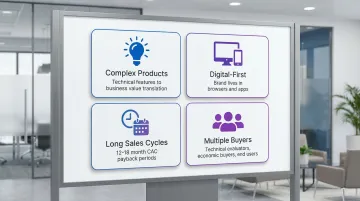
SaaS companies in climate tech and deep-tech face compounding challenges that make integrated branding more consequential than in most software sectors:
- Complex products require translation, not just explanation - A carbon accounting platform or grid analytics tool needs messaging that works for a utility procurement team, a CFO approving the budget, and an ESG officer evaluating compliance risk. Those are three different conversations that a piecemeal approach will almost never get right simultaneously.
- Digital-first brands need to work on every screen - Your brand lives in browsers, product dashboards, investor decks, and conference slides. Inconsistency across those surfaces signals operational immaturity to exactly the people you're trying to convince.
- Long sales cycles demand consistent messaging - With customer acquisition cost payback periods extending to 12-18 months in B2B SaaS, every touchpoint either builds or erodes trust. There is no neutral.
- Multiple buyer personas with different risk tolerances - Technical evaluators want proof of methodology. Economic buyers want ROI clarity. End users want adoption ease. A full-service agency builds messaging architecture that speaks to all three without sacrificing coherence.
Full-service vs. specialized providers
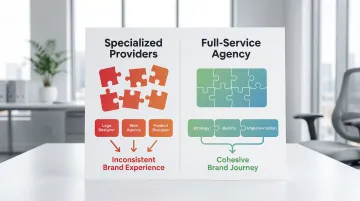
Specialized providers — logo designers, web agencies, product designers — focus on individual components but regularly create disconnects between brand strategy and execution. That fragmentation is particularly damaging for climate tech companies, where buyers already approach new technologies with skepticism. If your website signals innovation but your pitch deck looks like a template from 2018, that inconsistency registers, even if no one says it out loud.
Full-service agencies deliver clearer ROI when you're launching in a category that doesn't have established buyer language yet, when repositioning requires coordinated changes across all channels at once, when your marketing site and product experience are telling different stories, or when you've raised funding but lack the internal bandwidth to coordinate multiple vendors.
This is the core problem a full-service agency solves: the website promises one thing, the product delivers another, and the sales materials describe something else entirely. For climate and deep-tech companies selling to risk-averse enterprise buyers, that inconsistency can quietly kill deals.
10 best full-service branding agencies for SaaS companies in 2026
We selected these agencies based on SaaS-specific expertise, portfolio quality, client results, service breadth, and ability to serve companies at various growth stages.
What if Design
Most agencies treat climate tech like any other software vertical. They apply the same SaaS playbook — hero section, feature grid, generic social proof — without understanding that your buyer might be an enterprise utility running a 12-month procurement process, or a Series A investor deciding whether your narrative is fundable before they've even taken the first call.
What if Design partners specifically with US-based climate tech and deep-tech startups from Seed through Series B. Founded in 2020, the studio combines technical fluency across areas like carbon accounting, grid modernization, and clean energy infrastructure with human-centered storytelling that makes complex technologies legible to non-technical stakeholders.
The work is outcome-oriented: investor-ready websites that reduce the number of explanatory questions in the first pitch meeting, brand systems that help close first pilots, and visual identity frameworks that let your sales team have a different conversation with a CFO than with a CTO. They typically deliver a full brand identity in four weeks or less, faster than most agencies spend on discovery alone.
Where they stand out:
- Deep domain fluency in climate and deep-tech means less time explaining your technology and more time building the brand that closes deals
- Full-service from positioning through product design, so the brand your investors see matches the product your users experience
- Minimum Viable Brand (MVB) model for early-stage companies that need to move fast without sacrificing strategic clarity
- Embedded design partnership for Series A-B companies that need ongoing creative capacity without committing to full-time hires
You can review their climate tech and deep-tech portfolio at whatifdesign.co.
| Category | Details |
|---|---|
| Specialization | US-based climate tech and deep-tech SaaS companies, Seed to Series B |
| Notable clients | TATA1mg, Pristyn Care, Ministry of Health Saudi Arabia, Accel Partners |
| Key services | Brand strategy and positioning, visual identity, website design, product UX, investor decks |
Directive Consulting
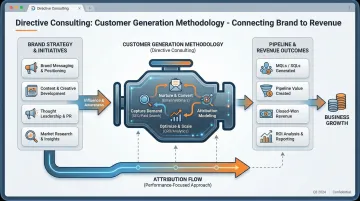
Directive Consulting is a performance-focused partner for B2B SaaS companies, using their Customer Generation methodology to connect branding directly to pipeline and revenue outcomes.
Unlike traditional branding agencies that focus on awareness metrics, Directive integrates brand strategy with demand generation and revenue operations, tying creative output to pipeline data and CRM-level attribution.
Key differentiators:
- Deep SaaS expertise across the full funnel from awareness to closed-won
- CRM-level attribution connecting brand initiatives to revenue, not just impressions
- Integrates creative with paid media, content, and conversion optimization
- Focus on measurable business impact rather than vanity metrics
| Category | Details |
|---|---|
| Specialization | B2B SaaS demand generation, brand strategy, and revenue-focused marketing |
| Notable clients | Enterprise and growth-stage SaaS companies |
| Key services | Brand strategy, positioning, paid media, content, conversion optimization, website design, go-to-market strategy |
Ramotion
Founded in 2009 and based in San Francisco, Ramotion has built a 15-year track record translating brand strategy through both marketing and product experiences. Their client list spans Netflix, Stripe, Adobe, Mozilla, and Clearbit, which signals the kind of technical SaaS credibility that matters when selecting a partner for complex, digital-first brand work.
Ramotion's full-service scope runs from brand strategy through web app development, and their track record includes products with tens of thousands of active users. What sets them apart technically is a specialization in digital-first brand expression — built for screens rather than adapted to them — and design systems that maintain consistency across both marketing and product interfaces at scale.
| Category | Details |
|---|---|
| Specialization | Technology companies and SaaS platforms requiring unified brand-to-product design |
| Notable clients | Netflix, Stripe, Adobe, Mozilla, Clearbit, Descript, Salesforce |
| Key services | Brand strategy, visual identity, web design, product design, app development |
MetaLab
MetaLab works with SaaS companies like Slack and Coinbase, and their dual focus on brand identity and product design creates an integration that most agencies don't offer: the brand experience your marketing site promises is the one users actually encounter inside the product. For SaaS companies where user adoption is part of the value proposition, that continuity matters.
Key differentiators:
- Product-led branding approach that defines brand through the user experience, not despite it
- User research and testing throughout development validates decisions with actual target users before launch
- Technical sophistication allows brand consistency even inside complex product interfaces
- Portfolio shows experience across both consumer and B2B software at scale
| Category | Details |
|---|---|
| Specialization | Integrated brand and product design for software companies |
| Notable clients | Slack, Coinbase, Headspace |
| Key services | Brand identity, product design, user research, interface design, prototyping |
Collins
Collins operates as a transformation consultancy rather than a traditional design agency, which changes what they prioritize in the engagement. Their work with Stripe, Dropbox, Airtable, and Figma reflects experience at the moments that matter most: when a company is moving from scrappy to institutional, and the brand needs to carry that shift without losing what made it credible in the first place.
Key differentiators:
- Integrated approach combining strategy, design, and messaging into a unified system rather than sequential deliverables
- Collaborative process that keeps brand work connected to the product roadmap and business strategy, not siloed in a creative workstream
- Demonstrated ability to communicate technical complexity clearly to non-technical audiences
- Recognition by Ad Age and D&AD for design excellence
| Category | Details |
|---|---|
| Specialization | High-growth SaaS companies requiring comprehensive brand systems |
| Notable clients | Stripe, Dropbox, Airtable, Figma, Spotify |
| Key services | Brand strategy, positioning, visual identity, voice and tone, implementation |
Pony Studio
If your brand currently looks like every other SaaS company — gradient background, neutral sans-serif, stock photography of laptops — Pony Studio is worth a look. This London-based studio, founded in 2019, is known for bold brand expressions in Web3, AI, and SaaS that actively distinguish their clients from the visual sameness that dominates tech marketing.
Key differentiators:
- Distinctive aesthetic that helps SaaS companies stand out rather than blend into a category
- Data-informed approach combined with creative decisions that aren't driven by convention
- Consistent craft across brand, website, and product interface work
- Suited for tech-forward companies that see their brand as a competitive tool, not a formality
| Category | Details |
|---|---|
| Specialization | High-impact branding for Web3, AI, and SaaS companies |
| Notable clients | Paradym, Seda, Lab5 |
| Key services | Brand strategy, visual identity, website design, product interface design |
Character
Founded in 1999 in San Francisco, Character has spent 25 years building brand strategy and identity for technology companies. Their process starts with competitive analysis, customer research, and market positioning before any visual work begins. By the time they're designing a logo or color system, those choices are anchored in competitive positioning, not aesthetic preference alone.
Key differentiators:
- Research-first methodology ensures design decisions are grounded in where you need to sit in the market
- Distinctive and confident visual expressions that help software companies occupy a clear position in crowded categories
- Brand systems built to scale as companies add product lines, expand markets, and evolve their positioning
- Long track record serving technology companies through multiple growth stages
| Category | Details |
|---|---|
| Specialization | Strategic brand positioning for growth-stage SaaS companies |
| Notable clients | Growth-stage technology companies |
| Key services | Brand strategy, competitive analysis, positioning, visual identity, brand systems |
The Brand Strategy Lab
The Brand Strategy Lab draws on 11 years of B2B SaaS experience through its sister agency Contensify, a content and demand generation firm. That operational context shapes how they approach brand work: positioning and messaging decisions are connected to how the brand will actually perform in demand generation, not just how it looks in a style guide.
The sister agency relationship with Contensify provides working knowledge of how brands perform across the B2B SaaS funnel — not just how they look in a style guide. Their approach covers positioning through visual identity through implementation without handoff gaps, with a focus on making brands market-ready in the ways that matter for pipeline and partnerships. They specialize in companies launching new brands or repositioning existing ones for a new growth stage.
| Category | Details |
|---|---|
| Specialization | B2B SaaS companies launching or repositioning brands |
| Notable clients | B2B SaaS companies |
| Key services | Brand strategy, positioning, visual identity, messaging, brand implementation |
Vector
Vector is a London-based SaaS design specialist with transparent startup pricing, focused on increasing conversion through memorable brands and improving retention through intuitive product UX/UI. Their embedded approach means they work closely with small, fast-moving teams rather than operating as an outside vendor.
Key differentiators:
- Embedded working style suited to small teams that need a design partner, not a project manager
- Expertise solving specific performance problems: poor marketing site conversion, feature UX bottlenecks, unclear onboarding flows
- Track record helping startups and scaleups execute their first major brand or product upgrade without months of process overhead
- Transparent pricing starting at $8,000 USD (£6,500) for visual identity packages
| Category | Details |
|---|---|
| Specialization | SaaS startups and scaleups executing major brand or product upgrades |
| Notable clients | RockawayX, EmailOctopus, Lumis, Ticketpass |
| Key services | Brand identity, website design and development, product UX/UI design |
Moving Brands
Moving Brands works with technology companies at all stages, from growth-stage SaaS to global enterprises navigating transformation. Their "living identity" approach is built on the principle that digital brands need to move, not just sit on a page. Their client work for Asana, Vanta, and Netflix demonstrates what that looks like in practice: brand systems with dynamic elements that adapt to different contexts while staying coherent.
Key differentiators:
- Strategic capabilities including research, competitive positioning, and messaging architecture
- Flexible identity systems with dynamic elements that adapt across contexts without losing coherence
- Global presence supporting SaaS companies expanding into international markets
- Motion-first design sensibility suited to digital-native brands that need to perform across video, product, and web
| Category | Details |
|---|---|
| Specialization | Technology companies and SaaS businesses at all growth stages |
| Notable clients | Asana, Vanta, Evisort, Budibase, Netflix |
| Key services | Brand strategy, research, positioning, visual identity, flexible brand systems |
Which agency is right for your stage and situation?
The 10 agencies on this list serve meaningfully different company stages, sectors, and brand challenges. Here's a practical guide to narrowing your options before you reach out.
Climate tech or deep-tech SaaS, Seed to Series B
If you're selling technically complex products into risk-averse industries — energy, utilities, industrial infrastructure, climate tech — and need a brand that works for investors, enterprise procurement teams, and technical evaluators simultaneously, What if Design is purpose-built for this. Their sector fluency means less time onboarding your agency and more time building the brand that moves your next raise or pilot forward.
B2B SaaS with pipeline and revenue attribution goals
If your primary goal is connecting brand investment directly to pipeline, and you have the marketing infrastructure to support that attribution, Directive Consulting integrates brand strategy into demand generation and revenue operations rather than treating them as separate workstreams.
SaaS companies with a brand-to-product continuity gap
If your marketing site and your product experience are telling different stories — and that gap is creating adoption or trust friction — MetaLab and Ramotion both specialize in unified brand-to-product design systems.
High-growth SaaS at a strategic inflection point
If you're moving from early-stage to institutional, and the brand needs to carry that shift, Collins has done this for Stripe, Dropbox, and Figma at exactly those moments.
SaaS brands that want to stand out visually
If you're tired of looking like every other SaaS company and want a brand that actively differentiates, Pony Studio builds bold, distinctive expressions for Web3, AI, and SaaS companies.
B2B SaaS launching or repositioning
If you're entering a new market or redefining your category position, The Brand Strategy Lab and Character both specialize in the strategic foundation work that makes repositioning stick.
SaaS startups with lean budgets
If you need a capable design partner with transparent pricing and an embedded working style, Vector offers clear startup-friendly packages starting at $8,000 for visual identity.
Global SaaS expansion
If you're taking a digital-native brand into international markets and need systems that adapt across contexts without losing coherence, Moving Brands has the global presence and motion-first methodology for that work.
How we chose the best full-service branding agencies
To compile this list, we reviewed each agency's publicly available portfolio case studies, client testimonials, process documentation, and stated pricing. We cross-referenced agency claims against documented client outcomes, prioritizing evidence of measurable business impact — conversion improvements, pipeline influence, or brand adoption metrics — over design awards alone. Agencies were excluded where portfolios were predominantly consumer-focused, where strategic capabilities couldn't be evidenced beyond visual execution, or where their process didn't demonstrate experience with the multi-audience messaging complexity that enterprise B2B software companies require.
We evaluated agencies using criteria specifically relevant to SaaS companies, not just general branding capabilities. For climate tech and deep-tech companies especially, our assessment prioritized the ability to translate technical complexity, experience with long sales cycles, and evidence of work that moved business outcomes rather than just earned design awards.
SaaS-specific requirements
Top agencies for climate and deep-tech SaaS companies demonstrate a genuine understanding of multi-audience messaging challenges — the same product needs different positioning for investors, enterprise buyers, channel partners, and technical evaluators. They can translate technically complex features into business outcomes that non-technical stakeholders actually care about. Their portfolio should show work with B2B software companies operating in regulated, complex-sale environments like energy, climate, or industrial sectors. And they should carry enough domain familiarity that they don't need a primer on your business model before the work can begin.
Common selection mistakes
SaaS companies make several avoidable mistakes when selecting agencies. The most common is prioritizing aesthetic appeal over strategic capabilities — producing beautiful work that doesn't move buyers. Related to this is hiring generalists who lack experience with subscription business models and technically complex products, or choosing based on agency reputation rather than relevant portfolio work at a comparable company stage. The most overlooked factor: whether the agency's working style and communication cadence fits how your team actually operates.
Key evaluation factors
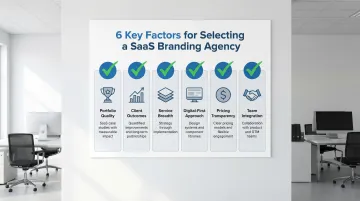
We considered these dimensions:
- Portfolio quality: Case studies showing SaaS expertise across different growth stages with measurable business impact, not just design awards
- Client outcomes: Quantified improvements in conversion, engagement, or brand awareness, plus evidence of long-term partnerships rather than one-off projects
- Service breadth: End-to-end capabilities from strategy through implementation, including brand-to-product design integration
- Digital-first approach: Understanding of how brands function within digital products, with experience in design systems and component libraries
- Pricing transparency: Clear pricing models for different company stages with flexible engagement structures, whether project-based or retainer
- Team integration: Proven ability to collaborate with product and go-to-market teams, working within existing workflows rather than alongside them
Conclusion
The right full-service branding agency understands your business model, can translate your technical depth into language that moves enterprise buyers and investors, and builds brand systems that stay consistent across every touchpoint in a long sales cycle.
Evaluate agencies based on demonstrated results with SaaS companies at your stage, not portfolio aesthetics or agency reputation. The questions that matter most: Do they understand your buyer's world? Can they show you how their work changed a specific business outcome? And can they move at the speed your timeline requires?
For climate tech and deep-tech companies specifically, there is an additional filter: does the agency understand the trust dynamics of selling novel technology into risk-averse industries? That is where sector fluency stops being a nice-to-have. In a market where 94% of B2B marketers identify trust as a prerequisite for purchase intent, your brand is either building that trust or eroding it — with every investor conversation, every website visit, every sales deck.
If your website hasn't evolved since your last raise, that's the place to start.
Connect with us to talk through what your brand needs to do at your next stage.
Frequently asked questions
What makes a branding agency "full-service" for SaaS companies?
Full-service agencies handle everything from strategic positioning and messaging to visual identity and implementation across websites, product interfaces, and marketing materials. This ensures brand consistency throughout the customer journey, rather than creating disconnects between strategy and execution.
How much does it cost to hire a full-service branding agency for a SaaS company?
Early-stage SaaS companies typically invest $25,000-$75,000, growth-stage companies spend $75,000-$200,000, and enterprise SaaS companies invest $200,000+ for a complete brand overhaul. For climate tech and deep-tech startups specifically, agencies with sector fluency can often move faster, which affects the total engagement cost.
How long does a typical SaaS branding project take with a full-service agency?
Comprehensive branding engagements typically span 8-14 weeks, covering discovery and research, strategic development, visual identity creation, and brand system development with website implementation. Agencies with deep sector familiarity — particularly those specializing in climate or deep-tech — often move faster because less time is spent on technology education.
Should early-stage SaaS startups hire a full-service branding agency?
Consider a full-service agency when you've achieved product-market fit and are preparing to scale, when you have budget for strategic brand investment, or when you're entering a competitive market where how you present matters to the deals you're trying to close. For climate tech startups, the threshold is often a funding event or an upcoming conference or enterprise pilot that requires your brand to do more heavy lifting than it currently does.
What's the difference between a branding agency and a design agency for SaaS?
Branding agencies focus on strategic positioning, messaging architecture, and visual identity, while design agencies focus on execution: websites, product interfaces, and marketing assets. Full-service agencies combine both. The practical difference is that a full-service agency can hold the strategic thread across everything they produce, while a design-only agency needs a brief to work from.
How do I know if a branding agency understands SaaS business models?
Evaluate whether the agency asks questions about your customer acquisition cost, lifetime value, sales cycle length, product-led vs. sales-led motion, and expansion revenue strategy. Their portfolio should demonstrate work for B2B software companies with similar business models and target audiences. For climate tech and deep-tech companies, also ask whether they understand the multi-stakeholder sales environment: selling to enterprises in energy, utilities, or heavy industry requires different positioning than selling general-purpose SaaS.