You've closed your seed round. Your pilot is running. You're starting to hire. And your website still looks like it was built over a weekend two years ago.
The issue isn't just aesthetics. For climate tech and deep tech SaaS companies, a website that reads like a research paper or feels unfinished is a credibility problem that surfaces in every investor call, partnership conversation, and enterprise sales cycle. Buyers and partners are doing their diligence before they ever speak to you, and what they find shapes whether they move forward.
This guide walks through the top Webflow agencies with verified SaaS portfolios and real Figma-to-Webflow expertise, so you can find a development partner who understands the timeline pressure, the technical complexity, and what it takes to build a site that works as a commercial asset rather than a digital brochure.
TLDR
- 8 vetted agencies with proven SaaS portfolios and Figma to Webflow expertise
- Pricing: $5,000 (growth-stage) to $50,000+ (enterprise builds)
- Key differentiators include SaaS CMS architecture, third-party integrations, and scalability planning
- Specialized agencies deliver in 2-4 weeks vs. months with traditional development
- Professional builds achieve measurable gains: 30% performance improvements and 3X faster page creation in documented cases
Why Webflow agencies work for SaaS startups
Climate tech and deep tech SaaS companies face a specific bottleneck that most generic agencies don't account for: your engineering team is doing irreplaceable work. Whether that's developing a hydrogen electrolysis process, building grid analytics software, or advancing a carbon capture pilot, pulling technical talent into website iteration cycles is genuinely costly. Webflow removes that bottleneck by giving marketing teams the ability to manage content, test messaging, and update pages without requiring developer involvement.
Gartner projected that by 2025, 70% of new applications would use low-code or no-code technologies, a trend driven by the need to move faster without scaling engineering headcount in parallel. Forrester research found that low-code platforms can accelerate development by 10X compared to traditional methods, which matters when you're racing toward a Series A or preparing for a key conference.
The Figma to Webflow advantage
A structured Figma-to-Webflow handoff reduces the back-and-forth that slows startups, cutting the time between design approval and a live site. Standard projects using this workflow complete in 2-4 weeks, compared to months with traditional development cycles. The Figma to Webflow plugin automates layout conversion, syncs design tokens, and transfers assets directly, reducing the manual reconstruction work that adds time and introduces inconsistencies.
SaaS-specific technical requirements
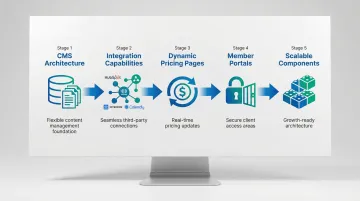
Specialized agencies understand what climate tech and deep tech SaaS companies need beyond a basic marketing site:
- CMS architecture for content marketing at scale: blog posts, case studies, technical resources, and impact reporting
- Integration capabilities with HubSpot, Intercom, Calendly, and analytics tools
- Dynamic pricing pages that update without developer involvement
- Member portals and gated content for lead nurturing
- Scalable component systems that grow from MVP to enterprise while maintaining visual and messaging consistency as your product and team scale
Resource efficiency for startups
For climate and deep tech startups where technical salaries often exceed $150,000 and every hire needs to be defensible to your board, outsourcing website development to a specialized agency keeps your team focused on what they were hired to do. A $12,000 agency project delivers a complete marketing site for less than one month of a senior engineer's salary, without the hiring costs, equity dilution, or ongoing overhead.
A senior engineer spending 20% of their time on website updates is an expensive cost that rarely shows up in a project budget. A focused agency engagement makes that cost explicit and finite.
Top 8 Webflow agencies for SaaS startups
These agencies were selected based on verified SaaS portfolios, Figma-to-Webflow expertise, transparent pricing, and documented results with startup clients. Each brings distinct strengths suited to different stages and needs.
Agency 1: Shadow Digital
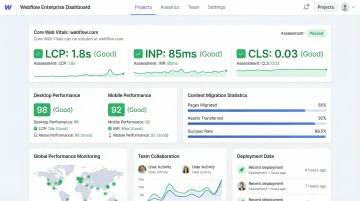
Shadow Digital's most telling result is the TSIA project: 200+ pages migrated in 6 weeks with a 112% mobile speed increase. That kind of execution matters when your marketing team is blocked waiting for a developer. They're a Webflow Enterprise Partner specializing in enterprise-grade migrations and multi-language implementations for scaling SaaS companies.
Why they stand out: Shadow Digital excels at large-scale content migrations and performance optimization. For their work with Bench, a fintech SaaS, they delivered 450 new pages in 6 months alongside a 30% performance boost, the kind of result that directly affects SEO, paid acquisition, and user experience at scale.
| Category | Details |
|---|---|
| Services offered | Enterprise Webflow migrations, multi-language site builds, CMS architecture, Figma to Webflow conversion, performance optimization, marketing team training |
| SaaS specialization | Worked with Bench (fintech SaaS, 450 new pages in 6 months with 30% performance boost), TSIA (200+ page migration in 6 weeks), Attentive (enterprise messaging platform) |
| Pricing range | $30,000+ for enterprise projects; custom quotes for complex migrations |
| Best for | Series B+ SaaS companies with large content libraries, multi-language requirements, or complex migration needs |
Agency 2: Veza Digital
Grata achieved two years of consistent 30% growth in traffic and conversions after working with Veza Digital. Chili Piper saw 90%+ traffic growth post-migration. These aren't design outcomes, they're pipeline outcomes, which is the distinction that matters for B2B SaaS companies where website performance connects directly to qualified leads.
Why they stand out: Veza Digital builds websites around demand generation rather than static presentation, connecting design decisions to traffic, conversion, and pipeline outcomes. Their integrated approach to design, development, and growth marketing addresses the full funnel rather than treating the website as a one-time deliverable.
| Category | Details |
|---|---|
| Services offered | Webflow design and development, SEO optimization, CRO testing, content strategy, HubSpot integration, ongoing growth support |
| SaaS specialization | Extensive B2B SaaS portfolio including Grata (5X ROAS), Chili Piper (90%+ traffic growth), Adonis; specializes in conversion-focused architecture |
| Pricing range | Growth packages: $5,000-$12,000; Enterprise: $15,000-$50,000+ |
| Best for | Seed to Series A SaaS startups prioritizing rapid growth and demand generation over pure design aesthetics |
Agency 3: Refokus
Refokus is a Webflow Enterprise Partner that generated $1M+ in revenue from Webflow projects in their first year and has launched 200+ sites. Their portfolio includes technically demanding SaaS builds like Brightwave, Josys, and Botify, companies where the design had to keep pace with complex product functionality.
Why they stand out: Refokus uses Webflow to compress development timelines and reduce build costs without sacrificing design quality, which matters when you're trying to launch fast at Series A without cutting corners on brand presentation. Their focus is design-forward SaaS brands where visual differentiation is part of the competitive strategy.
| Category | Details |
|---|---|
| Services offered | Premium Webflow design and development, advanced animations and interactions, API integrations, custom CMS solutions, brand identity work |
| SaaS specialization | Portfolio includes Brightwave (AI analytics), Josys (SaaS management platform), Botify (enterprise SEO); focuses on design-forward SaaS brands |
| Pricing range | Custom pricing; projects typically start at $6,000+ with enterprise builds significantly higher |
| Best for | Well-funded startups (Series A+) where brand differentiation and premium design are competitive advantages |
Agency 4: Flowout
Flowout specializes in rapid Figma-to-Webflow conversions with an unlimited design and development subscription model. They're trusted by major SaaS brands including Jasper.ai, Stripe, and Kajabi for ongoing website work.
Why they stand out: Flowout's workflow is built for speed and continuity. For startups that need to iterate on messaging, test landing pages, or push frequent updates, their subscription model provides predictable costs and removes the project-by-project overhead that slows momentum.
| Category | Details |
|---|---|
| Services offered | Figma to Webflow conversion, unlimited design and development subscriptions, CMS setup, responsive design, interaction implementation, ongoing website updates |
| SaaS specialization | Works with Jasper.ai (AI writing platform), Stripe (payments infrastructure), Kajabi (online course platform); specializes in rapid iteration cycles |
| Pricing range | Subscription model with monthly fees; project-based pricing also available starting around $5,000 |
| Best for | Fast-moving startups that need continuous website updates and prefer subscription pricing over per-project fees |
Agency 5: Flow Ninja
Flow Ninja has built sites for Upwork and ClickUp, both platforms with significant content volume, complex user journeys, and enterprise requirements. Their work emphasizes scalable systems rather than one-off builds.
Why they stand out: Flow Ninja combines strategic planning with technical execution, with a focus on sites that can grow without requiring a rebuild at each funding stage. Their emphasis on CMS architecture and analytics implementation means the site is built to inform decisions, not just present information.
| Category | Details |
|---|---|
| Services offered | Strategic Webflow development, enterprise scalability planning, CMS architecture, API integrations, conversion optimization, analytics implementation |
| SaaS specialization | Portfolio includes Upwork (freelance marketplace), ClickUp (project management), Hotjar (analytics); expertise in complex SaaS platforms |
| Pricing range | $8,000-$40,000+ depending on complexity and scope |
| Best for | Growth-stage SaaS companies (Series A-B) planning for scale and requiring strategic partnership beyond basic development |
Agency 6: Amply
Amply functions as an extension of clients' marketing teams with a specific focus on conversion-focused design for B2B SaaS. Based in Utah's Silicon Slopes, they bring a 34-person team to projects.
Why they stand out: Amply's methodology is built around business outcomes rather than design aesthetics. Their B2B SaaS specialization means they understand buyer journeys, lead scoring, and marketing automation requirements, which is the difference between a site that looks good and one that actually feeds pipeline.
| Category | Details |
|---|---|
| Services offered | Conversion-focused Webflow design, B2B SaaS website development, marketing automation integration, lead generation optimization, retainer-based support |
| SaaS specialization | Clients include Awardco (employee recognition), Anvilogic (security analytics), Zeni (AI bookkeeping); deep B2B SaaS expertise |
| Pricing range | Retainer and project models; custom pricing based on scope and ongoing support needs |
| Best for | B2B SaaS startups focused on enterprise sales where website conversion rates directly impact pipeline |
Agency 7: Finsweet
Finsweet created the widely-used Client-First styling system and has built a reputation for taking on the most technically demanding projects in the Webflow ecosystem. Their work with Jasper.ai and tools like Jetboost demonstrates the ceiling of what they can build.
Why they stand out: Finsweet tackles projects other agencies typically can't handle: complex API integrations, advanced CMS structures, and custom functionality that goes well beyond standard Webflow capabilities. If your requirements include custom data pipelines, complex member portals, or non-standard integrations, they're built for that.
| Category | Details |
|---|---|
| Services offered | Complex Webflow development, API integrations, advanced CMS automation, custom code solutions, technical consulting, Client-First system implementation |
| SaaS specialization | Portfolio includes Jasper.ai (AI writing), Jetboost (Webflow add-on tools); specializes in technically demanding projects requiring custom solutions |
| Pricing range | $15,000-$60,000+ for complex technical projects |
| Best for | SaaS companies with unique technical requirements, complex data structures, or custom functionality needs beyond standard Webflow capabilities |
Agency 8: What if Design
What if Design specializes in website design and development for climate tech, clean tech, and deep tech SaaS companies. As a certified Design Declares agency, they bring strategic design thinking to climate and deep tech companies working to bring first-of-a-kind technologies to market.
Why they stand out: What if Design combines Figma to Webflow expertise with deep domain knowledge in climate and sustainability sectors. Their 4-12 week delivery timeline includes strategic site mapping, technical illustrations, and SEO-focused builds specifically built for companies communicating complex technologies to investors, enterprise buyers, and partners who are skeptical of early-stage vendors. Because they work exclusively in this space, the onboarding is faster and the output reflects the actual commercial context your buyers are operating in.
| Category | Details |
|---|---|
| Services offered | SEO-focused Webflow builds, Figma to Webflow conversion, CMS setup, third-party integrations (HubSpot, Calendly, Google Analytics), conversion-focused copywriting, technical illustrations |
| SaaS specialization | Portfolio includes LabStart (climate tech venture studio), Susteon (renewable energy), HYDGEN (hydrogen technology), Shine Billing (solar data platform); specializes in climate tech and deep tech |
| Pricing range | Significantly lower cost than maintaining an in-house senior designer; custom pricing with 4-12 week project timelines; subscription models available |
| Best for | Climate tech, clean tech, and deep tech SaaS startups needing a design partner who understands complex technologies and can translate them into websites that earn credibility with investors, enterprise buyers, and partners |
Figma to Webflow conversion: what to look for
Quality Figma to Webflow conversion directly impacts your site's performance, maintainability, and scalability. Poor conversions create technical debt that compounds over time, affecting everything from load speeds to your team's ability to make updates independently.
Climate tech and deep tech founders are often managing a fundraise, a product launch, or a major conference on a short timeline. In that context, website development gets compressed, shortcuts get taken, and the result is a site that looks fine at launch but becomes a maintenance burden six months later. The difference between a good and bad conversion comes down to two factors: how well the design translates across devices, and whether common structural mistakes are avoided at the outset.
Design fidelity and responsive behavior
Professional conversions maintain pixel-accurate rendering across all breakpoints. When evaluating an agency's technical capabilities, look for evidence of expertise in these areas:
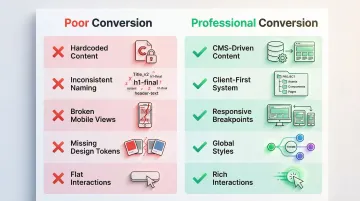
- Figma frames built without auto-layout won't map correctly to Webflow's flexbox structures, requiring manual reconstruction that adds time and can introduce layout inconsistencies
- Component architecture: Proper mapping between Figma components (instance overrides) and Webflow components (properties and slots) is what makes a site maintainable without developer involvement after launch
- Tablet and mobile views require manual adjustment beyond what the plugin's automated containers produce
- Animation implementation: Complex interactions such as scroll triggers and hover effects require manual rebuilding in Webflow's interaction editor
Common pitfalls to avoid
Even agencies with strong technical skills can miss critical details during conversion. These mistakes are rarely obvious at launch but create maintenance problems for SaaS teams managing rapid product iterations:
- Content baked into page structures instead of CMS collections, making updates require developer involvement every time
- Non-scalable class naming: Inconsistent naming conventions that make future updates difficult (the Client-First system exists precisely to solve this)
- Designs that render correctly on desktop but break on mobile due to insufficient breakpoint testing
- Missing design tokens: Failure to establish global styles for colors, typography, and spacing before conversion creates visual inconsistency that grows harder to fix as the site scales
- Interactive elements from Figma that don't transfer, resulting in a static site that doesn't reflect the quality of the original design
Agencies with real SaaS experience understand that conversion quality affects your team's velocity. A well-structured Webflow build lets marketing teams update content independently, while a poorly converted site forces every change through a developer queue, which is expensive and slow when you're iterating on messaging before a product launch or funding announcement.
How we chose these agencies
Most agency comparison lists stop at portfolio screenshots and client logos. This one doesn't. Here's what actually separates a Webflow agency that serves climate and deep tech SaaS well from one that delivers a generic build with technical debt baked in.
Selection criteria
SaaS portfolio review: Each agency had to demonstrate at least three verified SaaS case studies with measurable results: traffic growth metrics, conversion rate improvements, performance benchmarks, and documented outcomes — not just screenshots or vague claims.
Figma to Webflow expertise: We verified that agencies use structured handoff processes rather than ad-hoc approaches, including Client-First system implementation, auto-layout mapping capabilities, design token synchronization, component architecture understanding, and responsive conversion problem-solving.
Startup-friendly processes: We evaluated alignment with startup realities: communication transparency, pricing clarity and flexibility, understanding of tight event-driven timelines (conferences, fundraises, product launches), willingness to work within constrained budgets, and support for iterative development. Agencies requiring enterprise minimums or lengthy onboarding processes were deprioritized.
Technical capabilities: We assessed each agency's ability to handle SaaS-specific requirements: CMS architecture for content marketing, third-party integrations (HubSpot, Intercom, analytics), API connections, and member portal functionality.
Domain alignment
The best agency partnerships for climate and deep tech companies go beyond technical execution. For agencies in this space, domain familiarity is a practical advantage: less time explaining why your hydrogen electrolysis process is different from electrodialysis, more time building the assets that communicate it. For climate and deep tech companies with complex technologies and multiple audience segments, that knowledge gap matters.
Conclusion
The agencies listed here have the track record. Bench achieved a 30% performance boost and 3X faster page creation after working with Shadow Digital. Grata achieved consistent 30% growth over two years after partnering with Veza Digital. These aren't design outcomes, they're commercial ones.
For climate tech and deep tech SaaS companies, the right agency gives you a website that earns credibility before the first conversation, communicates complex technology without requiring a 20-minute explainer, and scales without requiring a developer for every content update.
The practical next step is straightforward: evaluate agencies based on your current stage and near-term goals. If you're pre-Series A and moving toward your first enterprise pilots, prioritize agencies with climate or deep tech portfolios, structured handoff processes, and the ability to build on Webflow's CMS. If you're scaling post-raise with a larger content library, look for enterprise migration experience and CMS architecture depth. Ask specifically about their Figma-to-development handoff process, how they approach communicating complex innovations, and what post-launch support looks like.
If your website doesn't yet reflect the company you've built, that's the gap worth closing. Get an audit to identify where your site is losing credibility and what it would take to fix it.
Frequently asked questions
Are Webflow developers in demand?
Yes, Webflow developers are in high demand, particularly in the SaaS and startup space. Based on publicly available compensation data, average hourly rates in the US sit in the $35-$45 range, with specialized or senior practitioners commanding significantly more, reflecting strong market demand for these skills.
How much do Webflow developers charge?
Webflow developers typically charge $20-$45 per hour for freelance work. For project-based engagements, expect $5,000-$12,000 for growth-stage sites covering 10-15 pages, CMS setup, and standard integrations, and $15,000-$50,000+ for enterprise builds with 20+ pages, multi-language support, and advanced features.
Is Webflow relevant in 2025?
Yes. Webflow's adoption has grown steadily among SaaS marketing teams, and recent enterprise features including Single Sign-On (SSO), native localization, and advanced security capabilities position it as a credible platform for scaling companies. The ability to manage and iterate on web content without engineering involvement is a meaningful operational advantage for teams moving fast.