You've built a carbon accounting platform or a grid analytics tool that solves a real problem. The product works. You've probably closed your first pilots. But your website still reads like a technical spec sheet, and enterprise buyers are struggling to understand the value before the first call.
This isn't a design problem. It's a positioning gap. When your website can't translate what your software does into language that makes sense to procurement teams, utility buyers, or sustainability officers, you're losing deals before a conversation even starts.
This guide covers eight Webflow agencies that have worked with SaaS companies on marketing sites, conversion architecture, and integration-heavy builds — and a framework for deciding which type of partner fits where you are right now.
TLDR
- SaaS-specific expertise matters more than Webflow certification — ask to see pricing page conversion work, not just portfolio aesthetics
- Budget realistically: early-stage builds run $15K-$40K; enterprise migrations with multi-language CMS and deep integrations can reach $200K+
- Timeline expectations vary by complexity — 6-8 weeks for focused marketing sites, 12-16 weeks for large-scale migrations
- For climate and energy software specifically, prioritize agencies that can translate technical product depth into buyer-friendly messaging
Why SaaS companies choose Webflow in 2026
Speed and marketing autonomy
Webflow projects typically launch in 6-8 weeks, compared to 12-16 weeks for traditional development builds. The difference comes from Webflow's visual development environment, which removes the handoff cycle between design and engineering.
For climate and energy software companies shipping product updates frequently, this matters. Your marketing team can update pages, build campaign landing pages, and test variations without waiting on development sprints — which is a meaningful operational advantage when you're moving fast between funding rounds or conference deadlines. In 2026, CSRD reporting requirements are expanding the buyer pool for carbon accounting and ESG software, creating new demand signals that climate tech marketing teams need to respond to quickly.
Performance built in
Webflow sites run on AWS and Fastly CDN infrastructure, delivering high uptime and optimized Core Web Vitals by default. GQueues, a task management SaaS, reported a 67% improvement in website performance scores after migrating to Webflow, as documented by BRIX Agency, the agency that handled the migration. For software buyers who abandon slow sites, this performance directly affects your pipeline.
Seamless integration ecosystem
For climate software companies managing long sales cycles and complex buyer journeys, the Webflow integration ecosystem covers the key touchpoints:
- CRM sync: HubSpot and Salesforce for automatic lead capture
- Payment processing: Stripe for pricing page integration
- Customer engagement: Intercom for real-time support
- Automation: Zapier connecting to 5,000+ apps without code
Total cost of ownership
| Cost factor | Webflow | WordPress/Custom |
|---|---|---|
| Hosting and security | Included (enterprise-grade) | Separate costs + SSL fees |
| Maintenance | Zero (managed platform) | High (plugin updates, patches) |
| Development speed | Faster (visual coding) | Slower (backend dev required) |
| Predictability | Fixed subscription + retainer | Unpredictable break/fix costs |
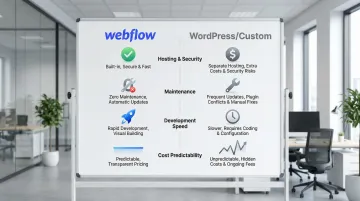
For mid-sized SaaS startups, Webflow's managed infrastructure frees resources from technical debt, creating capacity for growth and conversion work instead.
Top 8 Webflow development agencies for SaaS companies in 2026
These agencies were selected based on proven SaaS portfolio work and client testimonials, technical capabilities with integrations and migrations, and a clear understanding of SaaS business models and conversion optimization.
Shadow Digital
Shadow Digital, based in San Francisco, focuses on enterprise migrations and performance optimization for high-traffic SaaS sites. For climate software companies managing large content architectures — regulatory documentation, technical product pages, research summaries across multiple verticals — their migration work is worth examining.
They completed a 200+ page migration for TSIA in six weeks, which gives a reasonable benchmark for scope and timeline on complex projects. Their emphasis on building systems that non-technical teams can manage independently matters when your marketing team needs to publish content without waiting on dev resources.
| Category | Details |
|---|---|
| SaaS specialization | Enterprise migrations, complex CMS architectures, performance optimization for high-traffic SaaS sites |
| Notable SaaS clients | Attentive, Bench, TSIA, Netgain |
| Pricing range | $30,000+ for typical SaaS projects |
Veza Digital
Operating from Toronto and New York since 2018, Veza Digital approaches SaaS website development with an SEO-first lens. Their model prioritizes pipeline and organic demand generation over visual output, which makes them a reasonable candidate for growth-stage B2B SaaS companies focused on reducing customer acquisition costs through search.
Veza Digital has published client outcomes showing organic pipeline growth for B2B SaaS companies, though third-party roundups like this agency playbook summarize these results rather than linking to primary case studies. When evaluating their work, ask for direct client references and specific before/after metrics.
| Category | Details |
|---|---|
| SaaS specialization | SEO-first strategies, demand generation, growth-stage B2B SaaS optimization |
| Notable SaaS clients | Dialectica, B2B Tech firms (multiple anonymous reviews) |
| Pricing range | $8,000-$10,000+ for typical projects |
Flowout
Founded in 2021 with offices in Slovenia and the US, Flowout uses a subscription model for ongoing Webflow design and development. For climate software companies that need frequent campaign pages, product announcements, or content updates without going through a full agency project cycle each time, this model reduces friction significantly.
Their team of 50-200 operates as an extension of client marketing teams, which works well for fast-moving product launches, feature announcements, and campaign landing pages.
| Category | Details |
|---|---|
| SaaS specialization | Subscription-based ongoing development, rapid iteration for marketing teams, growth-focused builds |
| Notable SaaS clients | Jasper, ActiveCampaign, Stripe, Kajabi |
| Pricing range | Subscription models and projects from $5,000+ |
Flow Ninja
Established in 2015, Flow Ninja describes itself as one of the largest dedicated Webflow teams globally, with 65+ in-house team members across Serbia and the US. They've completed over 200 projects with a focus on enterprise-quality execution at startup timelines.
Their strength is in custom animations and interaction design for SaaS companies that need advanced user experiences, particularly where the product demo flow or feature visualization requires technical execution beyond standard Webflow builds.
| Category | Details |
|---|---|
| SaaS specialization | Enterprise-grade scalability, custom animations, growth-focused design patterns, complex integrations |
| Notable SaaS clients | Upwork, Checkout.com, Domo, Trustly |
| Pricing range | $10,000+ for typical SaaS projects |
StanVision
Founded in 2017 and based in Sofia, Bulgaria, StanVision takes a product-oriented approach that combines UX strategy with visual design. Their work has been recognized by Awwwards and CSS Design Awards.
Where they stand out is in designing for freemium and trial conversion models — understanding how to structure the user journey from free account to paid plan through architecture and messaging hierarchy, rather than just visual polish.
| Category | Details |
|---|---|
| SaaS specialization | UX/UI for SaaS products, conversion-focused marketing sites, freemium and trial model optimization |
| Notable SaaS clients | Jasper.ai, Primer, Consentmo |
| Pricing range | $10,000+ for typical projects |
BRIX Agency
San Francisco-based BRIX Agency, founded in 2015, built one of the more widely used Webflow component libraries. That component-based approach enables faster builds with more consistency — which matters when you need to move quickly without rebuilding the design system from scratch on each new page.
Their specific focus on pricing page architecture and B2B SaaS website design, including the multi-stakeholder decision flows that enterprise buyers follow, makes them worth evaluating for companies where the pricing page is a primary conversion point.
| Category | Details |
|---|---|
| SaaS specialization | Pricing page CRO, B2B SaaS website design, component-based development for iterative builds |
| Notable SaaS clients | Paradox, Teachable, Yesware, Upside |
| Pricing range | $25,000-$50,000 for mid-range projects |
SVZ Design
Operating from Los Angeles since 2013, SVZ Design handles enterprise-scale projects for publicly traded companies. As a Webflow Enterprise Partner of the Year finalist in 2022, they're known for performance engineering and high-stakes migrations.
For SaaS companies with global customer bases requiring multi-language sites, or companies with regulatory content that needs careful CMS architecture, SVZ has relevant experience at the required scale.
| Category | Details |
|---|---|
| SaaS specialization | Enterprise-scale CMS, multi-language sites, complex migrations for publicly traded SaaS companies |
| Notable SaaS clients | Zendesk, Kajabi, Fivetran, Patreon, Envoy |
| Pricing range | $50,000+ for enterprise engagements |
What if Design
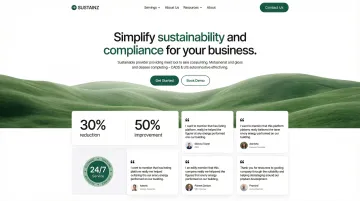
What if Design, founded in 2020, focuses specifically on climate tech, clean tech, and deep-tech SaaS companies at Seed to Series B. The difference from general Webflow agencies is domain fluency. The team can read a technical whitepaper, understand the regulatory context their clients operate in, and translate that depth into positioning that makes sense to investors, enterprise buyers, and policy stakeholders.
Their work covers full-service brand and website builds, from visual identity through Webflow development and product UX. Clients include TATA1mg, Pristyn Care, HYDGEN, and Susteon, as well as portfolio companies backed by Accel Partners.
For climate software companies where the product is technically complex and the buyer requires significant education before converting, the combination of domain knowledge and design execution is difficult to find in general Webflow agencies. We work with companies where the credibility gap between what the technology can do and what the website communicates is holding back pilots, partnerships, or the next funding round.
| Category | Details |
|---|---|
| SaaS specialization | Climate tech, clean tech, and purpose-driven SaaS; full-service from brand identity to Webflow development to product UX |
| Notable SaaS clients | TATA1mg, Pristyn Care, HYDGEN, Susteon, and portfolio companies backed by Accel Partners |
| Pricing range | Cost-effective relative to traditional agencies; full brand and website builds typically delivered in 4 weeks or less |
How to choose the right Webflow agency for your SaaS company
Look beyond portfolio aesthetics
The most common misstep in agency selection is evaluating portfolios the same way you'd evaluate a design award winner. A visually striking site built for a consumer brand or a fintech startup doesn't tell you much about an agency's ability to architect the conversion flow for carbon accounting software or structure the messaging hierarchy for a grid analytics platform.
When you're selling to utility procurement teams or sustainability officers at large manufacturers, your agency needs to understand how those buyers think and what they need to see before they're willing to start a conversation. That requires SaaS business model fluency, not just design craft. Ask specifically about their experience with technically complex products and long sales cycles — those two factors change the design requirements significantly.
Evaluate technical integration capabilities
Your agency should have demonstrated experience with the integrations your stack depends on:
- HubSpot, Salesforce for lead capture and CRM sync
- Segment, Google Analytics, Hotjar for user behavior tracking
- Stripe for pricing page and subscription management
- Intercom, Drift for in-page support and qualification
- Zapier, Make for workflow automation without custom dev
Request specific portfolio examples showing these integrations in production. A general statement about connectivity is not the same as having built a HubSpot-connected demo request flow with Segment event tracking for a B2B SaaS client.
Understand cost drivers
Budget varies significantly based on project scope:
| Project scope | Budget range | What's included | Timeline |
|---|---|---|---|
| Early-stage SaaS | $15K-$40K | Core marketing site, basic CMS, essential integrations | 6-8 weeks |
| Growth-stage SaaS | $40K-$80K | Conversion optimization, scalable CMS, deep integrations, custom animations | 8-12 weeks |
| Enterprise SaaS | $80K-$200K+ | Complex migrations, multi-language, advanced security, compliance features | 12-16+ weeks |
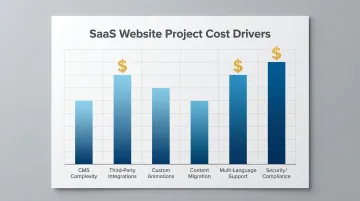
The factors that drive cost up most significantly:
- CMS complexity and programmatic SEO structures
- Number and depth of third-party integrations
- Custom animations and motion design
- Content migration from legacy systems
- Multi-language or multi-region requirements
Assess process and post-launch support
SaaS companies need agencies that support iteration after launch, not just deliver a finished site and disappear. The handoff quality — documentation, training, and how responsive they are when something breaks — matters as much as what they build.
Key factors to assess:
- Timeline transparency: Clear phases from discovery through launch, with milestones
- Training offerings: Will they train your marketing team to manage content independently?
- Documentation: Do they provide comprehensive handover materials?
- Retainer options: Can they support ongoing optimization and updates post-launch?
- Response time: How quickly do they handle urgent requests once the project is live?
Red flags vs. green flags
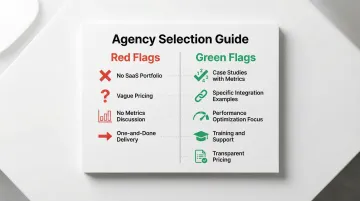
Red flags to watch for:
Watch out for agencies with no SaaS clients in their portfolio, or whose work is exclusively B2C and ecommerce with no relevance to software buying journeys. Be skeptical of pricing that seems low for the scope — custom SaaS sites with deep integrations rarely come in under $10K without meaningful compromises. If there's no conversation about conversion metrics, lead capture architecture, or how the site supports the sales process, that's a signal the agency doesn't understand SaaS fundamentally. And a proposal that ends at launch with no mention of training, documentation, or ongoing support should be treated as incomplete.
Green flags worth noting:
Look for case studies with concrete, measurable outcomes tied to specific campaigns or redesigns — signup rate improvements, reduced bounce on pricing pages, increased engagement for key buyer segments. Specific examples of HubSpot, Salesforce, or API implementations with technical detail are a stronger signal than a general claim of "we integrate with everything." Agencies that raise Core Web Vitals and performance optimization as part of the build process — without being asked — understand that performance affects pipeline. Training and documentation included in the engagement, not treated as add-ons, and transparent pricing with clear scope definitions are the basics that serious agencies don't hedge on.
Conclusion
A Webflow agency that has built generic B2C ecommerce sites is a different hire from one that has redesigned the pricing architecture for a grid analytics platform or rebuilt the conversion flow for a carbon management SaaS. The difference shows up in how quickly they understand your product, how precisely they can scope the work, and how useful the output is once your team takes over.
For climate and energy software companies specifically, the agency you choose needs to understand why your buyers are cautious — long procurement cycles, skepticism toward early-stage vendors, multiple stakeholders in a single deal — and design around those realities rather than ignoring them.
When you evaluate candidates, prioritize evidence over promises: specific migration case studies, real conversion metric outcomes, and a clear explanation of how they approach handoff and training so your team can maintain the site independently.
If your current website isn't doing enough of the sales work before the first call, that's a positioning gap worth fixing.
Frequently asked questions
What should climate software companies specifically look for in a Webflow agency?
Beyond general SaaS experience, look for agencies that understand technically complex products and long sales cycles. Climate and energy software often involves multiple buyer types — procurement teams, technical operators, financial decision-makers — and your website needs to speak to each of them differently. Ask specifically whether the agency has experience structuring segmented messaging and multi-audience conversion flows, not just building visually clean sites.
How much does it cost to hire a Webflow agency for a SaaS website?
Budget ranges from $15K for early-stage marketing sites to $100K+ for complex enterprise builds. Most mid-market SaaS companies spend $30K-$60K for a full redesign. For climate software companies with complex content requirements, deep integrations, or multi-audience messaging needs, budget toward the higher end of each tier.
How long does it take to build a SaaS website with Webflow?
Typical timelines range from 6-12 weeks depending on complexity. Focused marketing sites with standard integrations sit at the shorter end; enterprise migrations with multi-language CMS, compliance requirements, and complex content architecture take 12-16 weeks or more.
Should I hire a Webflow agency or use templates for my SaaS website?
Templates can work for very early-stage companies with tight budgets and straightforward needs. Once you have product-market fit, are closing pilots, or are preparing for a fundraise or major conference, the signal your website sends matters enough to warrant custom work — particularly if your product is technically complex and buyers need the website to do meaningful education before the first call.
What should I look for in a Webflow agency's SaaS portfolio?
Look for case studies showing concrete outcomes tied to specific redesigns or campaigns, evidence of integrations with SaaS tools at the technical level (not just checkbox mentions), and variety in SaaS business models across their work. For climate and energy software, it's worth asking whether they've worked with products that require buyer education, not just SaaS tools with obvious, self-evident value propositions.
Can Webflow handle complex SaaS product features and integrations?
Webflow handles marketing websites well and integrates with most SaaS tools via APIs, webhooks, or automation platforms like Zapier. The SaaS product application itself is typically built separately using tools like Memberstack or custom backends, with Webflow serving as the public-facing marketing and content site. For climate software companies, this means your Webflow site covers the pre-conversion journey — awareness, education, lead capture — while the product application lives elsewhere.