Your pilot is live. You've secured funding. You're hiring your first commercial team. And yet, when a potential enterprise buyer or investor lands on your website, they leave without understanding what your technology actually does or why it matters to them.
This isn't a messaging problem in the abstract sense. It's a structural gap between where your company is and how your brand communicates it. Technical founders building first-of-a-kind climate solutions are trained to explain how the technology works, not what problem it solves for the specific person reading the page.
This article breaks down how experience design (XD) bridges that gap: what it actually encompasses, why it matters specifically for climate tech companies navigating long sales cycles and skeptical buyers, and where to start if you're ready to make your brand do more work.
TLDR: key takeaways
- Experience design (XD) coordinates every touchpoint: your website, product interface, sales materials, customer onboarding, and investor communications
- For climate tech startups, XD is especially relevant because your buyers need to trust you before they'll commit to a multi-year contract
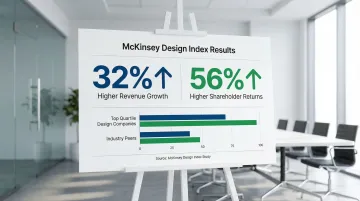
- Design-led companies outperform peers by 32% in revenue growth and 56% in shareholder returns
- Effective XD requires research, strategic messaging, interaction design, visual systems, and systems thinking working together
What is experience design?
Experience design is the practice of shaping how people move through and feel about every interaction with your product, service, and brand, including moments you haven't thought of as "design" at all.
For a climate tech company, this might mean the gap between how your website positions the technology and what your sales team actually says in a first call, or between what your pitch deck promises and what the onboarding experience delivers. A single buyer journey often spans website visits, demos, procurement conversations, onboarding flows, and ongoing account management. XD treats these as a connected system, not isolated touchpoints.
Where traditional design disciplines each own a narrow layer, XD coordinates them:
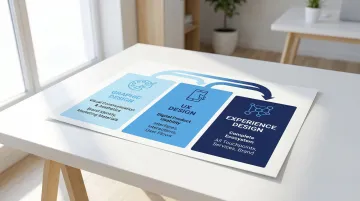
- Graphic design focuses on visual communication and aesthetics
- UX design focuses on digital product usability and interface interactions
- Experience design coordinates the entire system, ensuring consistency and coherence across all touchpoints
Core philosophy
XD is built on four foundational principles:
- Human-centered - Starts with deep understanding of the people making decisions, including what they're accountable for organizationally and what they need to justify a purchase internally
- Evidence-driven - Grounds decisions in research and testing rather than assumptions about what buyers want to see
- Iterative - Treats the first version as a hypothesis and refines based on real-world feedback from sales conversations, user behavior, and buyer interviews
- Holistic - Considers how individual touchpoints combine into a complete picture of your company's credibility and capability
These principles become concrete when applied to actual commercial challenges.
XD in action
Consider how companies like Aurora Solar approached their buyer experience. Rather than designing a generic solar software interface, they structured their platform onboarding around the specific workflows of solar installers and project developers: the real sequence of steps those users follow when designing and quoting a project. The result was a product that felt immediately familiar to the people using it, which accelerated adoption in a market that tends to resist new tools.
The same logic applies to your website, your sales materials, and every other touchpoint a buyer encounters. When your buyers need to justify a purchase to their CFO, their procurement team, and their board, every element of your experience either builds or erodes the confidence that justifies that commitment. In markets where trust cycles are long, the experience around your product often determines whether a pilot converts to a commercial deal.
Core elements of experience design
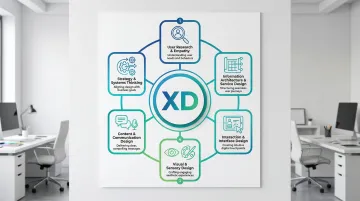
Experience design integrates six foundational elements. Each one addresses a different layer of the credibility and clarity problem that climate tech companies face.
User research and empathy
XD starts with understanding who actually makes the buying decision, not just who uses the product day-to-day. In climate tech, this distinction matters: the procurement officer approving a multi-year energy contract has fundamentally different questions than the operations engineer integrating your solution into existing infrastructure.
Research methods that inform XD include:
- Stakeholder interviews that uncover why deals stall, not just what users need functionally
- Journey mapping that captures the full arc from first awareness through contract renewal, identifying where your experience creates friction or confusion
- Competitive analysis that maps how your presentation compares to better-funded incumbents at each stage of a buyer's evaluation
- Quantitative review of where visitors drop off on your website or product, which surfaces gaps that interviews alone won't reveal
Research validates assumptions and ensures design decisions address the real barriers to adoption rather than the ones you assume are in play.
Information architecture and service design
XD structures how information is organized so buyers can navigate your offering without needing a deep technical background. For climate tech companies, this often means designing separate pathways for different decision-makers: an investor wants proof of market viability and team credibility, a procurement officer needs compliance documentation and integration specs, and an operations team needs training resources and support clarity. Serving all three from a single website requires deliberate architecture, not just a longer page.
Core tools include information hierarchy design, service blueprints that map what happens internally to support front-stage customer interactions, and content structures that surface the right evidence at the right moment in a buyer's evaluation process.
Interaction and interface design
XD designs the moment-to-moment interactions a user has with your product or platform, whether that's navigating a carbon accounting dashboard, configuring a grid optimization tool, or completing an onboarding flow. For software-heavy climate tech companies, interface design is often where early impressions are formed and where technical complexity either becomes clear or pushes buyers toward competitors.
This includes how your product responds to inputs, how information flows between screens, what feedback mechanisms confirm that an action worked, and how visual hierarchy guides a user through complex data. While it's one layer within XD, it's typically the one most buyers interact with first in a product trial or demo.
Visual and sensory design
Aesthetics do practical work in climate tech beyond creating a good impression. A visual identity that reads as technically sophisticated and credible signals to enterprise buyers and institutional investors that you're a serious company with the depth to be a long-term partner. Color systems, typography hierarchies, iconography, and photography each carry specific signals that either align with or undercut your positioning.
One concrete example: photography that shows real operating environments and quantified outcomes communicates proof in a way that stock imagery of wind turbines and solar panels does not. The visual choices you make either reinforce the claims you're making or create cognitive dissonance for a skeptical buyer.
Content and communication design
Language is where most climate tech brands lose credibility, not because they say the wrong things, but because they say the right things to the wrong audience. A website that leads with electrochemical process efficiency rates is speaking to a technical reviewer, not the procurement officer deciding whether to schedule a demo.
Content design at the XD level includes structuring your messaging hierarchy so the most decision-relevant claims appear first, writing copy that guides buyers through complex flows without requiring customer support, and building educational content that shortens the sales cycle by answering objections before a prospect thinks to raise them. Technical products benefit most from content that translates depth into clarity without losing accuracy.
Strategy and systems thinking
XD at its highest level asks: how does this experience fit into the broader system your buyer operates in? For climate tech companies, this means understanding that a utility buyer operates under regulatory constraints, that an enterprise sustainability buyer is accountable to ESG reporting frameworks, and that a government procurement officer moves at a fundamentally different pace than a Series A startup.
Practical implications include designing your product to integrate with existing workflows rather than requiring behavioral change, structuring your messaging around the organizational incentives your buyer actually faces, and building brand systems that can scale as your company moves from pilot to commercialization without needing a full redesign every six months.
Why experience design matters
Experience design delivers measurable business impact backed by substantial research, and the case for investing in it is proportionally stronger in climate tech, where credibility gaps are more costly and trust cycles are longer.
Financial performance
McKinsey's Design Index study tracked 300 publicly listed companies over five years across medical technology, consumer goods, and retail banking. The findings for companies in the top quartile for design strength were consistent:
- Revenue growth outpaced industry peers by 32 percentage points
- Total shareholder returns ran 56 percentage points higher
- The gap between top-quartile performers and the rest was disproportionate: the difference between second, third, and fourth quartiles was comparatively small, while the top tier pulled significantly ahead
These results held across physical goods, digital products, and services alike. For climate tech companies, where building trust with enterprise buyers requires more investment than in consumer markets, the financial case for experience design is proportionally stronger.
Beyond financial metrics, experience design creates competitive advantages in markets where the underlying technology is difficult to differentiate at a glance.
Competitive differentiation
In markets where multiple vendors are solving similar problems, experience becomes the deciding factor for buyers who are evaluating options without the technical background to distinguish between them on the merits. This is especially common in climate tech, where buyers are often making first-of-a-kind procurement decisions.
A few patterns from companies that have navigated this well:
- Climeworks (direct air capture) built a transparent impact reporting interface that lets buyers verify carbon removal outcomes in real time, directly addressing the credibility gap that has made carbon markets difficult to trust for enterprise buyers
- Aurora Solar structured its platform onboarding around the existing workflows of solar project developers, which reduced the learning curve that typically slows adoption of new software in the construction-adjacent trades
- Span (smart electrical panels) designed a customer experience that made home electrification feel manageable rather than technically intimidating, addressing the primary adoption barrier in their market
The common thread is that each company treated the experience around the product as a deliberate strategic decision that directly influenced how buyers perceived their credibility and capability.
Organizational transformation
Adopting XD requires structural changes to how decisions get made. In early-stage climate tech companies, this often surfaces as a tension between the technical team controlling product development and whoever is responsible for sales and marketing controlling how the company is presented externally. When those two groups are not aligned on messaging and experience, buyers notice the inconsistency.
Top-performing design organizations tend to share three characteristics:
- Cross-functional integration: designers are embedded with engineering and commercial teams rather than operating in a separate creative function that delivers outputs without context
- Measurement parity: design performance is tracked with the same rigor as financial metrics, including conversion rates, trial activation rates, and pipeline influence
- Buyer-driven decisions: customer feedback shapes product roadmap and messaging priorities through structured mechanisms, not just occasional anecdotes from the sales team
Research shows that over 40% of companies don't talk to end users during development, and 50% have no objective way to assess design quality. In climate tech, where a failed pilot or a lost enterprise deal carries disproportionate cost at early stages, those gaps are especially damaging.
Experience design in practice
The XD process
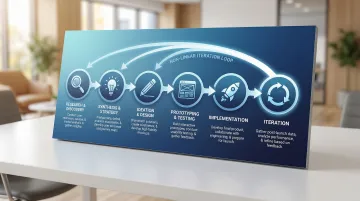
While terminology varies by team and project, most XD work follows a recognizable arc. For climate tech companies, understanding how this maps to your specific constraints is more useful than following a generic process diagram.
- Research and discovery: Understand who your buyers are at a decision-making level, what your competitors are presenting, and where your current experience breaks down. For climate tech, this often includes stakeholder research across multiple audience types: technical evaluators, commercial decision-makers, and procurement or legal teams.
- Synthesis and strategy: Identify patterns from research, define where the biggest experience gaps are, and establish a strategic direction. This is where messaging hierarchy and audience segmentation decisions get made before any design work starts.
- Ideation and design: Generate and refine solutions collaboratively, including wireframes, copy frameworks, and visual concepts. This stage should involve commercial stakeholders, not just designers, because the people closest to sales conversations know what objections the experience needs to address.
- Prototyping and testing: Validate ideas with real users or target buyers before committing to full development. For B2B climate tech, this might mean testing landing page messaging with a cohort of target personas before rebuilding the full site.
- Implementation: Launch with proper technical support and internal documentation so the experience can be maintained and updated without starting from scratch every time the team needs to make a change.
- Iteration: Track performance against defined metrics and refine based on what the data shows. One round of XD investment doesn't freeze your brand in place; it establishes a foundation you build on.
Teams cycle between stages rather than moving strictly linearly, especially when new user research reveals assumptions that need revisiting.
These stages translate into tangible deliverables that guide implementation.
Common XD deliverables
Experience designers create artifacts that visualize and communicate complex interactions:
| Deliverable | Purpose | Focus |
|---|---|---|
| Journey maps | Visualize user actions, thoughts, and emotions across touchpoints | User perspective and story |
| Service blueprints | Diagram backstage operations required to deliver front-stage experiences | Business operations and systems |
| Personas | Represent key user segments with goals, behaviors, and pain points | User archetypes and needs |
| Wireframes | Outline structure and functionality before visual design | Information hierarchy and layout |
| Prototypes | Test interactions and validate concepts before development | Interaction patterns and usability |
| Design systems | Ensure consistency across products with reusable components | Scale and coherence |
Interdisciplinary teams
Effective XD requires collaboration across specialties, and each role contributes something the others can't substitute:
- Researchers uncover why buyers hesitate, not just what features users want
- Strategists align design decisions with commercial goals and specific market dynamics
- Interaction designers define how products behave and respond in a way that matches user expectations
- Visual designers create the aesthetic signals that communicate credibility and competence
- Content designers translate technical depth into buyer-accessible language without sacrificing accuracy
- Service designers coordinate the cross-functional decisions that make the full experience coherent
Top-performing organizations integrate these roles into cross-functional teams rather than keeping them siloed, which enables faster iteration and tighter alignment between what the brand promises and what the product delivers.
Getting started with experience design
Audit before you redesign
Before changing anything, document what your experience currently looks like from a buyer's perspective. Walk through your website as if you're an enterprise procurement officer who has never heard of your company. Ask: can they figure out what you do, who it's for, and why they should care within the first thirty seconds?
Then do the same for your product onboarding, your sales deck, and your first follow-up email sequence. These touchpoints rarely get audited together, which is why they often contradict each other in ways that erode buyer confidence before you even get to a demo.
Specific things to look for:
- Where does your messaging assume the reader already understands your technology?
- Which audience are you actually addressing above the fold on your website: the technical buyer, the commercial buyer, or the investor?
- What happens after someone fills out your contact form? Does the follow-up experience match the credibility signal of the website?
Choose one critical journey to fix first
Comprehensive overhauls are expensive and slow, and they rarely hold together because so many decisions get made under time pressure. A more practical approach is to identify the single experience most directly tied to a near-term revenue or fundraising milestone and redesign that holistically.
For most early-stage climate tech companies, this is the website-to-demo conversion flow: what a prospect sees before they agree to talk to you. Improving that one journey often has more commercial impact than rebuilding everything at once.
Prioritize by asking which touchpoint, if significantly improved, would most directly affect pipeline or partnership conversations. Then assemble a small cross-functional group with the authority to make decisions, and set success metrics that go beyond visual quality: demo request rates, time-to-qualified-lead, and sales team feedback on how materials land in conversations.
Build the case internally before scaling
XD requires alignment across technical, commercial, and leadership functions. Without that alignment, design improvements often stall at implementation or get undermined by teams that weren't consulted during the process.
The most effective way to build that alignment is to start with evidence. Bring buyer feedback, recorded user interviews, or competitive comparison data to the conversation rather than asking stakeholders to take design quality on faith. Connect every design decision back to a specific commercial outcome: faster pilot conversions, shorter sales cycles, higher close rates on enterprise deals.
Climate tech companies that work with a design partner who understands long sales cycles, multi-stakeholder buying processes, and the specific credibility requirements of first-of-a-kind technology will move faster than those working with generalist agencies that need to be educated on the landscape first. At What if Design, we work specifically with seed to Series B climate and deep-tech companies that need brand and experience work done with domain fluency already in the room.
If your website and brand haven't evolved to match where your technology and traction actually are, it's worth getting a clear-eyed assessment of what needs to change and in what order.
Frequently asked questions
What does experience design do?
Experience design shapes how people interact with products, services, and organizations at every touchpoint, from the first time they encounter your brand on a website to the onboarding flows and account management experience that follow. For climate tech companies, this matters most at the points where trust needs to be built quickly: the website that needs to communicate credibility before a first call, the product interface that needs to make complex data legible to a non-technical buyer, and the onboarding experience that determines whether a pilot succeeds.
Is experience design the same as UX?
No. UX design is one layer within experience design. UX focuses on digital product usability and interface interactions, while XD encompasses the full ecosystem: your website, sales materials, onboarding process, customer support, brand identity, and the organizational decisions that shape how all of these connect. For B2B climate tech companies, the most impactful XD work often happens outside the product interface entirely, in the brand and website layer that buyers encounter first.
What are the stages of experience design?
Most XD projects move through six phases: research and discovery, synthesis and strategy, ideation and design, prototyping and testing, implementation, and iteration. These aren't strictly sequential; teams frequently revisit earlier stages as they learn. For climate tech companies, the research phase often extends longer than expected because understanding the full buyer landscape across technical, commercial, and procurement stakeholders takes time to do properly.
How is experience design different from traditional design?
Traditional design disciplines each own a specific output: graphic design creates visual communication, industrial design creates physical products, UI/UX design creates digital interfaces. Experience design coordinates these outputs into a coherent journey, paying attention to how each touchpoint builds on or undermines the others. In practical terms, this means asking not just "is the website well designed?" but "does the website, the product demo, the sales deck, and the onboarding experience all tell the same story?"
What skills do experience designers need?
Experience designers work across research, strategic messaging, interaction design, visual systems, content strategy, and systems thinking. The skill that is most undervalued and most critical in climate tech contexts is the ability to translate technical depth into buyer-accessible language without losing accuracy. Many designers can make something look credible; fewer can make something technically complex feel immediately clear to a non-specialist buyer.
How do you measure experience design success?
Success metrics include quantitative measures like conversion rates, trial activation rates, pipeline influence, and customer lifetime value, as well as qualitative signals like buyer feedback, brand perception audits, and sales team input on how materials land in conversations. For climate tech companies with long sales cycles, early indicators such as demo request rates and time-to-qualified-lead are often more immediately measurable than closed revenue. Top-performing organizations track design performance with the same discipline as financial metrics.