The power shift reshaping brand strategy
You've built a real technology. You've closed a seed round, maybe a Series A. You have pilots in progress or letters of intent signed. But when an investor or potential partner lands on your website, they can't tell what you actually do or why it matters to them.
This isn't a design problem. It's a positioning problem. Energy and climate tech companies face a specific credibility gap that most branding frameworks don't address: the space between technical depth and market-ready clarity. Investors compare you to dozens of other ventures that may be less technically rigorous but far better presented. Partners need to quickly understand your fit within their value chain. Customers want to know the business case before they'll sit through a demo.
This guide breaks down what makes branding different in the power and energy sector, the specific mistakes that create friction in funding and partnership conversations, and what a structured approach to brand strategy actually looks like for climate tech companies at the Seed through Series B stage. The patterns here come from What if Design's direct work with climate and energy tech companies across this stage range.
Key takeaways
- Energy transformation creates unique branding challenges: technical complexity, diverse stakeholders, and market skepticism
- Effective brands communicate technical credibility and measurable impact, not just sustainability promises
- Strategic frameworks must address investors, customers, and regulators with distinct but consistent messaging
- Success metrics include stakeholder engagement, partnership velocity, and capital attraction
Why energy transformation demands strategic branding
The competitive landscape has changed
The market context has shifted fast. Climate tech VC deals reached 2,677 transactions worth $37.8 billion in 2024, with grid infrastructure alone seeing 369 deals raising $5.7 billion. That volume creates a problem that's easy to underestimate: when capital is flowing into a sector, so is noise.
If you're raising at Seed or Series A in energy or climate tech, you're not just competing against other early-stage startups. You're competing against the optics of incumbents with decades of brand equity and marketing budgets that dwarf yours. The bar for perceived credibility has shifted.
Investors and partners now screen quickly. They triangulate your website, your pitch, and your public narrative before they take a meeting. If those three don't tell a coherent story, you're already behind before the conversation starts. Brand strategy isn't about differentiation as an abstract concept. It's about controlling what decision-makers understand about you in the first 90 seconds.
Beyond green messaging: the depth required
"Green" as a positioning angle has collapsed under the weight of overuse. In energy markets specifically, stakeholders have seen enough vague sustainability commitments to treat them as baseline expectations rather than differentiators. What actually moves investors and partners is evidence of technical credibility, a clear explanation of the business model, and a narrative that makes the scale opportunity obvious without overstating it.
Ørsted's transformation from DONG Energy is the reference case. The company committed to 96% carbon emission reductions by 2023 and divested fossil fuel assets before changing its name. The rebrand followed operational substance, not preceded it. The name change signaled strategic departure rather than aspiration.
Effective energy brands communicate across three distinct layers:
- Technical capability - Can you actually deliver the technology?
- Market positioning - Why should stakeholders choose you over alternatives?
- Impact vision - What specific transformation problem do you solve?
Stakeholder complexity in energy markets
Energy companies face unusually diverse stakeholder ecosystems, and this is especially true for early-stage companies still building their first customer base and investor relationships simultaneously:
- Investors prioritize returns, scalability, and exit potential
- Regulators demand compliance, safety, and public benefit
- Communities evaluate local jobs, environmental protection, and quality of life
- Customers seek reliability, affordability, and values alignment
A message that resonates with venture capitalists may create friction with local communities concerned about infrastructure impacts. A well-structured brand maintains a consistent core identity while adjusting how it speaks to each audience. That architecture needs to be intentional, not improvised as you go.

The trust deficit challenge
Public support for renewables remains high. 84% of UK residents support renewable energy use. But that broad support becomes fragile when projects move from abstract concept to local implementation.
Only 43% are explicitly comfortable with onshore wind farms in their area, and 49% expect the transition to increase energy bills in the short term. For climate tech companies, this creates a specific communication challenge: assuming general environmental support translates into project-level acceptance consistently leads to friction. Affordability concerns and local economic impact need to be addressed proactively, not reactively.
Strategic branding as competitive advantage
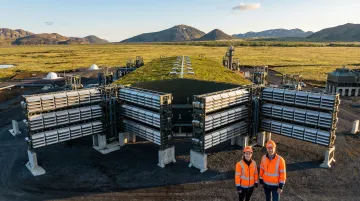
Climeworks secured CHF 600 million (USD 650 million) in funding partly through positioning as a pioneer and the most advanced player in direct air capture. Investors explicitly cited the company's clear roadmap and the narrative framing the technology as both necessary and inevitable. That's brand strategy operating as a capital-readiness tool.
For early-stage climate tech companies, the return on clear positioning shows up in shorter fundraising cycles, easier partnership conversations, and the ability to attract specialized talent without competing purely on compensation. The brand doesn't replace the technology. It makes the technology legible to the people who need to act on it.
The unique branding challenges in power and energy
Communicating technical innovation without jargon
Technical founders default to explaining how the technology works because that's where their confidence is highest. The problem is that most audiences, including investors and procurement teams, need to understand what changes in their world because of it before they care how it works.
This creates a pattern that shows up across climate tech brand materials: detailed explanations of the science or engineering, followed by vague claims about impact. The hierarchy is inverted. Decision-makers need the business case first, the evidence second, and technical depth available but not leading.
Practical approaches that work at the Seed and Series A stage: start every piece of communication with the problem the customer is experiencing, not the technology you've built. Quantify impact in the unit that matters to the specific audience — cost per ton, ROI timeline, grid reliability improvement percentage. Use technical detail as proof, not as the primary narrative. And create layered content where summary-level clarity is the default and technical depth is accessible for those who want it.
Navigating regulatory and political landscapes
Energy branding must account for regulatory frameworks and policy incentives that vary by geography and shift over time. The U.S. Inflation Reduction Act provides 10% bonus tax credits for projects meeting domestic content requirements. This policy context makes "Made in America" supply chains a brand differentiator, not just an operational detail. For US-based startups raising capital or closing commercial deals, weaving this framing into your positioning is a concrete credibility signal.
The EU's REPowerEU plan takes a different approach, emphasizing energy security and independence. European energy brands have had to pivot messaging toward resilience and sovereignty alongside sustainability. The regulatory context shapes what your market considers credible and valuable, which means it belongs in your brand strategy, not just your legal and compliance work.
Managing the transition narrative
These regulatory shifts create complex positioning challenges for companies transitioning from fossil fuels or establishing new renewable identities. As covered above, Ørsted's name change only landed credibly because it followed years of operational change, not preceded it.
For early-stage climate tech companies, the same principle applies differently. You may not have legacy operations to shed, but you likely have a credibility gap in the opposite direction: the technology works, or is close to working, but the brand still reads like a research project. The positioning challenge is translating what you've already proven into language that makes investors and partners understand the business you're actually building.
Naming, messaging, and visual identity should follow positioning clarity, not precede it.
Addressing the cost-benefit perception gap
Despite solar and wind becoming the cheapest sources of new electricity generation in many markets, 49% of consumers believe the transition will raise bills. This perception gap creates real friction in sales cycles and community approval processes.
Reframing value propositions for this context means going beyond immediate cost comparisons. Emphasize long-term price stability, not just current unit cost. Quantify reliability improvements and grid resilience in concrete terms. Where available, demonstrate local economic benefits with specific job and revenue numbers. And translate environmental health improvements into economic terms that procurement teams can use internally.
Building credibility as a new entrant
If you're a Seed or Series A company in energy, the credibility gap isn't only about your product's maturity. It's about how your entire market presence reads relative to what you've actually accomplished. A $15M raise, a working pilot, and a signed LOI don't automatically show up in how you're perceived if your website and brand haven't caught up.
The most common pattern: technical founders know the technology in depth but struggle to translate it into the business case that procurement teams, investors, or commercial partners need to hear. The pitch gets stronger in person, but the written materials and digital presence don't carry the same weight.
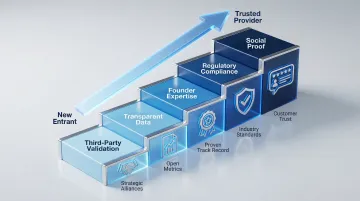
Credibility at this stage comes from visible proof: specific numbers from pilots, named partners where possible, clear explanations of what the technology does and for whom, and a visual identity that signals a serious organization rather than a research project looking for its next grant.
Building a brand strategy framework for energy companies
Most climate tech companies at the Seed or Series A stage have a clear internal answer to "what do we do." The problem is that the external version of that answer, on the website, in investor materials, in partner conversations, is often three or four different answers depending on who wrote it and when. Positioning work is fundamentally about making those answers consistent and sharp.
Strategic foundation must come before visual identity and marketing tactics. Without clear positioning, even well-executed design fails to differentiate or drive business outcomes.
Define your purpose and position
The starting point isn't your mission statement. It's understanding the specific decision-maker who needs to say yes to your company and what would make that decision straightforward for them. An investor evaluating your energy storage company needs a different framing than a utility procurement team, even if the underlying technology is identical.
Define what problem you solve, for whom specifically, and what proof exists that your approach works. This isn't "we're reducing carbon emissions." It's the specific, verifiable claim that differentiates you within the segment you're targeting.
A useful framework for identifying your unique value proposition: map the competitive landscape to identify positioning gaps, define target customer segments and their specific decision criteria, articulate how your solution differs from alternatives in terms of outcome rather than mechanism, and connect technical capabilities to measurable results your audiences can actually use.
Segment and understand your audiences
Map your stakeholder ecosystem: investors, customers (residential vs. commercial and industrial), regulators, community partners, and employees. Each group has different decision criteria and different levels of technical fluency.
Develop distinct value propositions and messaging for each segment while maintaining consistent brand identity across them.
The research methods worth investing time in: customer interviews that explore decision criteria and where the current process breaks down; investor conversations identifying what signals funding readiness versus friction; community forums to surface local priorities and likely objections early; and competitive analysis to identify where your positioning can be genuinely distinct.
Craft your brand narrative and messaging
Develop your core brand story explaining origin, mission, innovation approach, and impact vision.
Build a messaging hierarchy: a core positioning statement, key messages tailored for different audiences, specific proof points that support each claim, and tone guidelines that keep communication consistent across channels.
The narrative work is foundational. Rushing past it to visual identity or website execution typically means redoing the positioning work later, after you've already presented a muddled signal to the market.

Develop visual identity that reflects innovation
Once your narrative is clear, translate it into visual identity.
Logo, color palette, typography, and imagery style should communicate both credibility and forward-thinking capability. Generic industrial imagery and overused green tones read as category noise, not differentiation.
Three energy companies that have built distinctive visual identities through deliberate choices:
- Iberdrola evolved its logo to be 50% lighter, reducing energy consumption in digital formats while modernizing its presentation for digital-first audiences
- Apraava Energy uses generative design that combines live plant data including wind speed and solar intensity to create dynamic visual signatures tied to actual operations
- Enel built a flexible visual system around a "cursor" concept representing the origin of energy, designed to work consistently across 28 countries and multiple product lines
Create your brand playbook
If your team creates investor materials, a website, community presentations, and recruitment content in isolation, the cumulative effect is a brand that feels inconsistent and under-resourced. A documented brand playbook lets different people create different materials without fragmenting the signal you're sending to the market.
Comprehensive brand playbooks include:
- Positioning statements and core messaging for each audience segment
- Visual standards including logo usage rules, color specifications, typography
- Tone and voice guidelines with written examples
- Application templates for commonly needed materials
- Photography and illustration direction
This is especially critical when diverse teams create content for multiple audiences: customer materials, investor decks, recruitment campaigns, and partnership communications.
Build for multiple channels and touchpoints
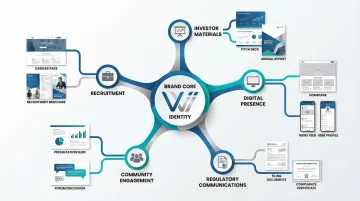
Energy brands need to work across investor pitch decks, customer-facing websites and apps, regulatory filings, community presentations, and recruitment materials. These channels have different formats, different audiences, and different conversion goals.
A well-built brand system maintains coherence across all of them without requiring a redesign every time a new material type is needed.
Bringing your energy brand to life: from vision to execution
Digital presence as brand foundation
Your website is often the first place investors, customers, and partners form an impression of your company. Every design choice, from navigation structure to color palette, either reinforces or undermines your market positioning.
For climate tech companies, the website isn't just a presence. It's the place where the positioning work either holds up or falls apart. If your brand strategy, website, and messaging were built at different times by different people, the signal they collectively send is almost always inconsistent. Working with a partner who understands both technical depth and positioning can close that gap faster than iterating internally.
Content that converts stakeholders
A strong content strategy helps energy brands translate technical complexity into narratives that decision-makers can actually act on. That means case studies with specific metrics and measurable impact from named pilots or deployments, founder stories that provide context for the technology without turning into a research paper, educational content that explains your market category for audiences who need the context, and infographics or videos that make technical mechanisms accessible without oversimplifying them.
Octopus Energy's "Portraits from the Precipice" campaign used AI-generated art to visualize climate data, driving a 163% increase in signups and adding 37,000 new customers. The approach worked because it connected data to human experience without explaining how the technology worked.
Investor and partnership communications
Investor-facing materials deserve the same brand consistency as customer-facing channels. Pitch decks, investor presentations, and partnership proposals that align with your visual and narrative identity build credibility and reduce the friction in funding decisions.
At the Seed and Series A stage, the gap between a technically sound pitch and a fundable pitch is often a clarity problem, not a technology problem. The materials need to communicate both what you've built and why the market opportunity is real, without requiring the reader to reverse-engineer those conclusions from your technical specs.
Community and stakeholder engagement
Energy projects with physical infrastructure require local community buy-in. Transparent communication about project impacts, collaborative planning processes, and demonstrated commitment to local economic benefits tend to matter more than polished messaging.
Documenting your community engagement approach as part of your brand story provides the proof-of-values that written positioning statements alone can't deliver.
Measuring brand impact in the energy sector
Most standard marketing metrics, impressions, reach, social engagement, were built for consumer brands with short sales cycles. They don't map well to climate tech, where a single partnership deal or funding close matters more than a thousand website visitors who don't convert.
Beyond awareness: meaningful brand metrics
The metrics worth tracking at Seed through Series B cluster around decision-maker signals:
- Stakeholder trust scores through periodic surveys of investors, partners, and customers
- Investor perception studies measuring how your company is understood and positioned relative to peers
- Customer engagement rates including website conversion and sales cycle length
- Employee advocacy through referral rates and retention
- Partnership velocity tracking time from introduction to signed agreement
- Media sentiment analysis evaluating coverage tone and whether your core message is being reflected accurately
Establish baseline measurements and track progress quarterly to identify trends and inform strategy adjustments.
Connecting brand to business outcomes
These metrics matter because they directly affect business results. The areas where brand investment shows up most clearly:
- Fundraising: Investors who already understand your positioning close faster and require less education time per meeting
- Customer acquisition: Shorter sales cycles when the website and materials do explanatory work before the first conversation
- Talent recruitment: Attracting specialized expertise is harder to do at competitive compensation when your brand reads as early-stage or unclear
- Partnership development: Inbound interest from qualified partners is a measurable signal that your positioning is working
Adapting strategy based on insights
Fast-moving energy markets require brand strategy agility. Conduct regular brand health assessments, stakeholder feedback loops, and market positioning reviews, particularly after major milestones like a new funding round, a significant partnership, or a product launch.
Be willing to evolve your positioning as technology and market dynamics shift, but maintain core identity and values to build long-term recognition across the relationships that matter.
Closing
The climate and energy companies that earn credibility consistently tend to share one quality: their external presence reflects where they actually are, not where they were two years ago or where they hope to be. Their website does explanatory work before the first conversation. Their narrative is specific enough that investors and partners immediately understand the opportunity without having to decode technical specs to find it.
Getting there doesn't require a months-long branding process. It requires clear positioning, a brand system built around your actual audiences, and execution that holds together across the channels that matter at your stage.
If your current presence is creating friction in conversations that should be straightforward, that's a signal worth acting on before your next major visibility moment.
What if Design works with Seed through Series B climate and energy tech companies to close exactly this gap. Because we work only in this space, there's no time spent explaining the regulatory context, the sales cycle dynamics, or why technical depth and market clarity need to coexist. We get to positioning and execution faster as a result.
Frequently asked questions
My company has raised funding and has real pilots. Why does our brand still not feel credible?
Credibility in the market isn't a direct function of what you've built internally. It's a function of how clearly your external presence reflects your actual stage and traction. Most early-stage climate tech teams are product and science-first, which means brand typically lags behind the business. The tell is when your website still reads like a pre-revenue prototype even after you've closed pilots and raised a proper round. Investors and partners compare your presentation against peers with better-resourced brand infrastructure, regardless of your technical depth.
How long does it take to develop a comprehensive brand strategy for an energy company?
Comprehensive brand strategy typically takes 4 to 6 months when built from scratch by a large agency. Partners that specialize in climate and energy tech can move faster because they arrive already familiar with the landscape. A full brand identity can often be completed in 4 weeks, with a minimum viable brand taking less than two. The timeline depends more on decision-making speed on your side than on the work itself.
Should energy startups prioritize branding or product development first?
Brand strategy should develop in parallel with product development, not after it. Early positioning work informs how you talk about the product in fundraising, partnerships, and early commercial conversations. Waiting until the product is fully built means you've been presenting an unclear signal to the market during the period when first impressions are being formed.
How much should a climate tech startup budget for branding?
Seed-stage companies typically allocate 10 to 20% of raised capital to marketing and brand infrastructure. Series A companies often increase this to 25 to 40% as they scale pipeline and enterprise sales. The more important question is sequencing: brand investment that happens before a major funding round, conference, or partnership announcement tends to have a higher return than reactive investment after friction has already appeared in conversations.
What makes energy branding different from other B2B or tech branding?
Energy branding faces a specific combination of challenges that don't appear together in most other sectors: regulatory complexity that varies by geography and shifts with policy cycles, diverse stakeholders with fundamentally different decision criteria, long sales cycles that make feedback loops slow, technologies that need to prove viability at scale before they can close major commercial deals, and market skepticism from years of greenwashing across the industry. These factors require a different approach than standard B2B positioning frameworks.
How do we know if our energy brand is working?
The clearest signals are behavioral, not attitudinal. Are investor conversations getting shorter before term sheets? Are inbound partnership inquiries increasing? Are qualified candidates applying without aggressive outreach? Is the sales cycle shortening as the website does more explanatory work upfront? Track these indicators quarterly alongside more standard metrics like media coverage quality and stakeholder survey scores.