
You've closed your first pilot. You've secured manufacturing partnerships. You have a product that works. But your website still reads like a capabilities brochure written for a trade show booth.
For climate tech and deep tech manufacturers, the gap between where the business actually is and how the website presents it creates real friction. Procurement teams, enterprise buyers, and potential partners make early judgments based on a digital presence that hasn't kept pace with the company's actual traction. That credibility gap costs deals before the conversation even starts.
This guide covers the specific website design strategies that help manufacturing companies convert technical credibility into commercial momentum — what to prioritize, what to avoid, and how to structure a site that does real work across multiple buyer types.
TLDR
- Balance technical depth with intuitive navigation for both engineers seeking specs and executives evaluating ROI
- Prioritize under 3-second load times, mobile-optimized technical content, and ungated basic product information
- Deploy clear positioning, persona-based navigation, advanced filtering, and diverse conversion paths
- Investment ranges from $10K–25K for basic sites to $100K+ for enterprise solutions with ERP integration and custom configurators
Why website design matters for manufacturing companies in 2026
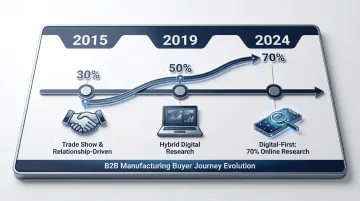
The manufacturing sales model has moved from relationship-driven, trade-show-centric selling to digital-first research and evaluation, and that shift is now reflected in how buyers actually make decisions. In 2025 and into 2026, AI-assisted procurement research and digital self-serve purchasing have accelerated this further — buyers now often complete vendor comparisons and narrow shortlists before any human contact, using tools that aggregate and summarize market options faster than any sales team can respond.
Research from TREW Marketing shows that 60–70% of technical buyers complete the majority of their purchasing process through independent online research before ever contacting a vendor.
A Gartner sales survey found that 61% of B2B buyers prefer a rep-free buying experience, actively avoiding sales contact until they've narrowed their options.
Your website is the primary credibility filter. For 85% of manufacturing buyers, the vendor website is their number one research destination, surpassing trade shows, peer recommendations, and industry publications.
An informative, well-maintained website ranks as the strongest indicator of quality when technical buyers assess potential suppliers. Users form opinions about your site in under a second, determining whether to stay or leave based on that first impression.
The financial stakes are significant. B2B eCommerce in manufacturing has become a major revenue channel, with digital transactions increasingly handling complex, high-value purchases. More than half of large B2B transactions ($1 million or greater) are now expected to flow through digital self-serve channels, according to Forrester.
Website quality directly signals operational sophistication, technical capability, and your ability to serve modern customers who expect clear, efficient digital experiences even when buying industrial components.
Essential design strategies for manufacturing websites
Lead with clear, specific positioning
Vague homepage messaging loses visitors within seconds. Technical buyers and procurement professionals don't have time to decode what you actually manufacture or why it matters to them.
Effective positioning immediately answers three questions: what you manufacture specifically, who you serve — by industry, application, or buyer type — and what sets you apart from competitors.
Weak positioning example: "Leading provider of innovative solutions for the industrial sector"
Strong positioning example: "Precision CNC machining for aerospace components — AS9100D certified with 5-axis capabilities and 72-hour turnaround"
The difference is specificity. Strong positioning uses concrete language that helps the right prospects self-identify while filtering out poor-fit inquiries. Include your core capability, primary market, and one meaningful differentiator in your hero section.
In a real enterprise procurement shortlist, a buyer comparing three vendors in a fifteen-minute research session adds the one whose site answers those questions immediately — and closes the tabs of the ones that don't. A climate tech manufacturer repositioning from "sustainable thermal management" to "aluminium heat exchangers for EV battery packs rated to 95°C continuous" didn't change the product. It changed who called: procurement engineers with a spec in hand, not researchers still mapping the category.
This is especially true for climate tech manufacturers, where novel processes and materials need plain-language framing before any technical detail lands.
Design for multiple audience personas
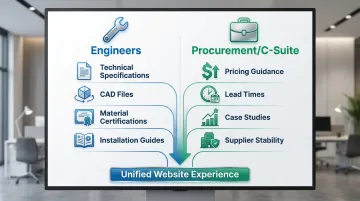
Manufacturing websites face a structural challenge: serving both technical buyers who need specifications and business buyers focused on ROI and reliability. These two groups are often evaluating your company at the same time, through the same website.
Engineers want:
- Technical specifications and tolerances
- CAD files (STEP, IGES formats)
- Material certifications and compliance documentation
- Application notes and installation guides
Procurement and C-suite want:
- Pricing guidance and TCO data
- Lead times and capacity information
- Case studies with measurable outcomes
- Supplier stability indicators
Navigation strategies that work:
- Create role-based entry points ("For engineers," "For procurement")
- Use mega menus that reveal multiple navigation levels simultaneously
- Provide both broad category navigation and specific part-number search
- Layer information progressively, with overview first and technical depth accessible from there
In a typical enterprise evaluation, the engineering lead approves technical fit and the procurement lead approves commercial terms — often without coordinating until both are satisfied. Your site needs to serve both conversations simultaneously. A Series A industrial sensors company whose site was built entirely for engineers — dense spec sheets, no pricing signals, no supplier stability indicators — found that procurement contacts were defaulting to a larger competitor whose site gave them the commercial overview they needed. After restructuring with a separate procurement landing page covering lead times, capacity, and customer references, the company reported shorter time-to-quote conversations with enterprise accounts.
This approach allows each persona to find relevant information quickly without forcing everyone through the same linear path.
Prioritize intuitive information architecture
Complex product catalogs require thoughtful organization, and when information architecture fails, visitors end up hunting through irrelevant categories until they give up and go to a competitor.
Effective organizational frameworks:
- By industry vertical: Medical devices, aerospace, automotive, industrial
- By application: Sealing solutions, motion control, fluid handling
- By product category: Pneumatic cylinders, valves, fittings, accessories
- By capability: Custom fabrication, standard components, engineering services
Several structural elements support this. Mega menus display multiple levels of hierarchy at once, helping users understand your full offering without clicking through pages. Faceted filtering lets visitors narrow thousands of SKUs by material, size, certification, or application. Prominent search with autocomplete accommodates part number variations, and breadcrumb navigation keeps users oriented within your hierarchy.
Choose the organizational approach that matches how your customers think about and search for your products. Getting this right means your ideal buyer finds what they need and moves forward in their evaluation without having to contact your sales team for a navigation guide — a shorter cycle and a better-qualified conversation when they do reach out.
Implement strategic visual hierarchy
Manufacturing websites don't need flashy design, but they do need clean, professional aesthetics that guide attention to key information and conversion points. The visual structure communicates competence before a single word is read.
A few visual hierarchy principles do most of the work. White space creates breathing room and prevents overwhelming technical audiences with dense content blocks. Typography contrast distinguishes headings from body text and makes scanning easy for time-constrained buyers. Color draws attention to CTAs and important specifications without competing with the content, while a consistent layout grid creates professional polish without requiring elaborate visual treatment.
Trust signals worth highlighting prominently include ISO certifications and industry-specific accreditations, client logos from recognizable brands, industry awards and third-party validations, and years in business and facility locations.
Professional product photography consistently outperforms stock imagery on manufacturing websites, with visual quality directly affecting how long technical buyers engage with product pages. Invest in real product images, 360-degree views, and application photos that show your products in context. When a procurement team is evaluating two equally capable suppliers, the one whose site looks built for serious buyers tends to win the shortlist. A materials startup that replaced stock renders with photos of their actual pilot production line — parts in progress, certification documents visible — found procurement contacts describing them as "clearly further along" than a competitor whose site was more polished but less real. Visual quality is a proxy for operational quality in a digital evaluation.
Optimize page speed and performance
Slow-loading sites lose technical audiences quickly. Engineers researching specifications won't wait for bloated pages to render, and on mobile networks the problem compounds.
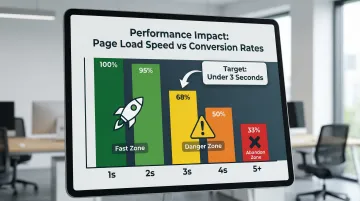
Target an initial page load under 3 seconds and an LCP of 2.5 seconds or less, and monitor Core Web Vitals as ongoing user experience metrics.
The impact on lead generation is direct. According to Portent, a B2B site loading in 1 second converts 3x higher than one loading in 5 seconds. The probability of bounce increases 32% as load time goes from 1 to 3 seconds, and on mobile every additional second of delay can reduce conversions by up to 20%.
Practical optimization steps include compressing images without sacrificing quality, minimizing JavaScript and CSS bloat, using lazy loading for below-the-fold content, implementing caching strategies, and choosing performance-optimized hosting.
Speed is a direct revenue lever that determines whether prospects engage with your content or move to a competitor's site.
Key website features that convert manufacturing leads
Robust product filtering and search
When you offer hundreds or thousands of SKUs, visitors need efficient ways to find exactly what they need without browsing every product page.
Effective filtering mechanisms:
- Faceted search combining multiple attributes (material + size + certification)
- Specification-based filtering for technical parameters like pressure ratings, temperature ranges, or dimensional tolerances
- Industry/application filters showing products relevant to specific use cases
- Dynamic filters updating available options based on previous selections
Search functionality that converts:
- Autocomplete suggesting products as users type
- Tolerance for part number variations and common misspellings
- Search by specification (e.g., "stainless steel valve 1/2 inch")
- Results showing product images, key specs, and availability at a glance
Engineers often know exactly what they need and want to find it in under a minute. Make search prominent and powerful enough to meet that expectation. When a buyer can find the right spec, download it, and hand it to procurement in a single session — without submitting a form or waiting for a sales callback — you've removed a full cycle from the evaluation process. A component manufacturer that implemented faceted search across 800 SKUs by material, certification, and temperature rating found that buyers were arriving at quote request conversations already knowing which part number they needed, cutting multiple back-and-forth rounds out of the sales process.
Ungated technical resources
Once visitors find what they need, they'll want technical details. Gating every piece of content frustrates technical buyers and adds friction at exactly the wrong moment.
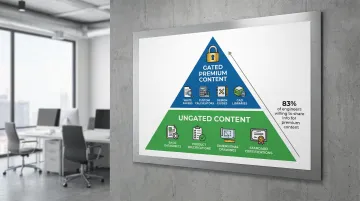
A practical gating approach: keep ungated the basics — datasheets, product specifications, dimensional drawings, and standard certifications. Reserve forms for in-depth white papers, custom calculators, comprehensive design guides, and CAD libraries.
Research from IEEE GlobalSpec shows 83% of engineers are willing to fill out forms in exchange for substantive technical content like white papers and detailed CAD drawings. The key is that the content needs to be genuinely valuable, not marketing collateral with a form in front of it.
The balance is straightforward in practice: provide enough ungated information for initial evaluation, then gate premium content that delivers clear additional value. Keep forms short — name, email, company, application — and deliver gated content immediately, without routing through a sales delay.
This approach captures leads while respecting the self-directed research process that modern B2B buyers prefer.
Industry-specific case studies and applications pages
Generic marketing copy doesn't build trust with technical audiences. Case studies that demonstrate problem-solving in similar industries accelerate decision-making because they reduce perceived risk for buyers evaluating you.
Effective case studies cover the specific technical challenges the customer faced, measurable outcomes with actual numbers (cost reduction, efficiency gains, quality improvements), industry context using terminology your prospects recognize, and the product specifications that drove the solution selection.
If you're selling into aerospace and your site shows a case study where you solved a tolerance problem for a Tier 1 supplier — with actual cycle time data — a procurement engineer at another aerospace company can translate that directly to their situation. That's the kind of evidence that gets you onto a shortlist without a sales call.
Application pages that convert are organized by industry vertical or use case — not by internal product taxonomy. They include the technical requirements typical of each application, show multiple product options with selection guidance, and link to related case studies and technical resources for buyers who want to go deeper.
Case studies with quantified outcomes help procurement teams build the internal business case and give engineering leads something concrete to present to leadership.
Multiple, strategic conversion opportunities
"Contact us" is not enough. Different prospects at different stages need different conversion paths, and forcing everyone through a single generic form loses the buyers who aren't ready to talk to sales yet. In practice, an engineer who downloads your spec sheet today may become the internal technical champion who recommends you in a procurement review six weeks from now. If the only option when they landed on your site was a contact form, they left without converting — and you never knew the opportunity existed.
Varied CTA options that work across buyer types:
- Request a quote for buyers ready to move forward
- Download specifications for technical evaluation
- Request samples for testing and validation
- Schedule a consultation for complex custom applications
- Chat with an engineer for immediate technical questions
- Subscribe to updates for early-stage researchers
CTA placement by page type:
- Product pages: request quote, download specs, request sample
- Case study pages: contact for similar application, download full case study
- Technical resource pages: download guide, speak with an engineer
- Homepage: multiple pathways based on visitor intent
Effective B2B sites create multiple entry points for lead generation rather than funneling everyone through a single contact form.
Mobile-responsive design with technical functionality
The assumption that engineers only use desktops is outdated. According to BCG, 80% of B2B buyers use mobile devices at work, and more than 60% report that mobile played a significant role in a recent purchase.
Mobile functionality requirements for manufacturing sites:
- Full access to technical specifications, not simplified mobile versions
- Readable tables and charts with horizontal scrolling where needed
- Downloadable PDFs and CAD files
- Functional product configurators and calculators
- Easy-to-complete quote request forms
The manufacturing-specific challenges are worth naming: complex specification tables need thoughtful responsive design that doesn't collapse critical data, technical drawings require zoom functionality, product configurators must work on touch interfaces, and load times are even more critical on mobile networks.
Google research shows 53% of mobile users abandon sites that take longer than 3 seconds to load. Mobile optimization is essential for capturing the majority of technical research that now happens on smartphones and tablets. A procurement manager reviewing your shortlisted position between meetings on their phone, unable to read your specification table, doesn't consciously disqualify you — they just move on. That's a deal-stage loss with no sales conversation and no chance to recover it.

Planning your manufacturing website redesign
Before jumping into design, successful website projects start with strategic foundation work that aligns stakeholders and clarifies objectives. Rushing into wireframes or visual design without this groundwork leads to costly revisions and websites that miss business goals. Getting this foundation right is directly tied to commercial outcomes — a site built on clear personas and validated messaging positions you to shorten your sales cycle, with buyers arriving in sales conversations pre-qualified and already holding the right expectations.
Strategic planning steps:
- Stakeholder interviews — Talk to sales, engineering, marketing, and leadership to understand what's working, what's broken, and what success looks like
- Competitor analysis — Audit 5–10 competitor websites to identify industry standards, differentiation opportunities, and feature gaps
- Persona development — Document your key buyer types, their information needs, and their typical journey from awareness to purchase
- Content audit — Inventory existing content, identify what to keep, what to update, and what gaps need filling
- Technical requirements — Document integrations needed (ERP, CRM, PIM), functionality requirements, and performance benchmarks
Once you've completed this strategic foundation, you can make informed platform decisions.
Platform selection guidance:
| Platform type | Best for | Investment range |
|---|---|---|
| WordPress | Small to mid-sized manufacturers needing flexibility and cost-effectiveness | $10K–80K |
| Custom development | Companies with complex integrations (ERP, PIM, configurators) | $80K–250K+ |
| Enterprise CMS | Large organizations needing multi-site, multi-language, advanced personalization | $100K–250K+ |
Cost expectations by complexity:
- Basic sites ($10K–25K): 10–20 pages, company overview, basic product catalog, contact forms
- Mid-range sites ($25K–80K): 30–75 pages, searchable product database, filtering, document downloads, CRM integration
- Enterprise sites ($100K–250K+): 100+ pages, ERP integration, custom configurators, customer portals, multi-language
Climate tech manufacturers face a specific version of this challenge: the technical complexity of the product often makes it harder, not easier, to achieve the clarity these design strategies require. Translating novel manufacturing processes, material certifications, or emissions reduction data into clean buyer-facing messaging is a positioning problem before it's a design problem. What if Design works specifically with climate and deep-tech manufacturers to solve this upstream — aligning messaging before wireframes, and building digital presence that reflects where the company actually is.
You can choose between in-house teams, traditional agencies, or specialized design partners. The right approach depends on timeline, budget, internal capabilities, and how much translation work the project requires, not just design execution.
Frequently asked questions
What makes a manufacturing website effective in 2026?
Effective manufacturing websites feature clear positioning that immediately communicates what you make and who you serve, mobile-optimized experiences with full technical functionality, and conversion paths beyond a single generic contact form. Sites that load under 3 seconds convert significantly better than slower alternatives, and sites structured around specific buyer personas consistently outperform those built around internal product taxonomies.
How much does a manufacturing website redesign typically cost?
Basic template sites run $10K–25K for straightforward needs. Mid-range custom sites cost $25K–80K with product databases and CRM integration. Enterprise solutions with ERP integration and customer portals start at $100K and can exceed $250K depending on complexity.
What platform is best for manufacturing websites?
WordPress works well for small to mid-sized manufacturers that need flexibility and cost-effectiveness. Custom development suits companies with complex ERP or PIM integrations. Enterprise CMS platforms like Sitecore serve large organizations requiring multi-site management and advanced personalization.
How can manufacturing websites improve lead generation?
Implement multiple strategic CTAs — quote requests, sample requests, spec downloads — rather than a single contact form. Ungate basic technical content while reserving forms for premium resources. Feature industry-specific case studies with measurable outcomes, and integrate marketing automation to nurture leads who aren't ready for a sales conversation yet.
What are common mistakes in manufacturing website design?
Vague positioning that doesn't clearly state what you manufacture loses visitors in the first few seconds. Gating all content frustrates technical buyers who need specs to evaluate you. Poor mobile experiences ignore that 80% of B2B buyers use mobile devices at work. Slow load times and single generic contact forms reduce conversion across every stage of the buyer journey.
How important is mobile optimization for manufacturing websites?
Critical. 80% of B2B buyers use mobile devices at work, with a significant share of research queries made on smartphones. Technical buyers expect full functionality including specifications, drawings, and product filtering — not stripped-down mobile pages. Sites that load slowly on mobile lose more than half their visitors before the page even renders.