Why landing page conversion rates live or die by trust
Your technology is validated. You've closed pilots, earned press, maybe raised a round. But your landing page is still doing what it did six months ago: describing your solution in technical terms to visitors who haven't decided yet whether to trust you.
That gap between traction and presentation is where most climate tech landing pages lose prospects. Visitors make trust judgments in 50 milliseconds, and bounce rates on landing pages typically range from 60-90%. By the time your visitor reads your headline, they've already formed an opinion about whether your company is credible enough to engage with.
The issue isn't design aesthetics. It's signal clarity. When you're introducing novel solutions to risk-averse enterprise buyers, trust signals—certifications, testimonials, social proof, security indicators—are the difference between a visitor who schedules a demo and one who disappears into a competitor's pipeline.
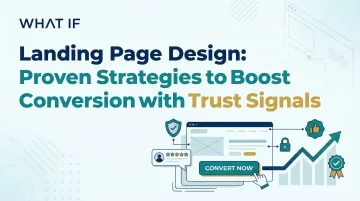
Strategically placed trust signals can increase conversion rates by 12-42%, with the strongest lift occurring near forms and CTAs. This guide covers what those signals are, where to place them, and what to avoid when deploying them.
TLDR:
- Position trust signals above the fold; visitors form credibility judgments in 50 milliseconds
- Strategic placement of trust elements can boost conversions by 12-42%
- Climate tech companies need specialized certifications (B Corp, LEED, SBTi) to counter greenwashing skepticism
- Place security badges next to forms and testimonials adjacent to benefit claims
- Three to five well-placed trust signals outperform a page cluttered with generic badges
What are trust signals and why they matter for conversion
Trust signals are visual and textual elements that reduce visitor anxiety and establish credibility at critical decision points. These include customer testimonials, security badges, industry certifications, client logos, media mentions, and social proof indicators like user counts or awards.
The psychology of instant judgment
Your landing page faces a measurable challenge: users assess visual appeal and credibility within 50 milliseconds of arrival. This reaction happens through automatic cognitive processing before visitors consciously read your content.
If your design fails to communicate trustworthiness in this sub-second window, visitors bounce before they ever engage with your value proposition.
These rapid judgments are remarkably stable. First impressions formed in milliseconds continue to shape how visitors perceive your usability and credibility through the entire session, which means recovering from a poor first impression within the same visit is functionally impossible.
When you're introducing unfamiliar or first-of-a-kind technologies, strategic placement of credibility markers is essential from the moment the page loads — not something to layer in after the content is written, and not something an enterprise buyer will give you a second chance to get right.
The conversion impact of trust
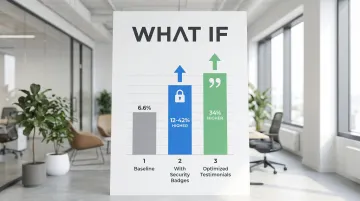
The median landing page conversion rate sits at 6.6%, but top performers exceed 10% by strategically deploying credibility markers. The lift from adding trust signals varies by context:
- Security badges: 12.2-42% conversion increase on pages handling sensitive data
- Money-back guarantees: 32.6% sales increase when prominently displayed
- Optimized testimonials: 34% increase in form submissions with strategic placement
When your buyers are evaluating long-term partnerships and significant capital investments, these percentage gains translate to measurable pipeline outcomes. They shorten the time from first visit to first conversation, which in a sales cycle that can run 12-24 months is a meaningful compression.
Types of trust signals for high-converting landing pages
Customer testimonials and case studies
Authentic customer voices are the most powerful trust signal because they provide third-party validation of claims that climate tech buyers are, by default, skeptical of. In an industry that has dealt with significant greenwashing, a specific testimonial from a named contact at a recognizable organization carries weight that no badge or certification can replicate on its own.
The impact is measurable: products with five reviews show 270% greater purchase likelihood than those with zero reviews.
Video testimonials outperform text by creating emotional connection and demonstrating real people behind the endorsement. Effectiveness depends on specificity—include real names, photos, companies, and quantified results rather than generic praise.
Key elements of credible testimonials:
- Full name and company affiliation (with permission)
- Professional headshot or video recording
- Specific outcomes: "Reduced carbon footprint by 40% in 6 months" beats "Great results"
- Context about the challenge solved
- Industry-relevant credentials when applicable
Testimonials with photos generate significantly higher viewer recall (p-value = 0.0035) compared to text-only versions. This makes visual elements critical when you're building name recognition with buyers who encounter dozens of similar-sounding solutions — and in a competitive evaluation, a photo-backed testimonial from a named VP of Operations can be what shifts you from 'under consideration' to 'shortlisted.'
Security and privacy badges
Security badges address transactional anxiety, particularly near forms collecting sensitive information or payment details. These visual elements signal that you've implemented industry-standard protections, which matters especially for enterprise buyers who may need to justify vendor selection through internal procurement processes.
Most recognized security badges: The Norton Secured seal (consistently ranks as most trusted) and SSL certificate indicators — the padlock icon with "Secure" text — are the highest-recognition options. Payment processor badges like PayPal and Stripe carry similar weight, as do privacy compliance marks such as GDPR and CCPA.
Strategic placement matters: Position security badges immediately next to form fields or CTAs where visitors experience maximum anxiety. A generic padlock icon with "SSL SECURED" text often performs better than unrecognized branded seals, because recognition drives trust, not visual complexity.
Industry certifications and credentials
For your climate tech or deep-tech company, third-party certifications serve as high-value trust signals that directly address greenwashing skepticism, which is a real barrier in sectors where bold environmental claims have gone unverified for years.
These credentials provide independent validation of your environmental claims.
Critical certifications for climate tech:
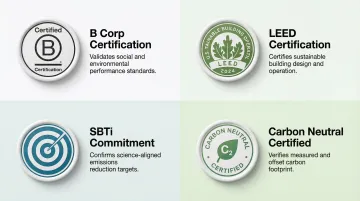
- B Corp Certification: Rigorous third-party verification of social and environmental performance, with enhanced standards launching in 2026
- LEED: Globally recognized standard for green building and sustainable design
- Science Based Targets initiative (SBTi): Validates emissions reduction commitments grounded in climate science
- Carbon Neutral Certification: Third-party verification of net-zero claims
For buyers evaluating long-term partnerships, these certifications carry real weight: products with sustainability labels see 13-14% increased consumer demand, based on NYU Stern's sustainable market share research, with similar lifts observed in Amazon's Climate Pledge Friendly program. In climate tech, they often serve as table stakes rather than differentiators, which means not having them is a bigger problem than having them.
When working with climate tech startups on website positioning, certifications like B Corp and SBTi tend to belong in the hero section rather than buried in the footer, because for the buyers you're targeting, verified credentials are a prerequisite for further engagement, not a nice-to-have.
Social proof indicators
Social proof works through the bandwagon effect: when prospects see that peers in their industry have already engaged with your solution, perceived risk drops significantly. When you're selling into risk-averse sectors like utilities, heavy manufacturing, or municipal infrastructure, showing that similar organizations have taken the first step is often more persuasive than any specification sheet.
Effective social proof formats:
- User counts: "Join 50,000+ climate leaders" or "Trusted by 200+ utilities"
- Client logos from recognizable brands (especially industry leaders)
- Media mentions: "As featured in TechCrunch, Bloomberg, GreenBiz"
- Awards and recognitions from credible industry organizations
- Real-time activity notifications: "Someone just downloaded the whitepaper"
Implementing real-time social proof notifications can increase conversions by 10-15% by creating urgency and demonstrating active engagement. Authenticity is critical here; fabricated activity notifications damage trust as soon as they're discovered, and in a sector defined by due diligence, that discovery tends to happen.
Authority and expert endorsements
Expert validation from industry leaders, academics, or recognized authorities builds credibility through association. This approach works especially well when your technical complexity creates evaluation barriers for non-specialist buyers.
Authentic authority signals:
- Direct quotes from industry experts or advisors
- Advisory board members with relevant credentials
- University or research institution partnerships
- Government grants or research contracts (ARPA-E awards, EPA partnerships, federal energy research contracts)
- Speaking engagements at recognized industry conferences
Focus on authentic endorsements from real press mentions and genuine partnerships rather than accumulating generic awards or purchased certifications. Sophisticated buyers in climate tech conduct active due diligence — imagine a procurement lead at a large utility verifying your ARPA-E grant on the DOE database mid-evaluation; that check either confirms or ends the conversation. Prioritize signal quality over signal volume.
Essential landing page elements that work with trust signals
Compelling headline with clear value proposition
Your headline must immediately communicate what you offer and why it matters to the specific buyer reading it. Trust signals reinforce that foundation, but they cannot compensate for a headline that leads with technology capabilities rather than business outcomes. For your company, this distinction is especially sharp: a headline about molecular carbon capture efficiency communicates to a scientist, not to a procurement lead or CFO evaluating operational risk.
Strong headline formula: Specific outcome + relevant audience + timeframe or constraint
Examples:
- ✅ "Reduce industrial emissions 40% without disrupting production"
- ❌ "Revolutionary climate technology solutions"
Apply the "so what?" test to every headline claim. If a visitor can't immediately understand the benefit and relevance, trust signals won't matter; they've already decided the page isn't for them. A CFO evaluating three competing solutions will default to the one whose headline makes the business case instantly — your technical lead may never get the chance to explain the rest.
Strategic visual hierarchy and hero section
Design directs attention toward trust signals and CTAs through size, color contrast, whitespace, and positioning. On your landing page, where visitors often arrive with significant prior skepticism or technical knowledge, understanding where eyes land first determines whether a certification badge or client logo gets processed before a visitor decides to keep scrolling — and for an enterprise buyer doing initial vendor research, that decision is often the difference between a demo request and a permanent pass.
Natural reading patterns guide trust signal placement:
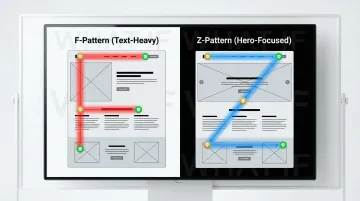
- F-pattern (text-heavy pages): Users scan horizontally at top, vertically down left side, then horizontally again. Place critical trust signals (client logos, certifications) along these scan lines.
- Z-pattern (hero-focused pages): Eyes move horizontally across top, diagonally through center, horizontally across bottom. Position trust elements at the hero section's base.
- Above the fold: Users treat information above the fold as 84% more important. Your most critical trust signal must be immediately visible.
Persuasive, benefit-focused copy
Features describe what your product does; benefits explain why it matters to the buyer. Trust signals back up benefit claims by providing evidence that outcomes are real, not hypothetical.
Benefit-focused structure: Start by naming the pain point your audience actually experiences, then present your solution's specific outcome. Back that claim with a trust signal — a testimonial, case study, or data point — and close with additional proof points that reinforce the decision.
This approach applies across industries. In climate tech, for example, technical capabilities become business outcomes: "Our carbon capture system removes 95% of CO₂ from industrial exhaust" transforms into "Achieve carbon neutrality goals three years faster while maintaining production capacity, as validated across 12 manufacturing facilities" — and that second version is what gets a CFO to forward the page to their sustainability lead.
Clear, action-oriented CTAs
Your call-to-action must use specific action words, contrasting colors, and strategic placement. Trust signals positioned near CTAs reduce friction at the moment of decision.
Effective CTAs use action verbs — "Schedule your carbon assessment" beats "Learn more" — with strong color contrast so the button stands out from surrounding elements. Maintain a single primary CTA; multiple competing actions create decision paralysis. And place trust signals within one or two scrolls of that CTA, so security badges, guarantees, or testimonials are immediately visible when a visitor is deciding whether to act.
The proximity of trust signals to conversion elements determines whether they actually reduce anxiety at the moment it counts. A security badge buried in the footer won't reduce form abandonment; place it directly next to the form field. In a B2B sales cycle where a demo request is often the first verifiable buying signal, that placement decision can mean the difference between a lead in your CRM and a visitor who never returns.
Optimized forms with minimal friction
Forms are where conversion funnels lose the most prospects, and design decisions here have a disproportionate impact on whether someone completes the action you've built the page around.
Form optimization principles:
- Field count: Research from Zuko Analytics challenges the "fewer is always better" rule — field relevance matters more than raw quantity
- Progressive profiling: Collecting data gradually over multiple interactions can boost conversions by 47%
- High-friction fields: Requesting phone numbers decreases conversions by 18.7%; ask only what you'll immediately use
- Inline validation: Real-time feedback reduces errors by 22% and completion times by 42%
Place security badges, privacy statements, and "We never share your information" assurances next to form fields. This addresses anxiety at the exact moment visitors consider abandoning, turning what would otherwise be a lost prospect into the first qualified lead in your pipeline.
How to strategically place trust signals on your landing page
Strategic placement determines whether trust signals drive conversions or become visual noise. Think of it this way: a sustainability director researching decarbonization vendors might visit your page, scan the hero section, and make a meeting-or-no-meeting decision before they reach your case studies — so what they see in the first viewport needs to do the work of a strong first sales meeting.
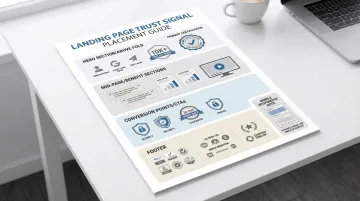
Above the fold (hero section):
- Client logos from recognizable brands (3-6 maximum)
- User count or social proof headline: "Trusted by 10,000+ companies"
- Primary certification badge (B Corp, industry-specific credential)
- Media mention icons if from tier-1 publications
Mid-page (near benefit sections): This is where testimonials do their heaviest lifting — place them directly alongside the specific benefit claims they support. Case study snippets with quantified outcomes, video testimonials for authentic connection, and awards relevant to the benefit being discussed all belong here, where the reader is in active evaluation mode.
Near conversion points (CTAs and forms): The moment before a visitor submits a form or clicks a CTA is when transactional anxiety peaks. Security badges (Norton, SSL indicators), money-back guarantees or risk-reversal statements, privacy compliance marks (GDPR, CCPA), and a final testimonial reinforcing the decision should all be within immediate view of the conversion action.
Footer: Reserve the footer for your complete certification lineup, full client logo grid, additional media mentions, and industry association memberships — the comprehensive inventory that due-diligent buyers will look for after they've decided to explore further.
Mobile-responsive considerations: Stack logos in 2-3 columns rather than horizontal rows, and ensure badges remain legible at smaller sizes. Prioritize your single most important trust signal above the fold. Test all elements on actual mobile devices — 61% of users won't return to a mobile site they had trouble accessing, and a trust signal that renders incorrectly does more harm than having no trust signal at all.
Common trust signal mistakes to avoid
Fake or exaggerated trust signals
Stock photos labeled as "customers," fabricated statistics, or irrelevant badges destroy credibility when discovered. Sophisticated buyers in climate tech, where due diligence is standard practice, will verify claims against external sources, industry databases, and direct outreach.
Red flags that damage trust:
- Generic testimonials: "Great service! – Anonymous User"
- Stock photography presented as real customers
- Outdated certifications or expired credentials
- Irrelevant awards or "badge farm" certifications
- Inflated or unverifiable statistics
One fake testimonial is enough to undermine every legitimate trust signal on the page, and in a sector where buyers actively conduct due diligence, that damage is rarely recoverable. In landing page audits for climate tech companies, this pattern comes up consistently: genuine traction, real pilots, verifiable outcomes — undercut by a testimonial no one can trace back to a real person or a badge that doesn't hold up to a basic search. When that happens mid-procurement, the conversation rarely recovers.
Trust signal overload
Displaying too many badges, testimonials, or logos creates visual clutter and reduces trust through analysis paralysis. When everything competes for attention equally, visitors default to skepticism rather than confidence.
Signs of overload include crowding the hero section with more than 8-10 client logos, stacking multiple certification badges without hierarchy, letting testimonials consume more than 30% of page real estate, and filling every section with trust elements that compete equally for attention.
The solution: Select three to five high-impact trust signals based on what your specific audience is most skeptical about, then place them at the moments in the page where that skepticism is highest.
For the enterprise buyers you're targeting, a B Corp certification, two client logos from recognized companies, and one specific testimonial with quantified results will outperform 20 generic badges — and will move you toward a second conversation faster than a page that looks like a credential exhibition.
Generic, vague testimonials
Testimonials without specifics, names, or context fail to build credibility. Effective testimonials tell a story: the challenge faced, the solution implemented, and the specific outcome achieved.
Weak testimonial: "Working with this company was amazing. Highly recommend!"
Strong testimonial: "We reduced our Scope 1 emissions by 43% in 8 months using their carbon capture system, which put us three years ahead of our net-zero timeline. The ROI exceeded projections by 28%." – Sarah Chen, VP of Sustainability, [manufacturing company name]
The strong version includes specificity, quantified results, full attribution, and enough context for a similar prospect to recognize their own situation in the outcome. Every element can be verified, which is exactly what enterprise buyers in climate tech will attempt to do.
Frequently asked questions
What's a good conversion rate for a landing page?
Average landing page conversion rates range from 2-5%, with the median at 6.6% across industries. Top performers reach 10% or more, depending on traffic source, offer type, and how well the page addresses visitor skepticism. Climate tech and B2B SaaS companies typically see 3-4% for lead generation forms, though high-intent pages targeting warm audiences can exceed 12%. Strategic trust signal placement can lift baseline rates by 20-30%.
How do trust signals improve landing page conversion rates?
Trust signals work by reducing visitor anxiety at the specific moments in the page journey when skepticism is highest, typically near forms and CTAs. They validate a conversion decision by showing that others have engaged with your brand successfully, that credible third parties endorse your claims, and that standard security protections are in place. For climate tech buyers evaluating novel solutions, the authority and certification signals often carry more weight than they would for a general B2B audience.
What types of trust signals are most effective for conversion?
Customer testimonials (especially video), recognizable client logos, and security badges near forms consistently show the highest impact. For your company, third-party certifications (B Corp, LEED, SBTi) and government research partnerships build credibility with enterprise buyers evaluating long-term investments.
Where should trust signals be placed on a landing page?
Strategic placement follows the visitor journey: hero section (client logos, user counts), mid-page (testimonials near benefit claims), and near CTAs and forms (security badges, guarantees). The most critical trust signal should appear above the fold, visible within the first 50 milliseconds of page load.
How many trust signals should a landing page have?
Use 3-5 well-placed, relevant trust signals rather than overcrowding the page. Quality and strategic placement matter more than quantity. One specific testimonial with quantified results outperforms five generic endorsements. Select trust elements based on your audience's primary concerns: security, social proof, authority, or verified credentials.
Do trust signals work differently for climate tech and deep-tech companies?
You'll especially benefit from third-party certifications (B Corp, carbon neutral, LEED), testimonials that quantify operational impact, and transparency signals that address the greenwashing skepticism common in the sector. These buyers actively seek verified credentials to distinguish legitimate innovations from overstated claims, which makes the quality and specificity of trust signals more consequential than in less scrutinized industries.
If your landing page isn't converting the traffic your team is working to earn, the gap is usually a credibility signal problem, not a copy or design problem. What if Design works with climate tech and deep-tech startups to build websites that communicate traction, technical credibility, and buyer-specific value from the first scroll. Connect with us to talk through what your landing page needs.